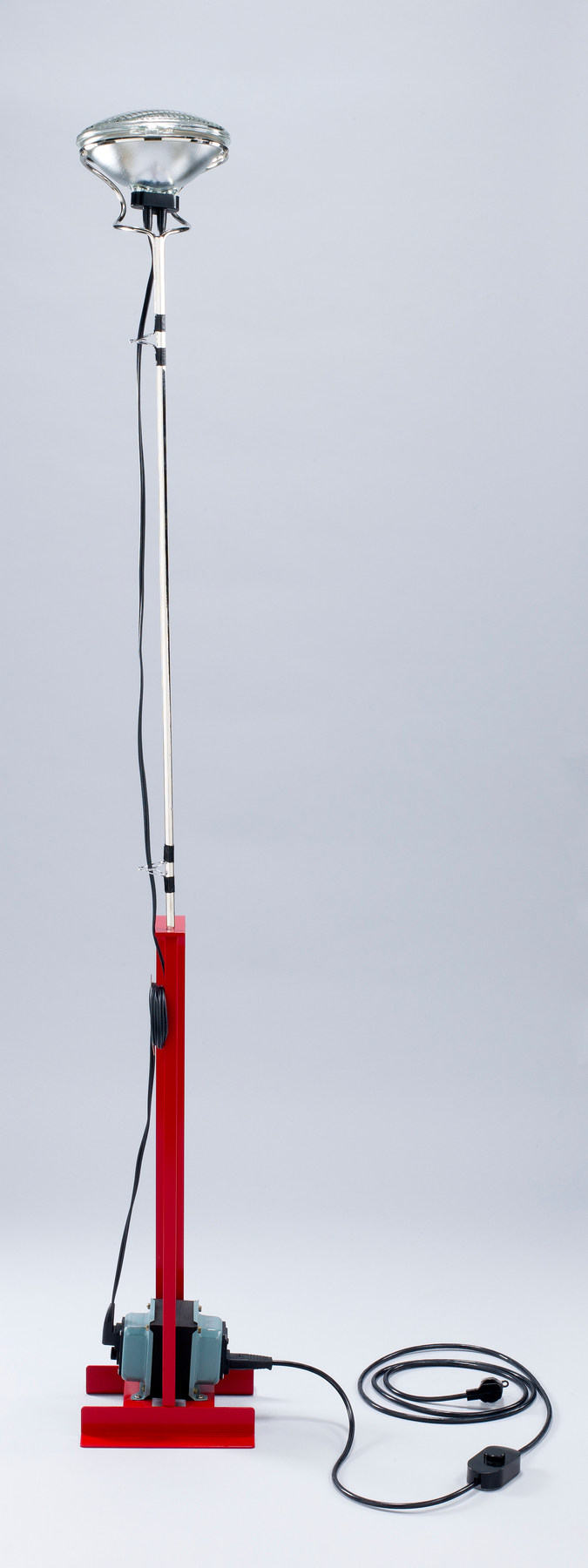
Turn the headlamp towards the ceiling
A car reflector sends a concentrated beam along the road. Toio redirects that familiar device into a room, aiming it upwards so the surrounding architecture participates in spreading the light.
The head is small beside the height of the stem. There is no large lampshade to conceal where the light comes from. That imbalance gives the lamp much of its character: a bright functional component at the top of an almost skeletal support.
MoMA’s Castiglioni exhibition explains the historical arrangement through the automobile reflector and the electrical transformer placed at the foot of the lamp. The design dates to 1962.1
Three borrowed jobs
The reflector is only the most conspicuous piece of reuse. Small rings guide the exposed cable up the stem, drawing on a detail familiar from fishing rods. The wire becomes a visible line alongside the structure rather than disappearing inside a decorative casing.
At the base, the transformer has two jobs. It belongs to the historical electrical system, and its weight helps steady the tall lamp. The object does not have to invent a separate visual language for a counterweight when a necessary component can contribute mass.1
The Pier Giacomo Castiglioni archive also describes the adjustable stem and the arrangement of the cable. These details make the lamp feel less like a finished shape filled with hidden equipment and more like equipment deliberately organised into a finished shape.2
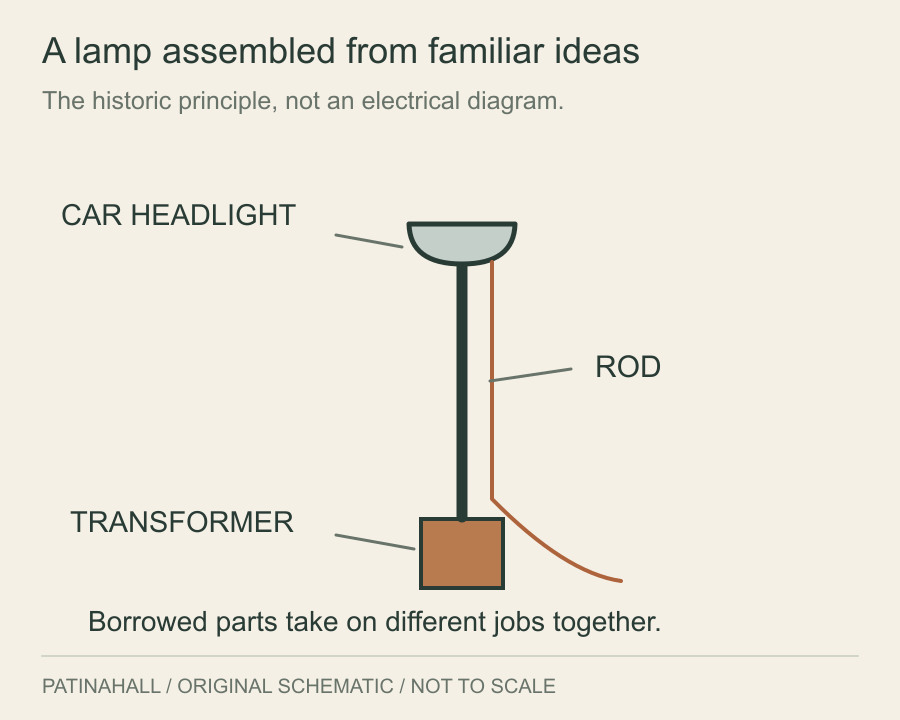
Coherence is a design decision
Borrowed parts do not automatically add up to a good object. Their proportions, positions and relationships still have to be resolved.
Toio makes that work visible. The small head needs the slender upright to reach its useful height; the upright needs a stable base; the moving length needs a way to manage its cable. The components answer one another’s requirements.
The Saint Louis Art Museum’s example records lacquered steel, nickel-plated brass and an automobile headlamp, with Flos as maker and both Achille and Pier Giacomo as designers. Its photographed form lets us follow the material changes from base to stem to light.3
It is tempting to call the lamp an assembly of found objects and stop there. The more interesting question is why these particular objects make sense together.
Nothing is embarrassed by its old life
Toio does not ask the reflector to look like a flower or the cable guides to disappear behind trim. Their earlier practical character remains available to the eye.
That makes the lamp unusually friendly to a curious viewer. You can begin at the floor and work upwards, discovering a reason for each part. The surprise is not that an automobile component has entered a sitting room. It is how quickly, once the parts are arranged, the whole thing starts to look inevitable.