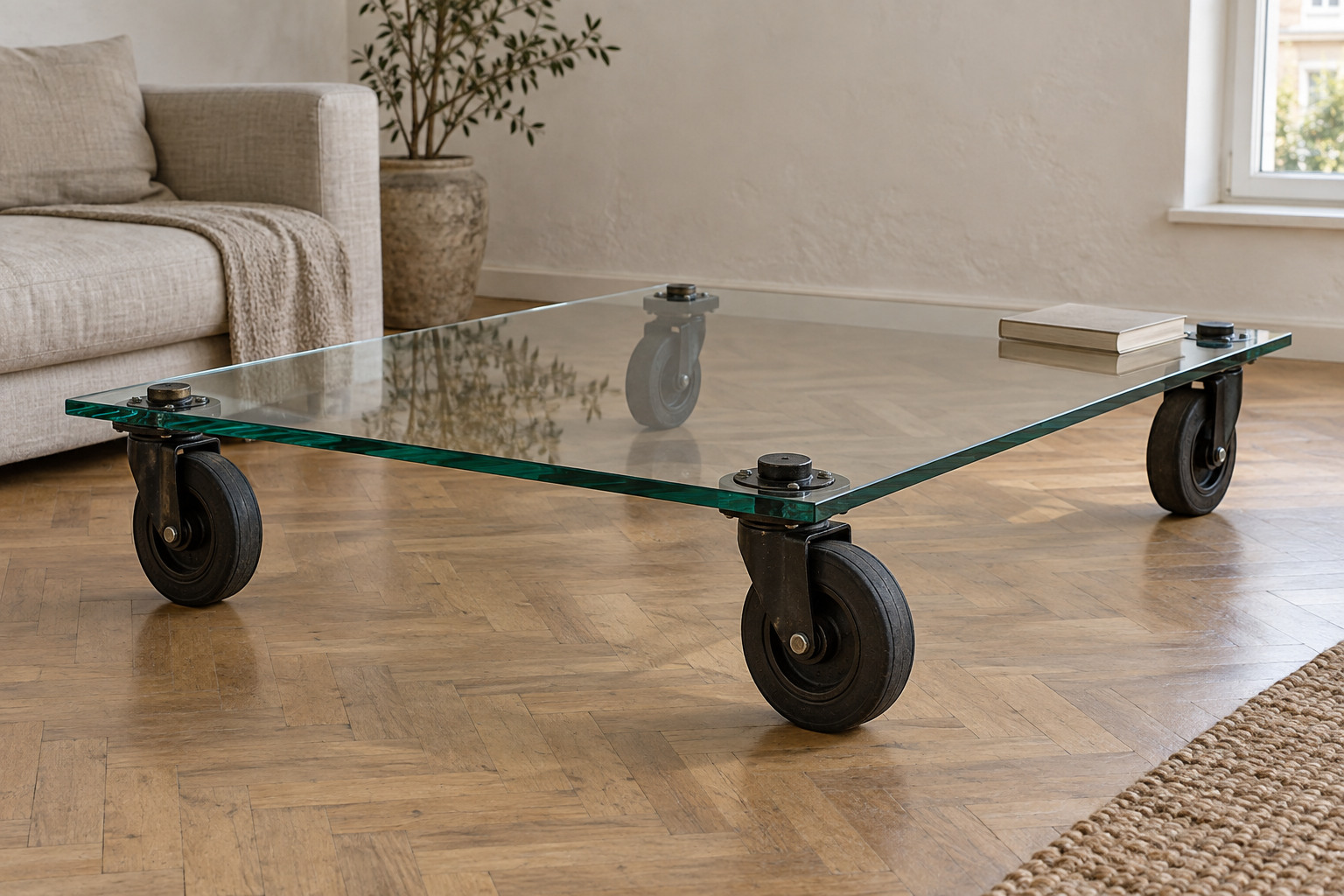
A useful object on the factory floor
FontanaArte traces the table’s beginning to a trolley in its glass workshop. The working vehicle carried glass on a wooden platform. Aulenti kept the idea of a low surface on substantial wheels and made the surface itself from glass.2
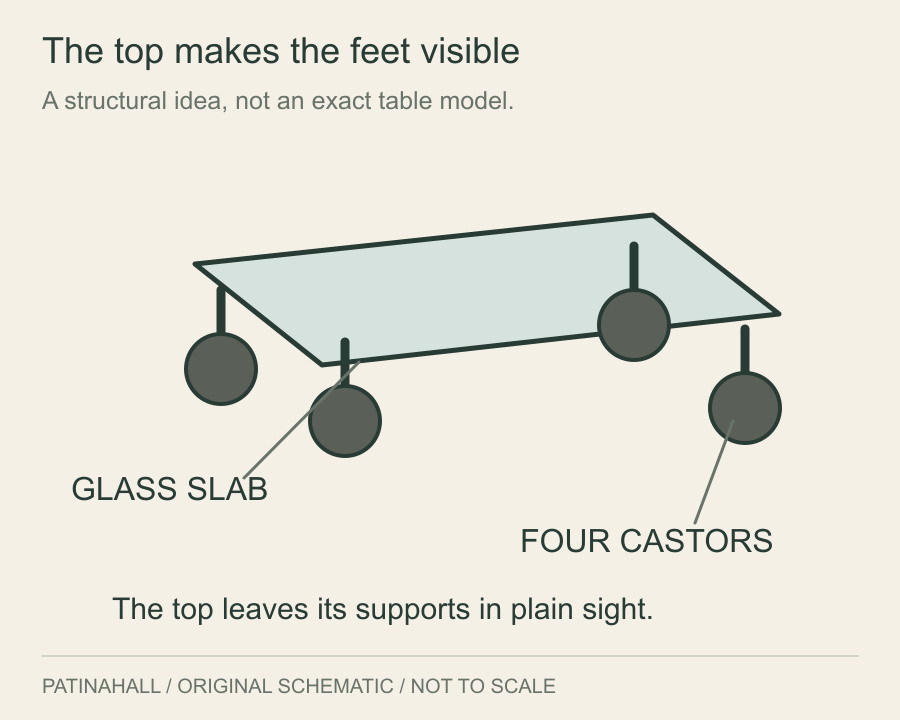
That substitution is easy to describe and surprisingly consequential. Wood would conceal most of the hardware from above. Clear glass makes the support visible through the very thing it carries.
The table brings a relationship from the factory into the sitting room: a heavy, vulnerable material resting on equipment designed to move it. The glass is no longer just the load being transported. It has become the useful surface.
The feet move into view
Look down through the top. Each castor occupies a corner with enough visual weight to be noticed. The metal bracket connects the transparent plane to the black rubber wheel beneath it.
Nothing needs to disguise that change of material. Glass, metal and rubber are the materials listed for MoMA’s example, a rectangular table about 27 centimetres high. Their different appearances make the assembly easy to read.1
The top seems light because we can see through it. The wheels seem heavy because they are dark, solid and recognisably industrial. Neither impression tells us the actual weight of the component. Together they make an unexpectedly expressive piece of furniture.
Movement adds another possibility. A low table is usually treated as a fixed centre around which seats gather. Visible wheels suggest that the centre might shift when the room needs to do something else.
A date belongs to a record
The familiar catalogue date is 1980; that is the date MoMA gives its model. FontanaArte’s archival brochure also reproduces a plan and photographs identifying an earlier presentation at Euroluce in 1979.3
Those records need not be forced into one date. A public presentation, a catalogue appearance and the manufacture of an individual table are different events. Keeping them separate gives us a more useful history of how a design entered the world.
It also prevents a later wheel or a current size option from becoming a shortcut for describing the entire production history. The central idea can endure while details of a particular version change.
What makes it feel domestic?
The table needs remarkably little adjustment to leave the workshop. Lower its scale, refine the edges of the glass and place it within reach of a sofa: an industrial arrangement becomes part of an ordinary evening.
Set a book on the surface and the change is complete. The castors still remember a practical job, but the object they support now serves a different routine.
Aulenti’s table makes that passage visible. Its character comes from recognising the borrowed parts and enjoying how little effort they make to hide.