The front moves one slat at a time
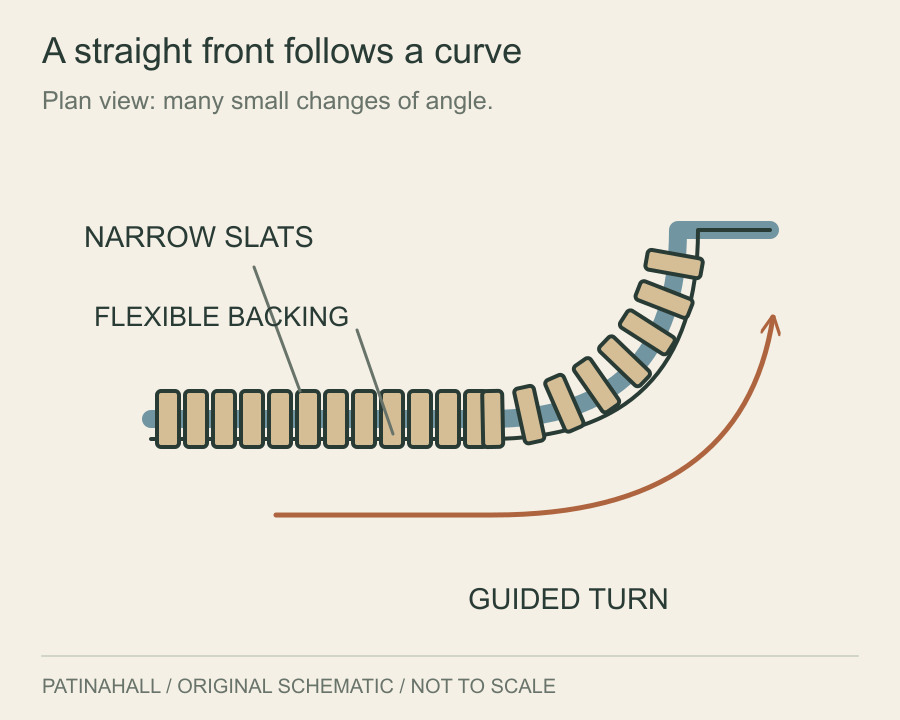
Imagine trying to push a solid wooden door around the corner of a cupboard. Its width resists the turn. Divide that width into narrow vertical strips and the problem changes: each strip can adopt a slightly different angle.
LACMA’s account of a tambour desk by John and Thomas Seymour describes thin strips of wood glued to canvas. The strips provide the visible face, while the canvas lets the assembly remain connected as it follows the curved part of its route.2
Seen from above, the principle is a sequence of small turns. Seen from the front, it can still read as an orderly wooden surface. The design makes a flexible assembly look calm when closed.
Opening need not occupy the room
The space a piece of furniture uses includes its movements. A hinged cupboard door needs a clear arc in front of it. A tambour can retreat into a path inside the case, leaving the approach more open.
The difference is especially useful to imagine at a desk. The person sitting there already occupies the area immediately in front. A sliding front can expose small drawers and compartments without placing two broad panels beside the writer’s arms.
This does not make the movement free of spatial cost. The disappearing front still needs somewhere to go. Some of the cabinet’s interior is committed to its route, trading space within the object for a different kind of opening outside it.
A desk can use two kinds of movement
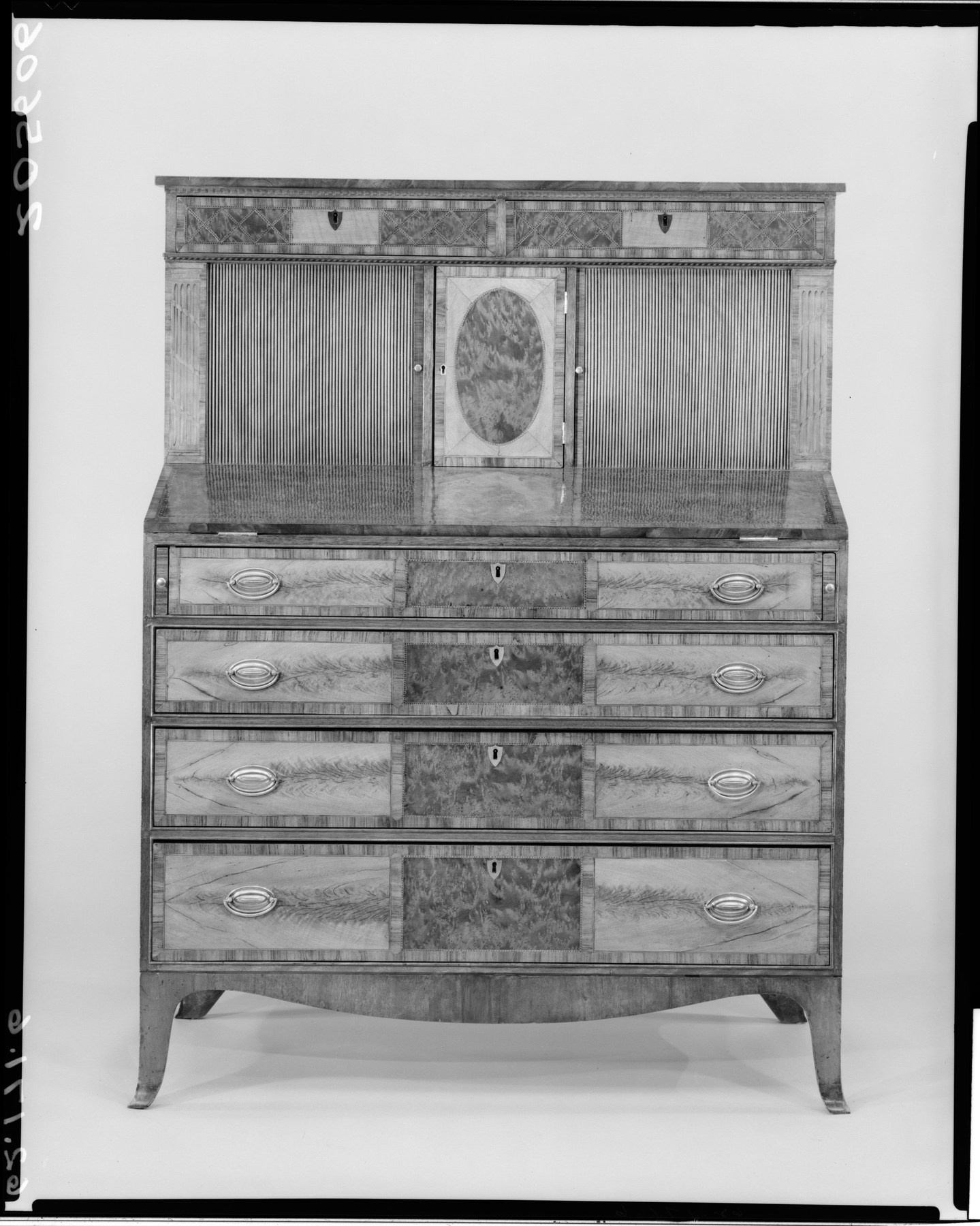
The Met’s tambour desk by Reuben Swift, made around 1805 in New Bedford, gives the mechanism a richly figured setting. Burl walnut and flame-grain birch are among its recorded woods. The sliding fronts sit above a substantial chest of drawers, so the flexible mechanism occupies only one part of a larger storage piece.1
An approximately contemporary Seymour desk at the Cleveland Museum of Art combines mahogany with brass and enamelled pulls. The small fittings help distinguish the parts a user would grasp from the larger surfaces around them.3
These desks also show why it helps to identify each moving part separately. Sliding fronts control access to storage; a hinged writing leaf can increase the available working surface. The two operations answer different needs.
Watch where the straight lines go
Closed, the slats make a repeated rhythm across the front. Open, that rhythm turns away from the viewer. The change is visible at the moment when a straight sequence starts to follow the corner.
That is the satisfying part of the mechanism. Nothing has to vanish by magic. The cabinet has simply given each narrow piece a path, and the pieces take the turn together.