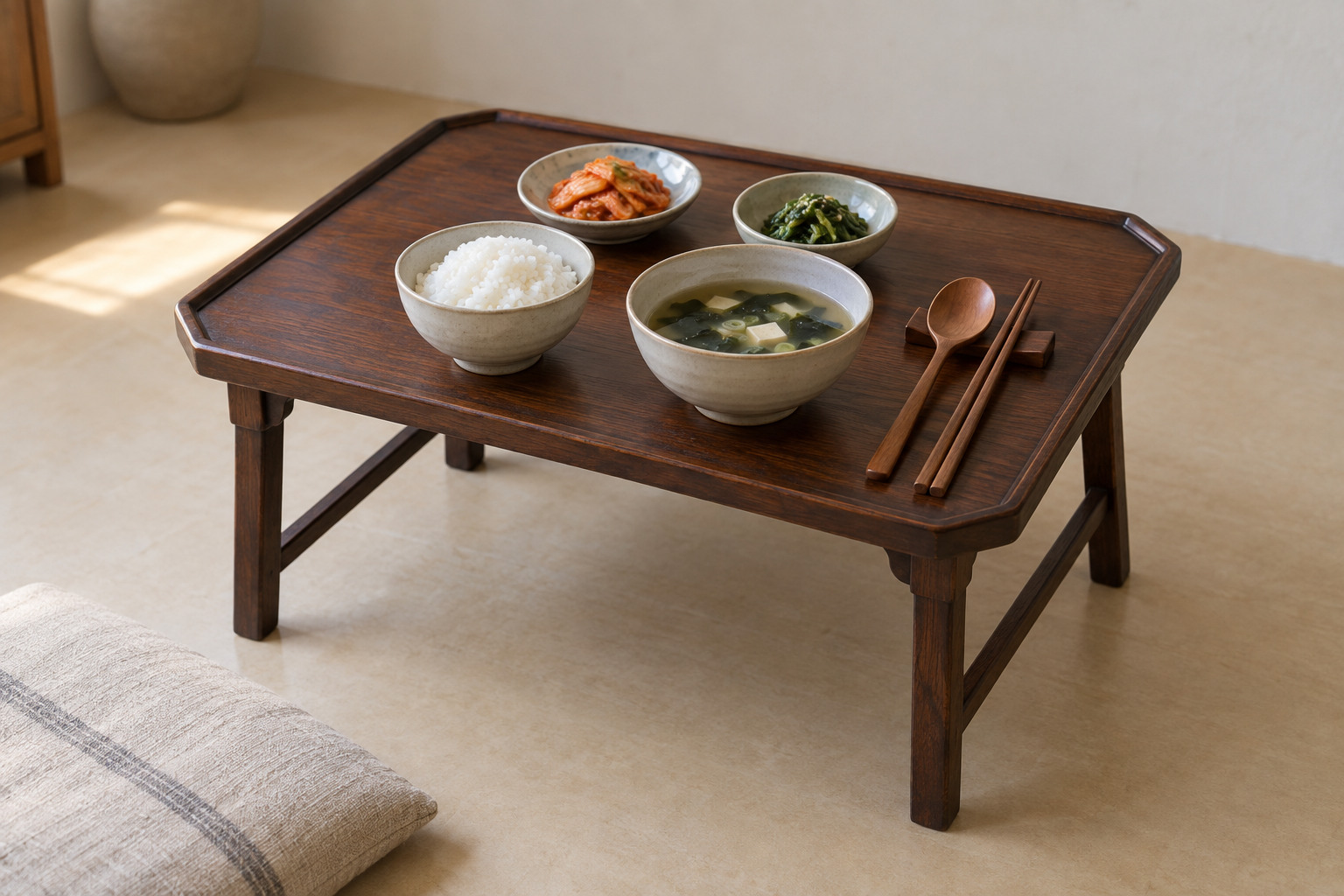
The table makes the short journey
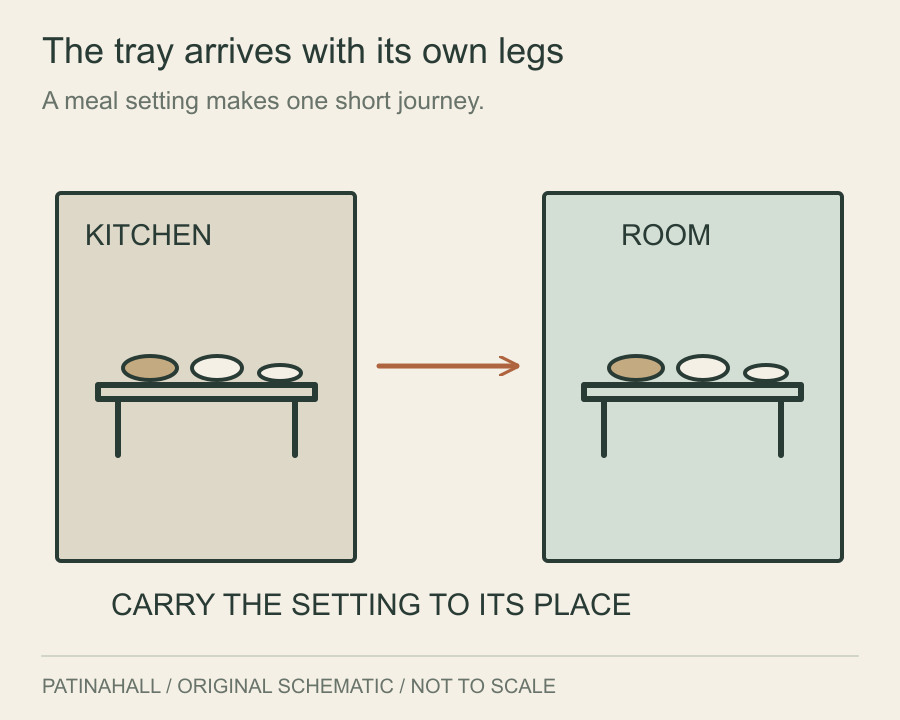
In a house where cooking and eating take place in different rooms, a meal needs a way to cross the distance. A tray carries the bowls, but still needs somewhere to be put. A small table with its own legs combines the journey and the destination.
The Korean Culture and Information Service describes soban within this arrangement of domestic life and floor seating. It also records a broad variety of forms associated with places including Naju, Haeju and Tongyeong. The shared idea accommodates different outlines, legs and local traditions.1
The transformation is wonderfully economical to imagine. The table arrives as a complete little setting. When the meal is over, both dishes and supporting surface can leave together, making the floor available again.
The weight belongs to the person carrying it
A tabletop’s material is often discussed through colour and grain. Here it also has to be considered in the hands. Add dishes to a small piece of furniture and even a modest difference in its own weight becomes relevant.
In a 2025 Koreana interview, the Naju maker Kim Chun-sik explains his preference for ginkgo because it is lighter than zelkova. The account connects this choice to the people carrying the loaded tables, historically often women.2
That detail gives material selection a human scale. The wood is part of a sequence involving preparation, lifting, serving and clearing away. A beautiful surface is only one part of what the table asks of its maker.
One name contains many outlines
The Museum of International Folk Art records an octagonal soban with curved legs, made in Korea by an unrecorded maker. Its description identifies use for an individual meal or tea. The object gives the wider family a specific example without standing for every version.3
Compare the top and supports separately. A circular, polygonal or rectangular surface sets a different boundary around the dishes. The legs then give that surface its stance: visually open, compact, upright or curving.
Kim’s work also shows how much knowledge can reside in older furniture. The Koreana account describes his study through taking apart and reassembling hundreds of old tables. Their joints and proportions became practical evidence for making again.2
A place can be made for one person
A large dining table establishes a fixed centre in a room. A soban can establish a smaller centre around a particular meal. Its scale makes the arrangement feel complete without needing to occupy the space permanently.
Imagine the empty floor before it arrives and after it leaves. For the duration of dinner, the low surface gathers food, attention and the person eating. The furniture’s usefulness lies partly in knowing when its work is finished.