Design story

Shylight: the light that opens on its way down

A hanging light usually gives a room a fixed point. Shylight makes that point change shape and position. Layers of silk open as the form descends, then gather as it retreats upwards, turning illumination into something one also follows through space.

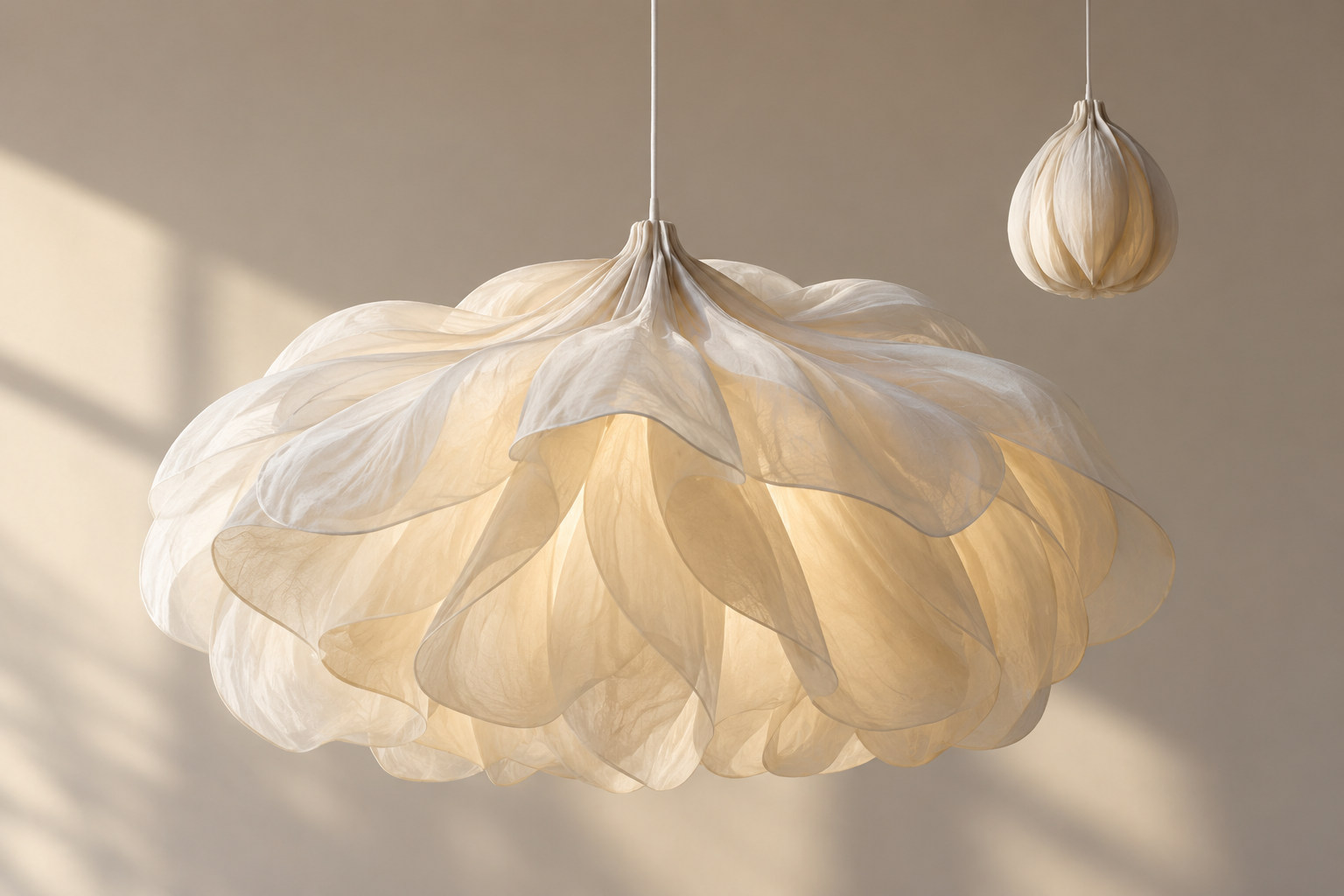
Layered pale silk-like hanging form shown open, with a smaller closed form above and behind.
PatinaHall editorial reconstruction. It is not a documentary photograph. Open and gathered forms introduce the changing silhouette described in Shylight’s movement.
On this page
Key facts & takeaways

At a glance

Subject
Shylight
Entry
Design story
Last reviewed
26 October 2026

Three things to remember

  1. Layers of silk make the opening and closing visibly continuous.
  2. The studio describes controlled movement, not biological sensing.
  3. A dated acquisition announcement is different from a verified current installation.

The shade is allowed to change

A lampshade normally asks us to accept its outline as fixed. Shylight makes the changing outline part of the work. A compact form can open into a much broader, layered volume, then return towards itself.

DRIFT calls it a kinetic installation of light and movement. The studio lists aluminium, polished stainless steel, silk, LEDs and robotics, and describes five years of research behind the result.1

The material list explains why the effect cannot be reduced to a piece of draped fabric. A soft visible body belongs to a work that also depends on controlled motion. The silk supplies a surface through which that control becomes perceptible.

The journey changes the silhouette

In the studio’s account, the form descends while opening and closes as it retreats upwards. Many silk layers make those changes gradual. The eye can follow a transition rather than seeing one rigid shape replace another.1

Opening also changes the amount of space the light appears to claim. A small shape high above can become a broad presence lower in the room. Its return gives that space back, making the surrounding emptiness part of the sequence.

This is why motion matters to the design’s reading. A still image can introduce a state, but it cannot contain the relationship between all the states. The original schematic sets them beside one another so that the idea remains understandable on a page.
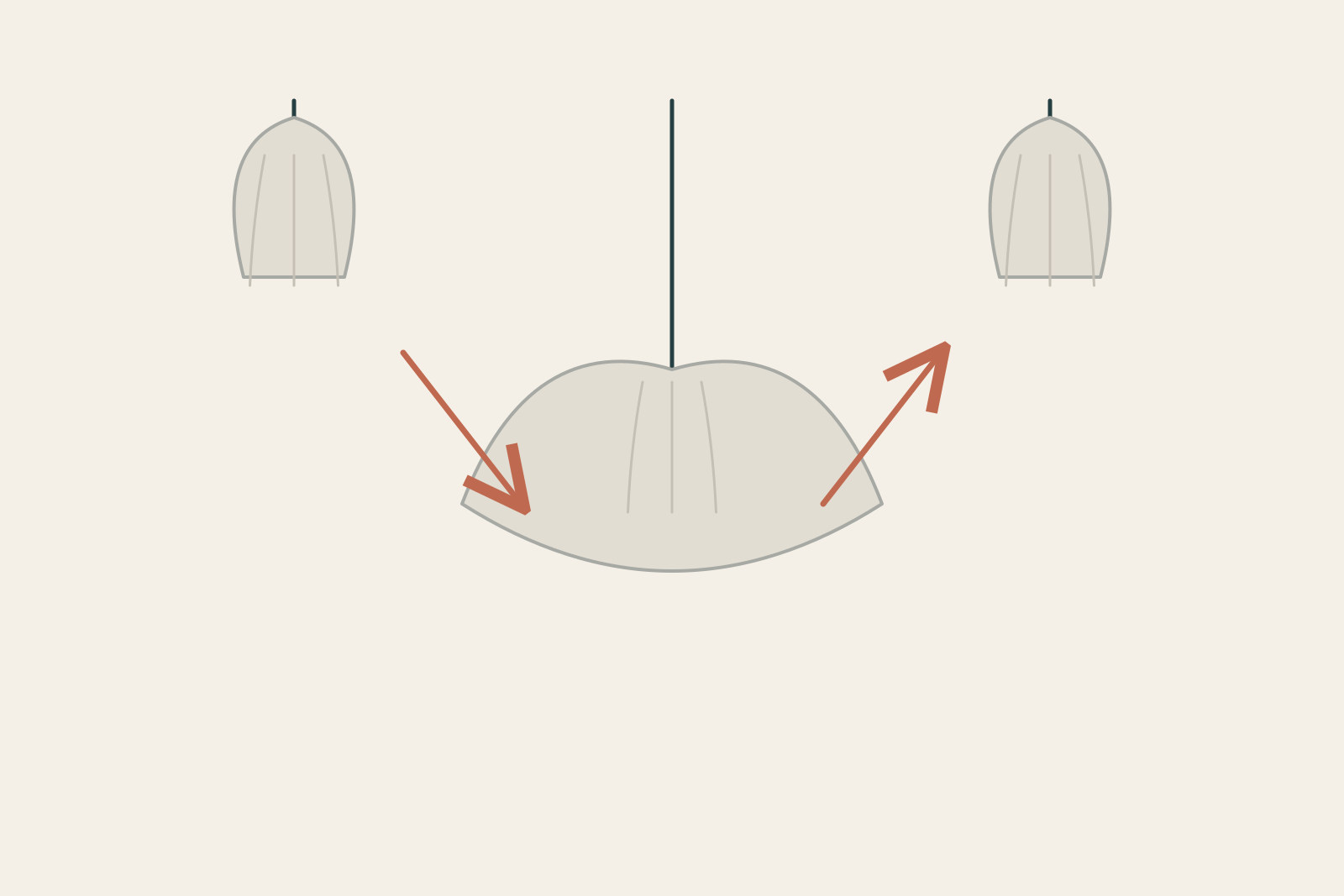
Closed, descending/open and retreating states explain a choreographed change in a silk form, without a technical mechanism or visitor-sensing claim.
Closed, descending/open and retreating states explain a choreographed change in a silk form, without a technical mechanism or visitor-sensing claim. Original PatinaHall schematic, not to scale.

A flower supplies a question

DRIFT names nyctinasty, the closing of certain flowers at night, as its inspiration. The useful connection is the changing form: an object that might have been static instead opens, gathers and withdraws.1

The analogy does not mean that the light senses the world as a plant does. The studio describes precisely controlled choreography. A natural observation becomes a starting point for a designed sequence of movement.

That translation gives the work a character without requiring a face or a figure. The room contains an object whose posture changes, and following those changes becomes part of looking at it.

Five lights enter a museum story

On 4 April 2014, the studio announced that the Rijksmuseum had acquired an installation of five Shylights. It said a permanent public presentation was planned from 1 November that year. Those are the terms of the announcement, rather than evidence of a separately checked opening or present-day display.2

The museum connection places the work in a shared interior, but the broader idea remains easy to imagine at room scale: a hanging light can organise attention through time as well as through brightness. Shylight gives a familiar fixture an unfolding presence.

Research notesEvidence, connections and limits

The studio’s work account establishes the form and material idea. Its 2014 Rijksmuseum announcement is a dated acquisition and presentation plan; this article does not claim a separately verified opening date or current visitor experience.

Evidence map

Connected subjects and evidence

Reviewed connections

  • Shylightuses techniqueControlled layered-silk motion in Shylightdocumented

    DRIFT describes a controlled descent in which layers of silk open, followed by closing and upward retreat. The studio calls this a kinetic installation inspired by flowers that close at night. It is not evidence of autonomous biological sensing or a response to each visitor.

    Reviewed 26 October 2026 by PatinaHall editorial.
    • Source 1Work or object record and accompanying maker account: Shylight. Shylight
  • Shylightuses materialSilk in Shylightdocumented

    DRIFT explicitly lists silk among Shylight’s materials and explains the effect of its many layers in motion. The work is credited to DRIFT as a studio creation. This does not identify a physical manufacturer or assign individual fabrication or engineering roles.

    Reviewed 26 October 2026 by PatinaHall editorial.
    • Source 1Work or object record and accompanying maker account: Shylight. Shylight

Research trail

Sources and further reading

  1. ShylightDRIFTAccessed 26 October 2026
  2. Rijksmuseum acquires five ShylightsDRIFTAccessed 26 October 2026

Last reviewed 26 October 2026. Found an error or a stronger primary source? Contact PatinaHall.