The drawers do not all pretend to be the same
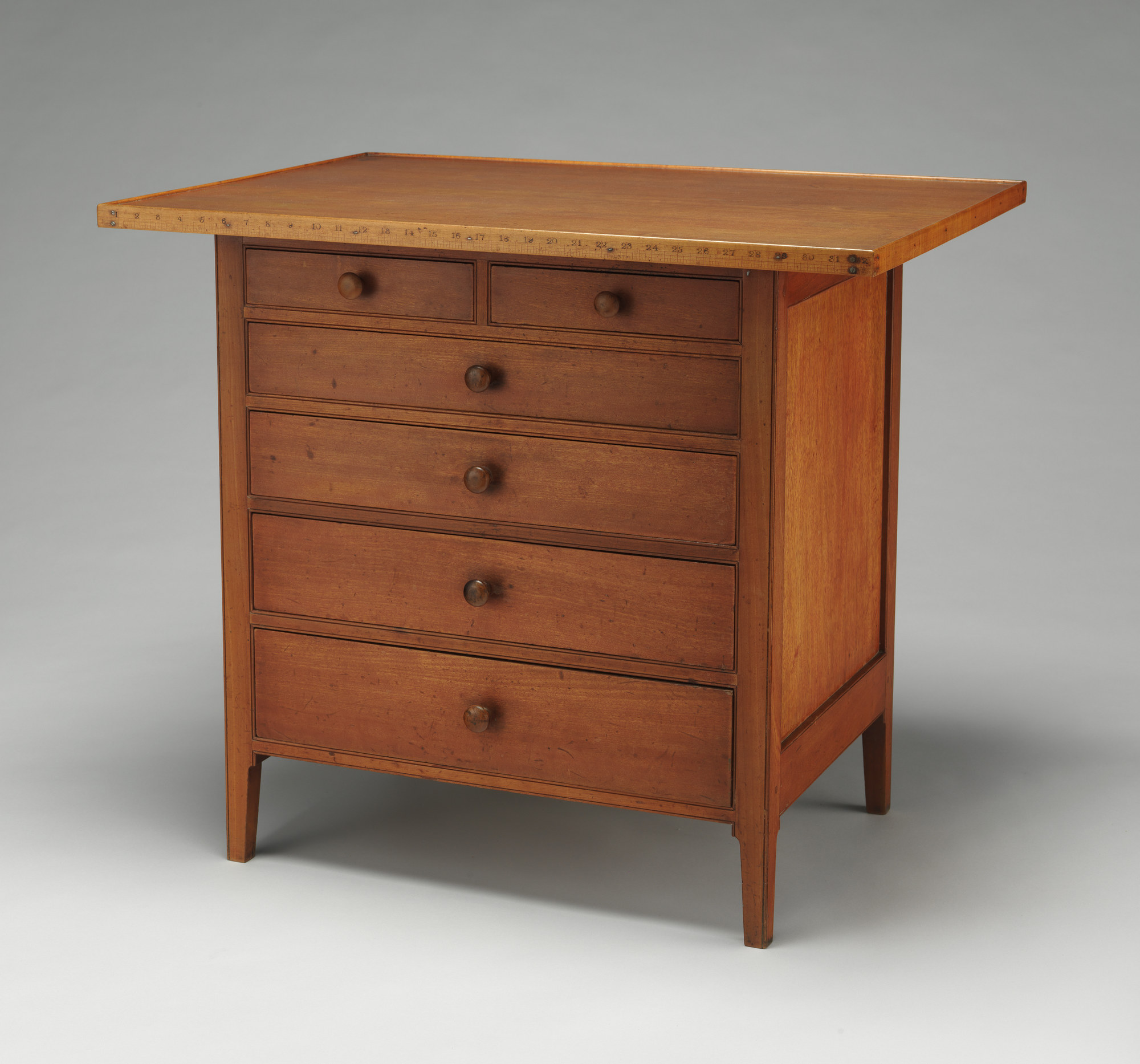
At first glance, the Met's 1843 sewing table is an exercise in restraint: a rectangular top, a narrow case and four square legs. Then the drawers begin to disagree. Two shallow drawers share the upper row; beneath them, four broad drawers span the front. The arrangement is balanced, but it is not a stack of identical boxes. Different storage volumes are allowed to look different.
That is the useful answer to the table's calmness. Order does not come from making every part repeat. It comes from giving each difference a clear place. The Met's wider account of Shaker furniture points specifically to asymmetrical drawer arrangements and multipurpose forms as ways makers added interest without applying ornament for ornament's sake. Object 66.10.18 is one of the examples attached to that observation.2
The drawers have been excused from marching in identical uniforms. Their knobs, edges and alignment still make them a family.
Storage follows the work
The tabletop is wider than the case below and edged by a small raised lip. It offers a generous working plane while the drawers keep materials close. The Met measures the table at 71.1 centimetres high, 82.6 wide and 59.7 deep: more compact than a large communal workbench, but substantial enough to gather a task and its supplies in one place.1
The public record does not tell us which exact drawer held thread, scissors or folded cloth, so assigning a nineteenth-century inventory would be theatre. Another museum object can still clarify the broader furniture type. Hancock Shaker Village describes a different small sewing case whose shallow drawers held small implements and whose drop leaf enlarged the cutting surface. That comparison explains why varied, reachable storage mattered to sewing work; it does not transfer a drop leaf or a known drawer use to the Met table. 3
This distinction makes the object more interesting, not less. We can see a work surface and differentiated storage without pretending to know the last needle that occupied it.
Six woods, one table
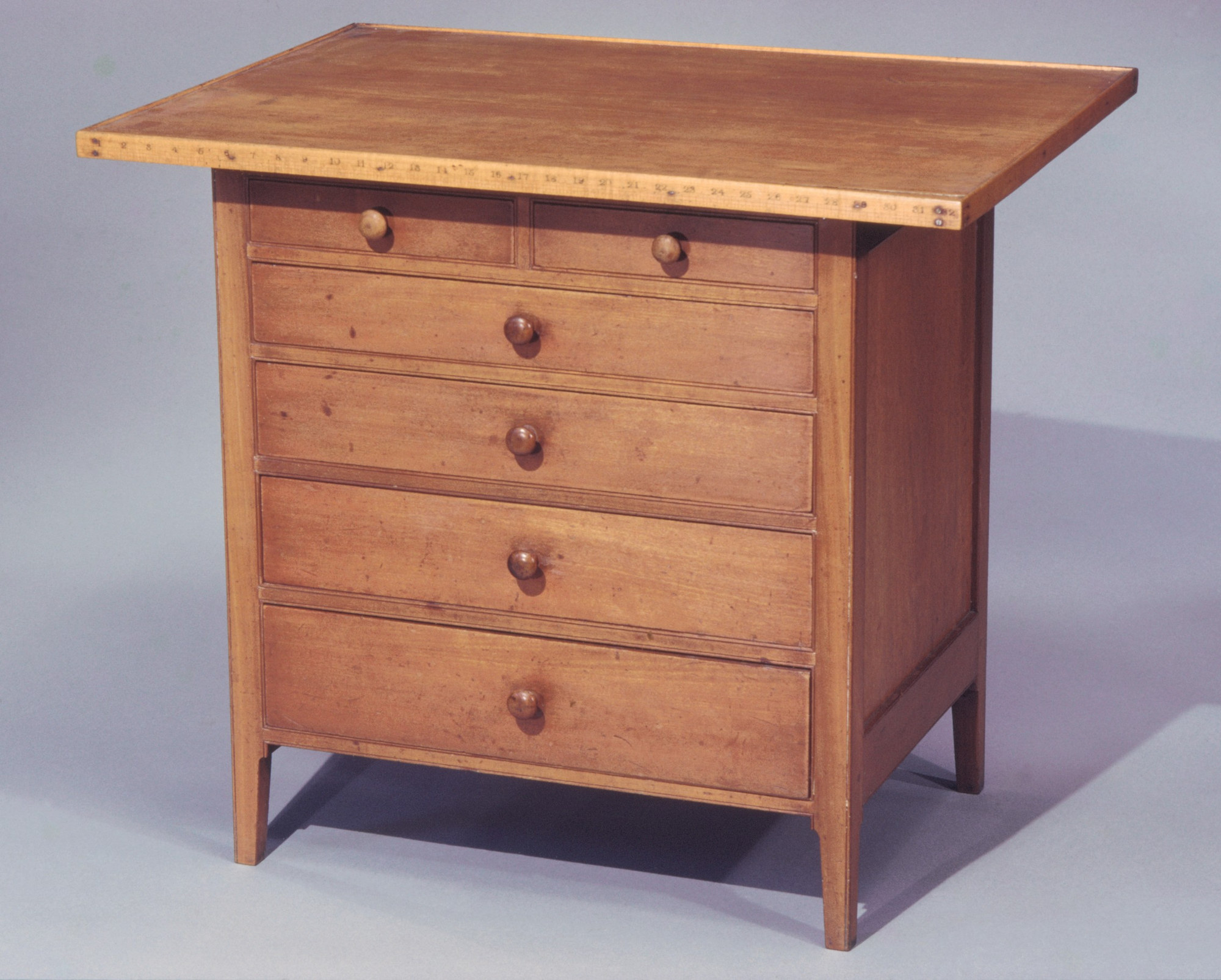
The Met lists six woods in object 66.10.18: cherry, butternut, pine, basswood, sycamore and maple. That is a surprisingly varied material record for an object often encountered under the vague label of simplicity. The species do not announce themselves as a decorative sampler. They have been brought into one quiet case.1
The museum's Shaker essay provides the broader context. Rather than imported mahogany or rosewood, Shaker makers commonly used American woods including pine, maple and cherry. They also rejected veneers, inlay and applied carving associated with display. Local material and direct construction carried the visual burden.2
The public object record does not map each species to each visible board, and this page will not invent that map from colour. Wood changes with finish, light, age and photography. What the record does establish is more useful: material economy did not require a single species, and visual unity did not require material sameness.
One maker inside a community
The Met names both James X. Smith and the United Society of Believers in Christ's Second Appearing as makers. It also records New Lebanon, New York, as the place of manufacture and 1843 as the date. Those fields keep an individual craftsperson visible without detaching him from the communal setting in which the object was made.1
New Lebanon was the largest and most influential Shaker community, established in 1787. Shaker settlements produced their own buildings, tools and household furnishings, and they adopted labour-saving machinery alongside careful hand work. The Met's essay describes circular saws, mortising machines and steam-powered lathes as part of that culture of production. 2
That history complicates the lazy image of Shaker furniture as anonymous, pre-industrial purity. This table belongs simultaneously to a named maker, a religious community and an organised system of work. Simplicity was not the absence of production thinking. It was one result of it.
Simple does not mean blank
Look again at the front. Narrow moulded edges articulate the drawers. Turned wooden knobs give the hand an obvious place to pull. The top projects beyond the case, the legs taper and the side remains a broad uninterrupted panel. None of these features is extravagant, yet together they prevent the object from becoming a mute box.
The numbered marks visible along the front edge of the top are especially tempting. They look meaningful because numbers usually do. The reviewed public record, however, does not explain their purpose, so they remain an observed feature rather than a solved clue.
Finish needs similar restraint. The warm clear surface in the current colour photographs is part of the table's present appearance. The Met warns that many Shaker pieces were originally painted or stained and that later owners refinished some pieces now seen with clear surfaces. That general history does not prove a specific earlier finish for this table.2
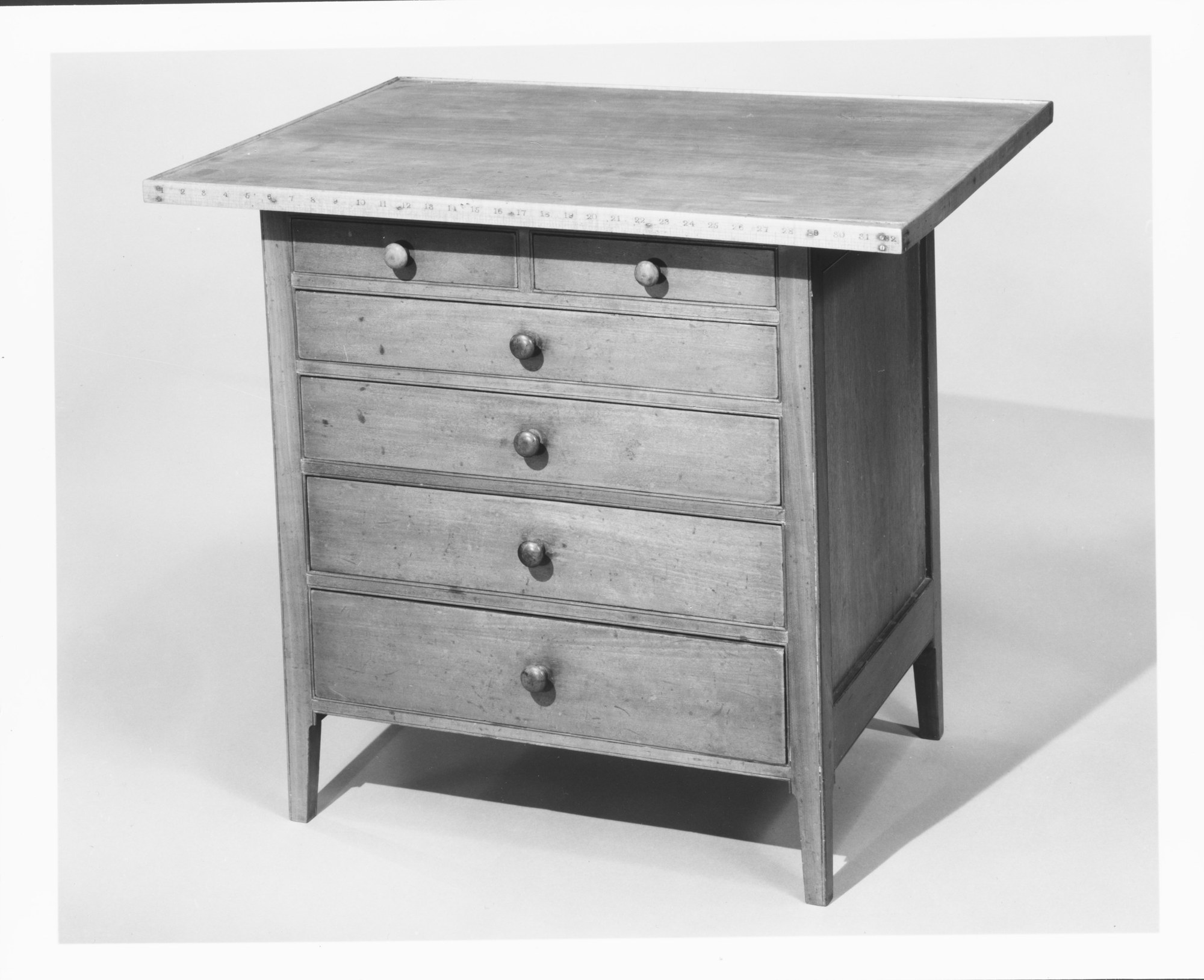
The older black-and-white collection photograph offers another view of the same accessioned object, not a shortcut back to 1843. A monochrome image can document shape and condition at the time it was taken. It cannot tell us what colour the table originally was.
One artefact, not a generic style
Object 66.10.18 gives us unusually firm coordinates: a title, two recorded makers, a year, a place, dimensions, materials and an accession number. Those facts make it possible to tell a precise story about one physical table. They do not make its drawer pattern, woods or present finish universal Shaker rules.
That boundary is the reason to keep artefacts distinct from designs and types. A general entry on Shaker sewing furniture could compare drop leaves, work bags, drawer layouts and village variations across many objects. This record can do something narrower and more intimate: show how one New Lebanon table turned varied needs and varied woods into visible order.
Its lesson is not that useful furniture must look plain. It is that usefulness can supply enough structure to make an object worth looking at. Two drawer widths, six woods and one broad worktop are not distractions from simplicity. They are the work from which its simplicity was made.