A chair made to carry an argument
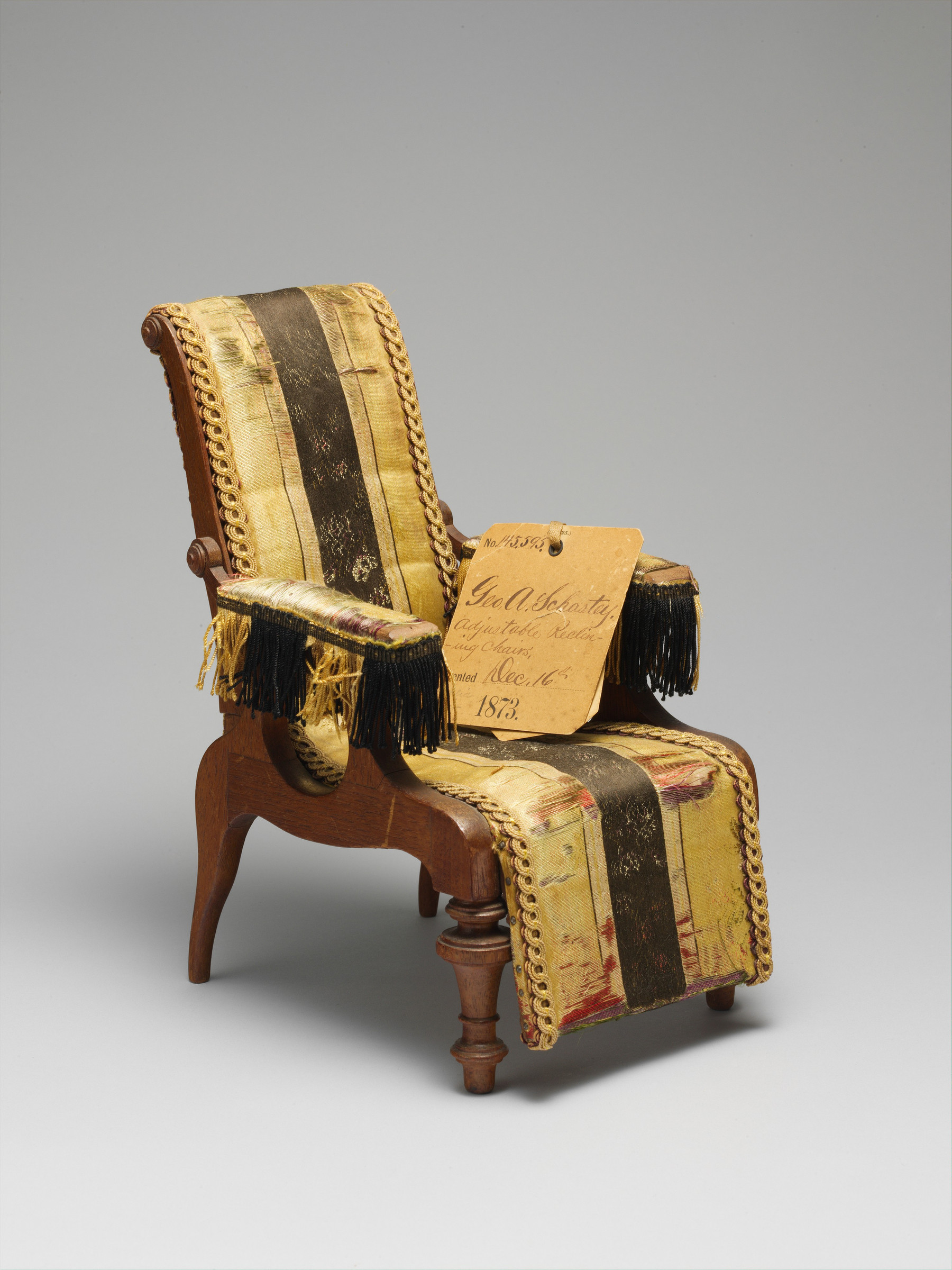
The first surprise is not that this chair reclines. It is that it is only ten inches high. The Met measures it at 25.4 centimetres, with a width of 15.2 and a depth of 17.8. The proportions, scrolls, turned front legs, upholstery and fringe all speak the language of full-size seating, but the object was made for inspection rather than occupation.1
That scale changes how we should look at it. A miniature chair can preserve the relationships between back, seat, arms and leg support while using less material and taking up less space. An examiner could hold it, turn it and compare its parts with the submitted drawings. The model did not need to be comfortable for a person. It needed to make Schastey's proposal intelligible.
Its label still states the maker, the adjustable reclining chair and the 1873 patent date. The surviving object therefore joins three kinds of information: a machine in miniature, a drawing with labelled parts and a paper identity attached to the thing itself. Patent prose can describe motion. This chair gives that motion a body.
Two positions, one steady armrest
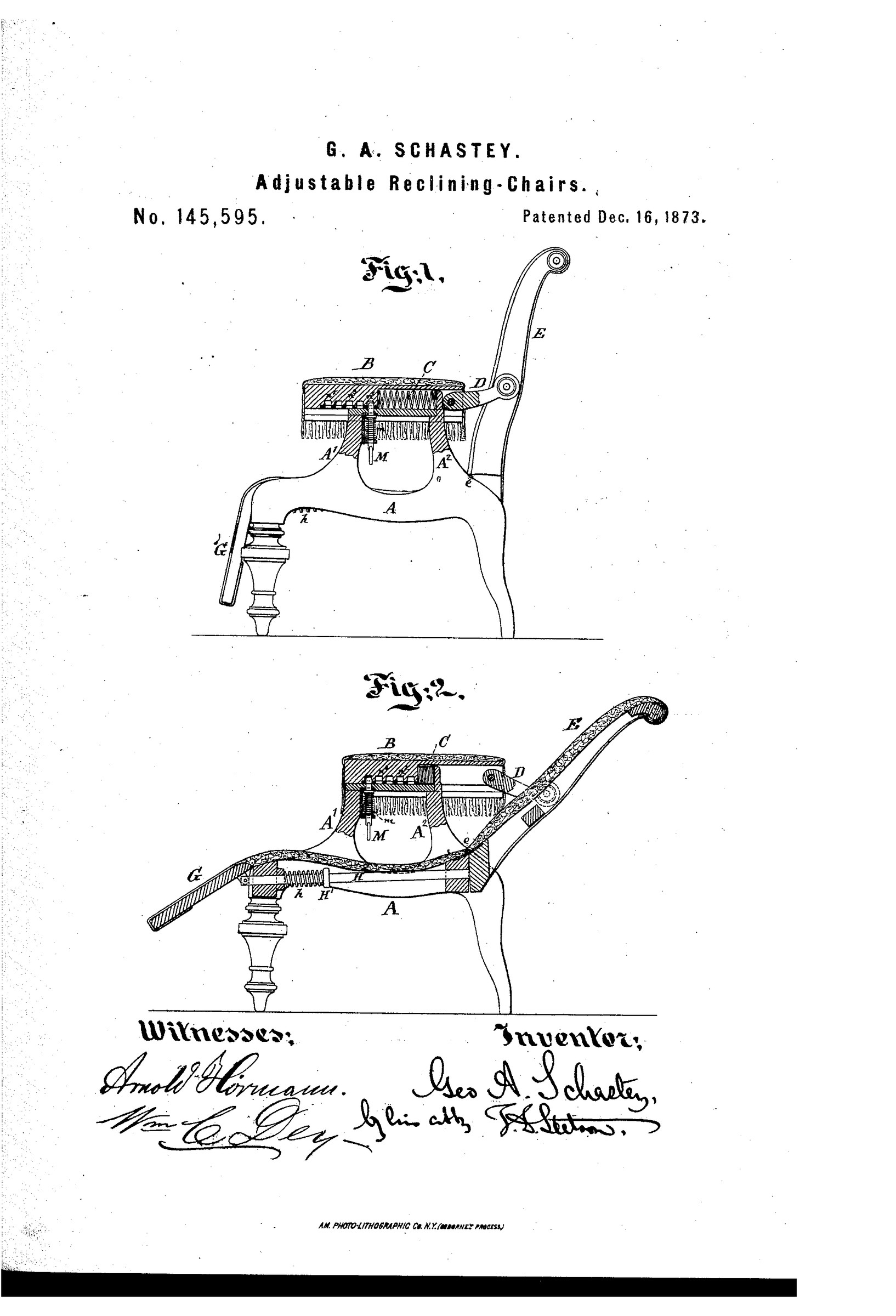
The patent drawing tells the story in two frames. Figure 1 shows the chair nearly upright. Figure 2 drops the back and brings the upholstered leg support forward. The padded arm marked B remains level in both. What changes is the geometry beneath it: links, pivots, catches and springs coordinate parts that would otherwise move independently.2
That level arm is more than a visual nicety. A recliner that sends its armrests tilting with the back may move the sitter's hands, elbows and balance at the same time. The Met's study of Schastey describes his improvement as offering greater stability and control by keeping the arms on an even plane. The back can yield without making every point of contact follow it. 3
Look at the drawing before the photograph and the model becomes easier to read. The curved back is not simply a silhouette. Its lower pivot is part of a sequence. The leg support is not an ornamental apron. In the reclined drawing it becomes an extension for the sitter's legs. Even the bulky upholstered arms are housings and control surfaces as well as places to rest an elbow.
The upholstery is part of the proof
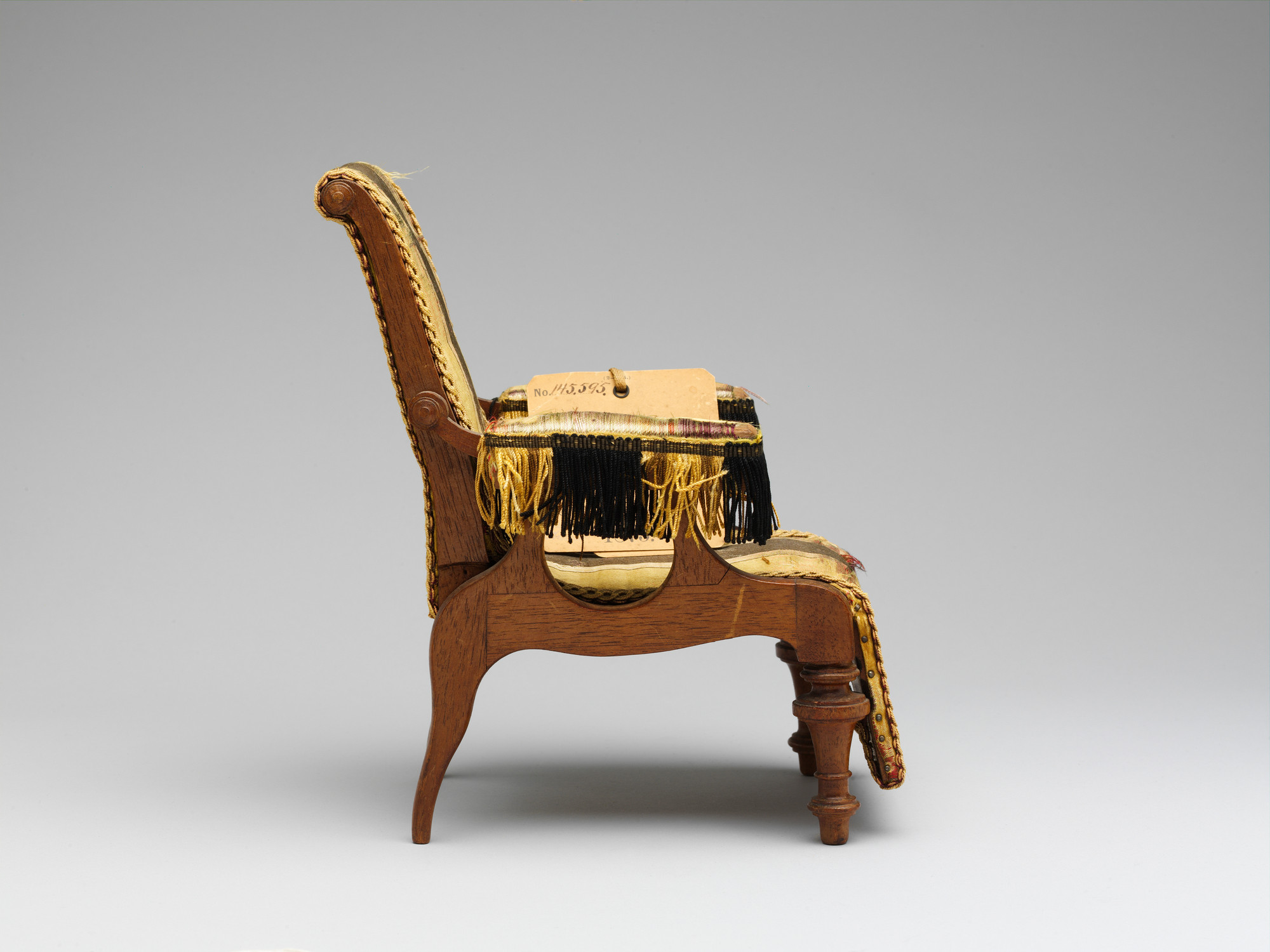
The mechanism could have been demonstrated as a bare wooden skeleton. Instead, Schastey dressed the model as furniture. The Met records walnut, paper labels and original silk upholstery. Gold and dark stripes run down the back and leg support; braid follows the edges; alternating fringe hangs from the arms. The mechanical proposal arrives wearing Renaissance Revival evening clothes. 1
That finish is useful evidence. Upholstery adds thickness around the moving parts and shows what the invention was meant to become once it entered a room. It also lets the viewer follow continuity: the same striped surface begins at the back, crosses the seat and continues over the rising leg support. In the side view, timber links and pivots remain visible below the padded arm, so comfort and mechanism occupy the same small object rather than separate demonstrations.
The survival is especially unusual because the soft material and paper tags are precisely the parts easiest to lose, replace or discard. They do not prove that the chair was operated in 1873 exactly as it appears today. They do preserve how a technical claim was presented as a recognisable, finished piece of domestic furniture.
The Patent Office wanted objects
Schastey's model belonged to a system in which an invention could arrive in Washington as an object as well as words and drawings. The Met explains that the United States Patent Office later removed the working-model requirement and dispersed the accumulated collection. Many models left the institutional context for which they had been made.1
This history gives accession 2008.639 a double identity. It is furniture, down to the silk trim, but it is also administrative technology: a compact way to make a claim inspectable. A drawing flattens movement into successive images. A model lets a hand test clearances and watch parts pass one another. Each format answers a different question, and together they make the patent easier to understand than either would alone.
The paper tag matters for the same reason. It keeps the physical chair tied to Schastey's named proposal rather than leaving a curious miniature to acquire a story from resemblance. Object, label and patent number still point at one another.
The year Schastey opened his own shop
The patent came at a hinge in Schastey's career. Born in Merseburg and brought to New York as a child, he worked in the city's furniture trade after serving in the Civil War. The Met places the opening of his own business in 1873, the same year as the reclining-chair application and model. 1
That coincidence makes the object feel less like a sideline. Schastey was establishing himself in a competitive trade in which comfort, novelty and technical control could distinguish a firm. His later reputation rested on elaborate interiors and furniture for wealthy clients, but this early survivor shows an inventor working through motion at the scale of the hand.
The Met's Gilded Age study places the model beside the larger story of his decorating business. It helps correct a familiar imbalance: opulent rooms are easy to remember, while the small experiments that supported a maker's technical identity are easier to overlook.3
What a ten-inch survivor can tell us
The safest conclusions are also the most satisfying. George A. Schastey made this model in New York in 1873. It corresponds to US Patent 145,595. The patent depicts upright and reclined positions; the model retains its walnut frame, paper identification labels and original silk upholstery. Those facts belong to one physical artefact in the Met.2 1
They do not tell us how many full-size versions left a workshop, how buyers responded, whether this particular model can safely move now or whether a similar unlabelled recliner is by Schastey. A patent records a proposed invention, not an automatic production history.
What survives is already enough: an ambitious chair reduced until its idea could sit on a desk. The silk says furniture, the drawing says mechanism and the tag says who was willing to put his name on both.