The future arrives painted white
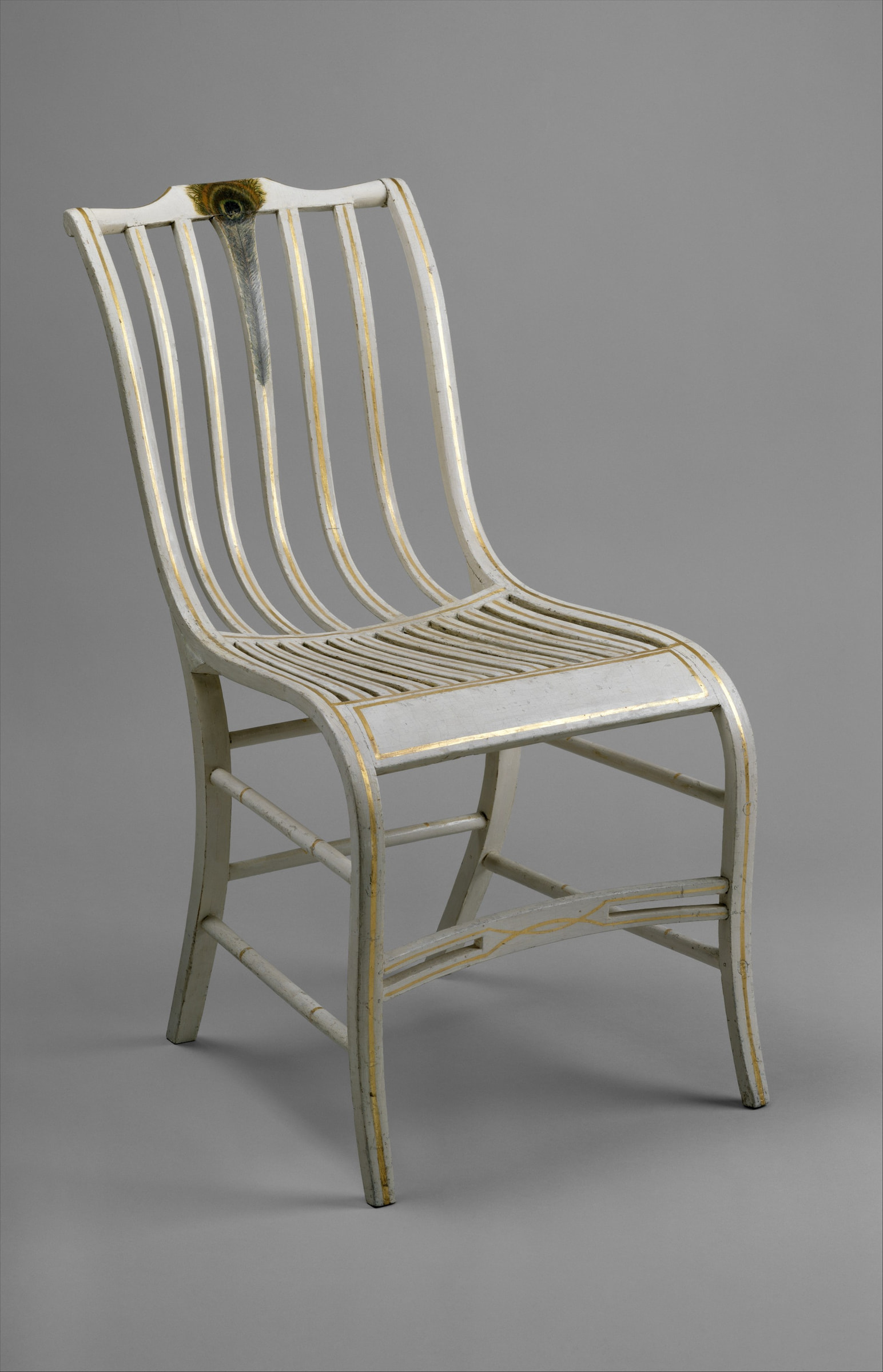
At first glance, this is not a machine-age chair. It is slender, pale and almost courtly. Gold lines skim its edges. A peacock feather descends from the crest. The back opens into a fan of narrow uprights and the front legs turn forward with the poised sweep associated with the Greek klismos.
The Met dates this exact chair to about 1810, identifies Samuel Gragg as its maker and records Boston as its place of manufacture. Object 1980.496 is only 86 centimetres high, 46.4 wide and 66 deep. Its recorded wood is ash or chestnut, an uncertainty worth retaining rather than silently choosing one species.1
Its apparent delicacy is the point of entry, not the whole story. The chair does not begin with a conventional frame and borrow a curving outline through carving. Much of the outline is made by long, thin wooden members bent into position. Style and structure occupy the same line.
Follow one line from crest to floor
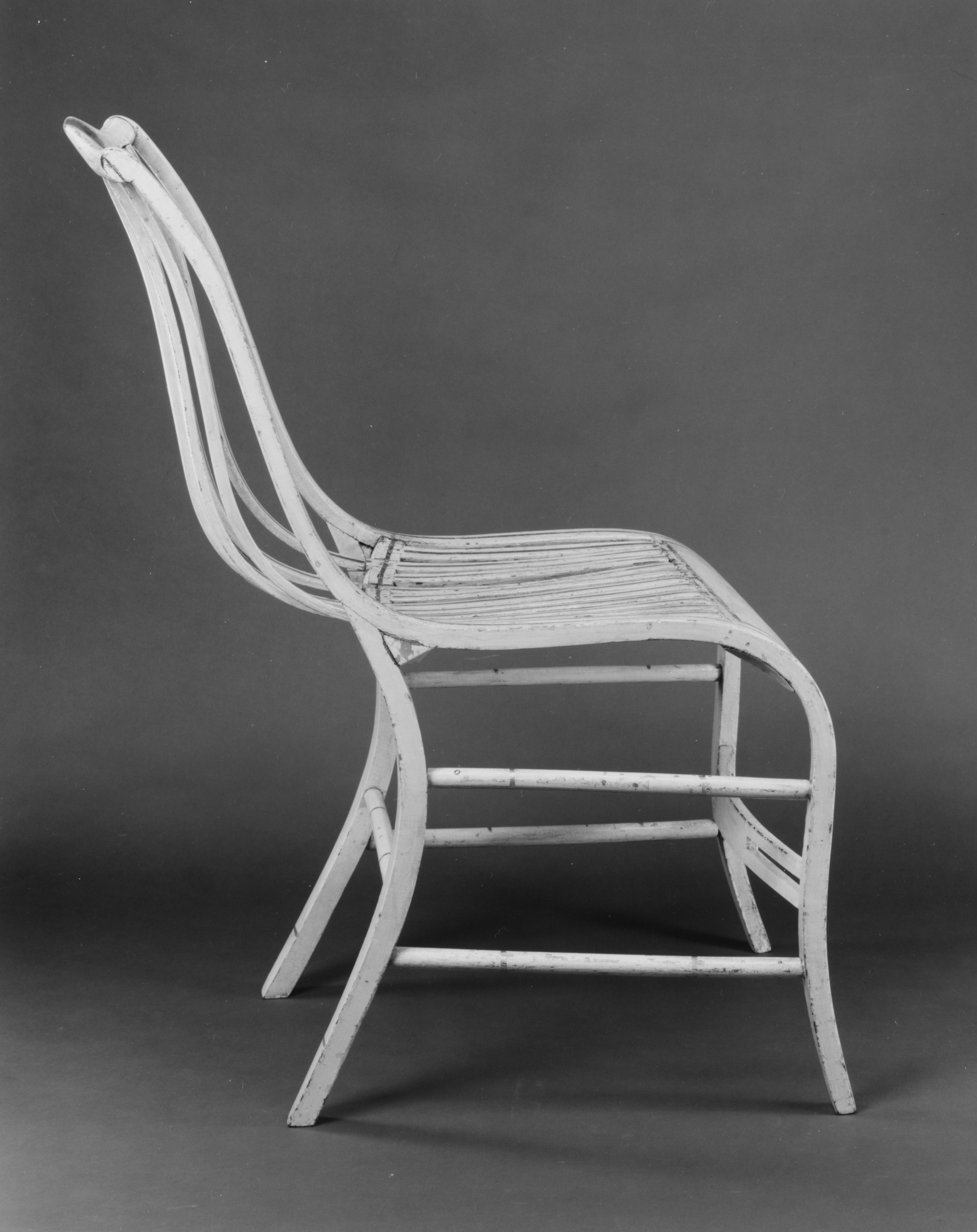
The side photograph provides the quickest way into Gragg's idea. Start at one upper corner of the crest and follow the outer stile down the back. It bends forward beneath the sitter, becomes the side of the seat and keeps travelling until it turns down as the front leg. What looks like a drawn S-curve is a continuous structural route.
Gragg made another elastic-chair type in which the bent back stile continued into the seat rail but a separate front leg was socketed in place. The more radical version represented by 1980.496 carries the line into the front leg as well; modern scholarship often calls this the fully elastic form. The Met's acquisition note singles out this exact object as one of the chairs whose front legs continue from the stiles and seat rails.2
That distinction prevents a useful idea from becoming a vague label. Elastic does not merely mean that some wood was bent. It describes a particular relationship among back, seat and support, one that a profile photograph can make clearer than a general history of bentwood.
The seat is a field of changing curves
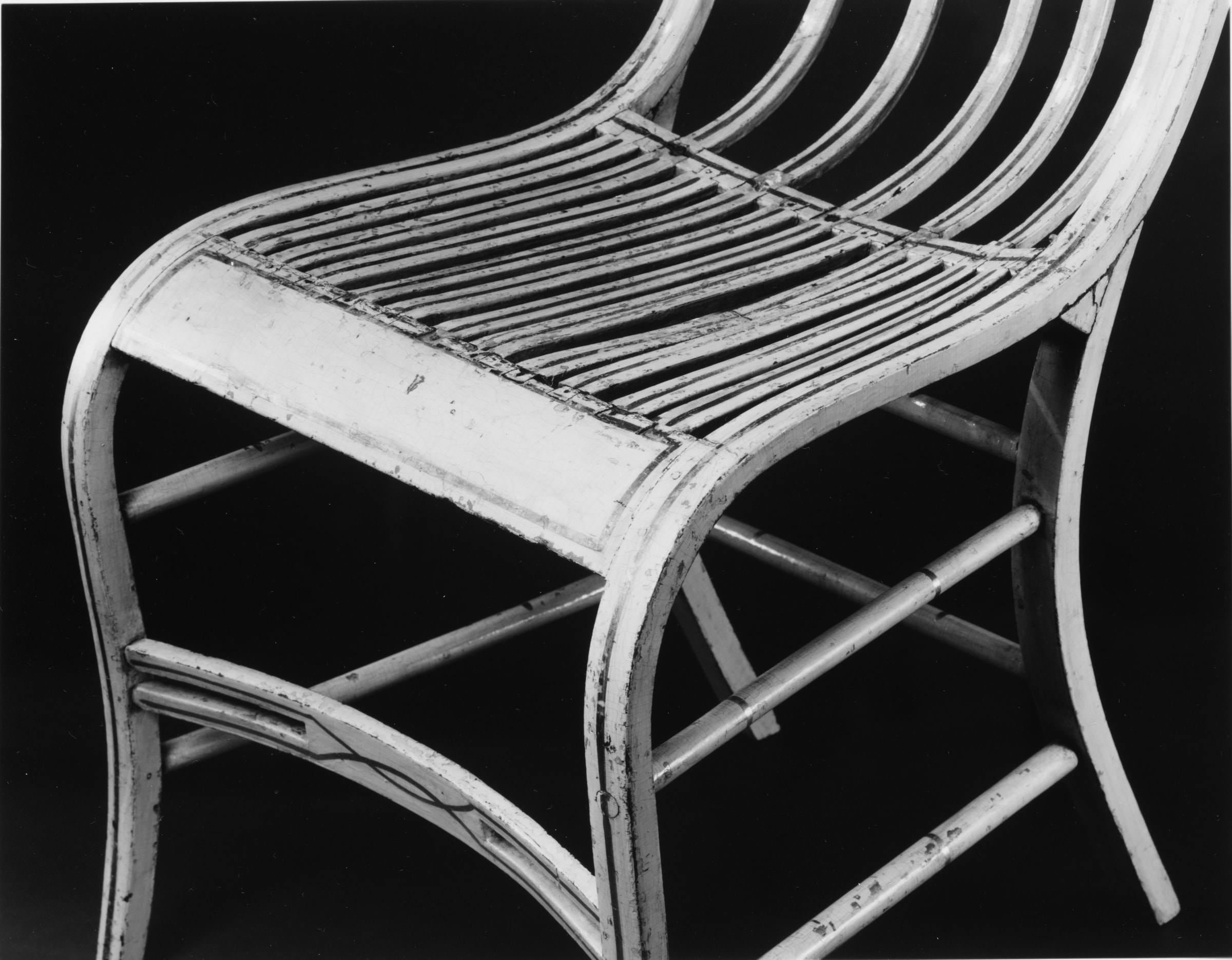
The outer members are only the chair's border. Across the opening, narrow slats run down the back and forward through the seat. They do not all share one flat arc. Their curvature increases toward the middle, so the back swells outward and the seat becomes a shallow shaped field rather than a rigid plane.
The close photograph shows how much work hides inside that light effect. Long slats pass through the transition at the rear of the seat; shorter pieces fill the seat between them. Published technical study describes tabs at the crest, notches at the rear rail and dovetailed fitting at the front rail, followed by fastening. Each slender part had to meet several curves and several neighbours at once.3
That is why the empty spaces matter. They are not gaps left after a solid seat was removed. They let us see each strip acting as an individual line inside a coordinated surface. The sitter was supported by a family of curves, not by a single board.
Bending was only the beginning
It is tempting to summarise the chair with one dramatic verb: steam-bent. The research is more interesting. Heat, steam or boiling water could make a wood element pliable, but the invention still depended on how those sinewy parts were assembled after bending.
The published reconstruction of the sequence begins with a shaped rear seat rail, compared to a small keel. Serpentine side elements were fitted into its notches and screwed; crest and front rail were then half-lapped across the bent members. During assembly the sides were twisted and sprung apart to establish the splay of back and seat. Rear legs met the seat rail with angled scarf joints, while stretcher tenons pierced thin legs and were wedged from the outside.3
The same study relates these choices to light watercraft construction, where bent frames, laps and metal fastenings build strength piece by piece. It treats the exact spark of Gragg's inspiration as speculation, however. The valuable comparison is technical: a chair could be assembled as a curved frame instead of being carved to impersonate one.
The klismos was camouflage and catalyst
Nothing about that assembly required white paint, gold lining or a peacock feather. Those details locate the experiment in the visual culture of its own moment. The Met describes the chair as derived from the Grecian klismos, while its acquisition account calls attention to the contrast between a fashionable Late Federal fancy chair and unusually bold wooden bending. 1 2
The classical reference did more than conceal technology. It supplied the problem that the technology could solve. A klismos asks for a back that leans, a seat that seems to flow and legs that sweep away from the body. Cutting such curves from straight-grained timber risks weak short grain or demands heavier sections. Gragg's long bent elements could keep the grain travelling with the line.
The result is a useful reversal. This chair does not hide a modern structure under an ancient-looking shell. Its ancient-looking profile becomes possible because the structure itself has been taught to curve.
An invention with expensive grace
Gragg received his elastic-chair patent on 31 August 1808. The early federal patent record was later destroyed in the 1836 Patent Office fire, but Gragg's own copy resurfaced during research for a 2003 exhibition. Surviving chairs, documents and that copy give the construction a firmer history than its small survival count might suggest.3
They also reveal the design's tension. Every slat had to be bent, twisted, fitted and finished into compound curvature. The technical study argues that this painstaking labour undermined an otherwise brilliant proposal. The Met likewise notes that very few of the fragile chairs survive. Innovation here did not simplify the chair into a repeatable handful of parts; it multiplied the judgement required at each junction.1
That is what makes 1980.496 more than an early stop on a straight road toward later bentwood furniture. It is its own answer: an intensely hand-fitted frame whose technology and ornament meet in the same elastic curve. Its future was not mass production. Its future was the startling possibility, still visible in profile, that a fashionable line could carry weight because the wood itself had learned how to follow it.