A complete surface that is not fixed
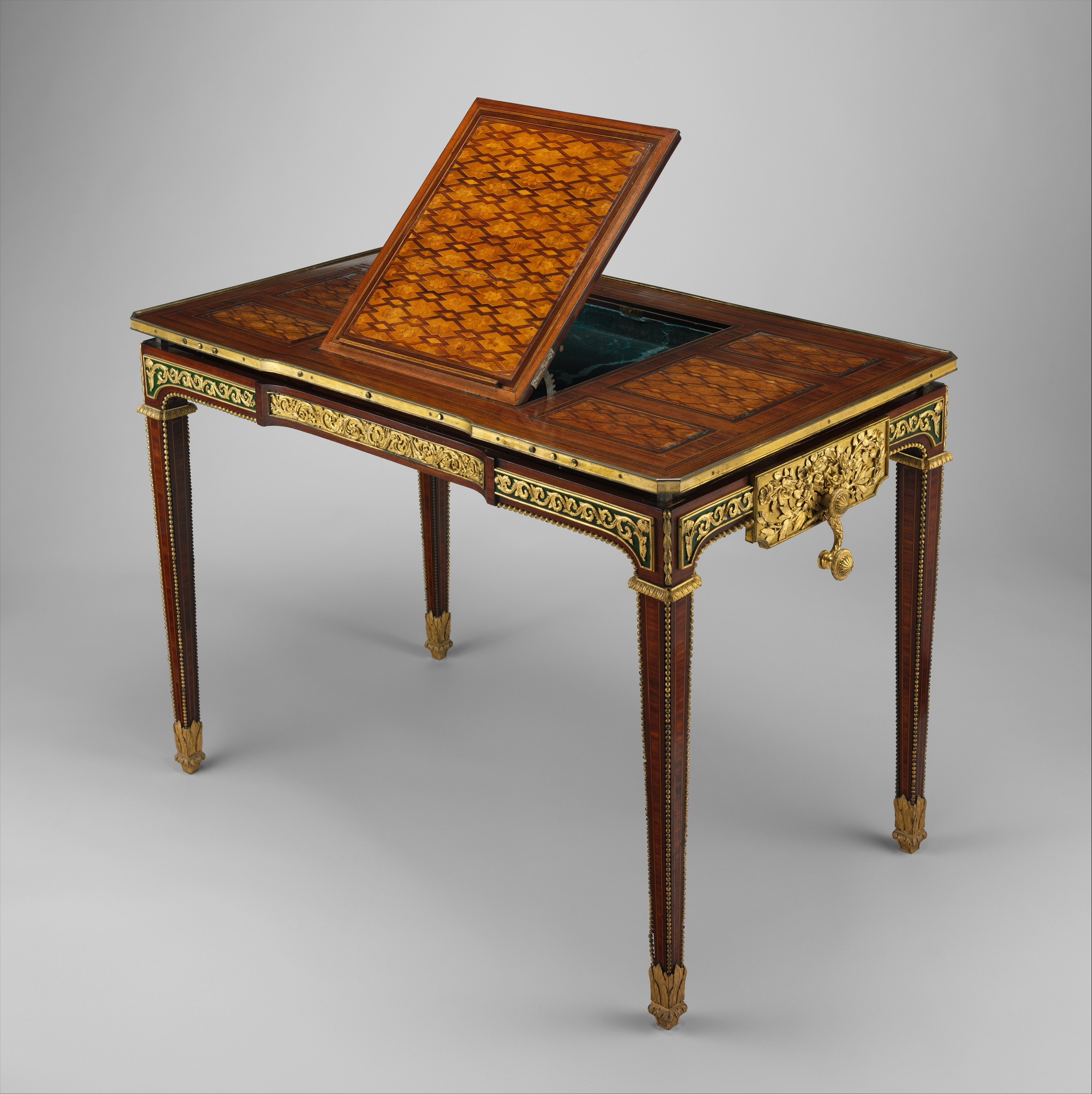
Mechanical Table 33.12 first presents the visual grammar of a court cabinet: four slender legs, gilt-bronze borders and mounts, green accents, and a broad top divided into carefully framed marquetry panels. Nothing in that symmetry requires the top to move. The machine arrives only when the object is asked to change its height or task.
The Met dates this exact table to 1778 and gives its dimensions as 78.7 centimetres high, 113 wide and 69.2 deep. It identifies Jean Henri Riesener as maker and separately credits the mechanism to Jean Gotfritt Mercklein. That division of credit keeps cabinet work and mechanical specialism visible inside one object.1
The table belongs to a broader eighteenth-century category of mechanical furniture, in which moving parts allowed one piece to support reading, writing or dressing. But category is only context. The painted number, materials, delivery and photographed configurations discussed here belong to accession 33.12, not automatically to every table mécanique. 2
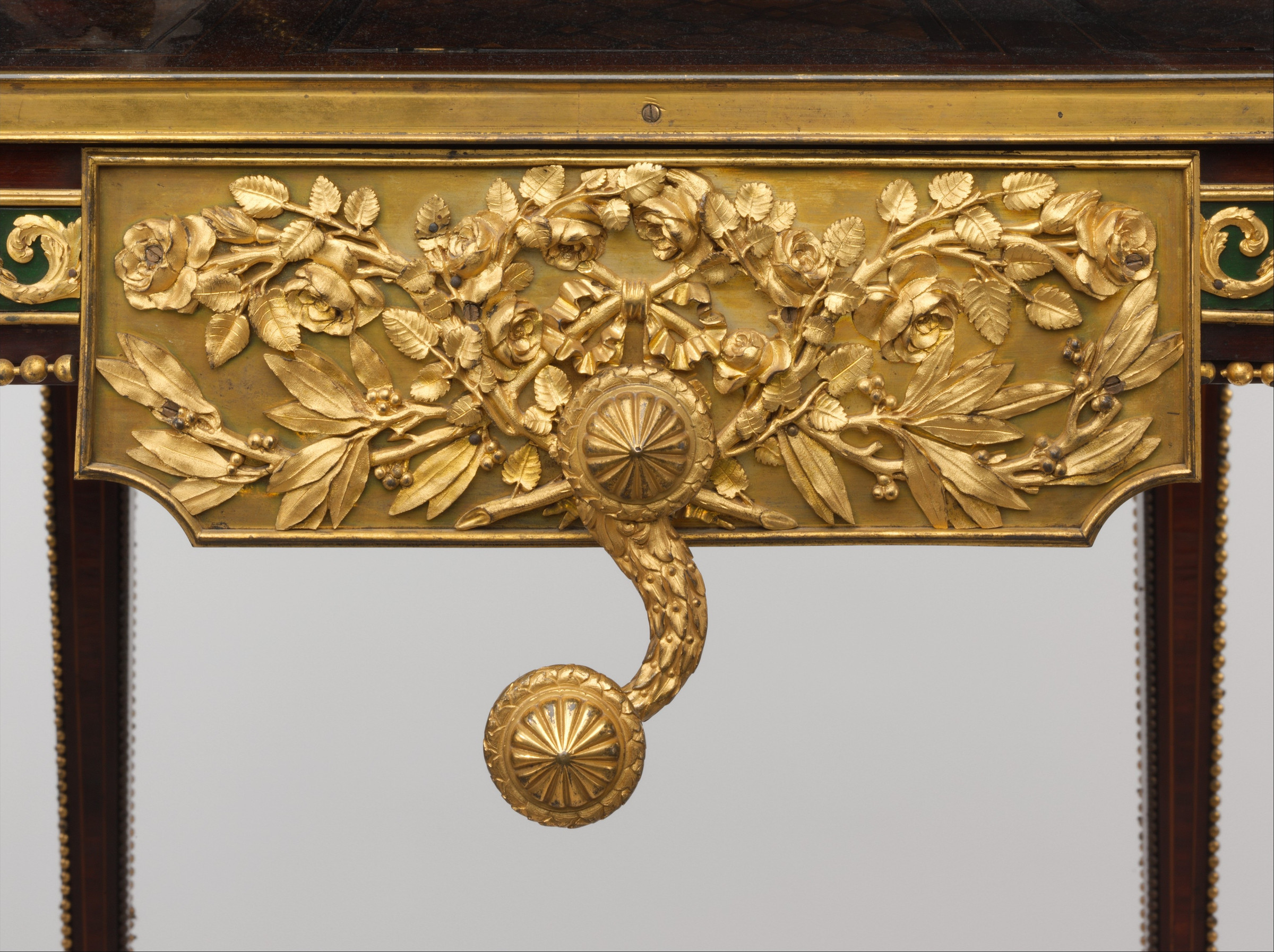
The crank coordinates four hidden shafts
The control is surprisingly small. A detachable S-shaped crank enters beneath the central gilt-bronze plaque. Turning it raises or lowers the whole upper assembly. According to The Met, ratcheted metal shafts move within the four hollow legs, allowing the top to meet a seated or standing user. 1
The visible photograph and the written mechanism must be read together. The crank detail proves where the user applies force, while another view shows the top lifted clear of the base on four metal uprights. Neither view opens a leg or exposes the complete transmission. Describing gears or dimensions not recorded by the museum would turn explanation into reconstruction.
What can be said is already remarkable: four widely separated supports must remain coordinated closely enough for a large veneered top to rise as one plane. Height adjustment is not an accessory placed on the surface. It is a relationship among control, concealed shafts, hollow legs and the entire tabletop.
One surface, several tasks
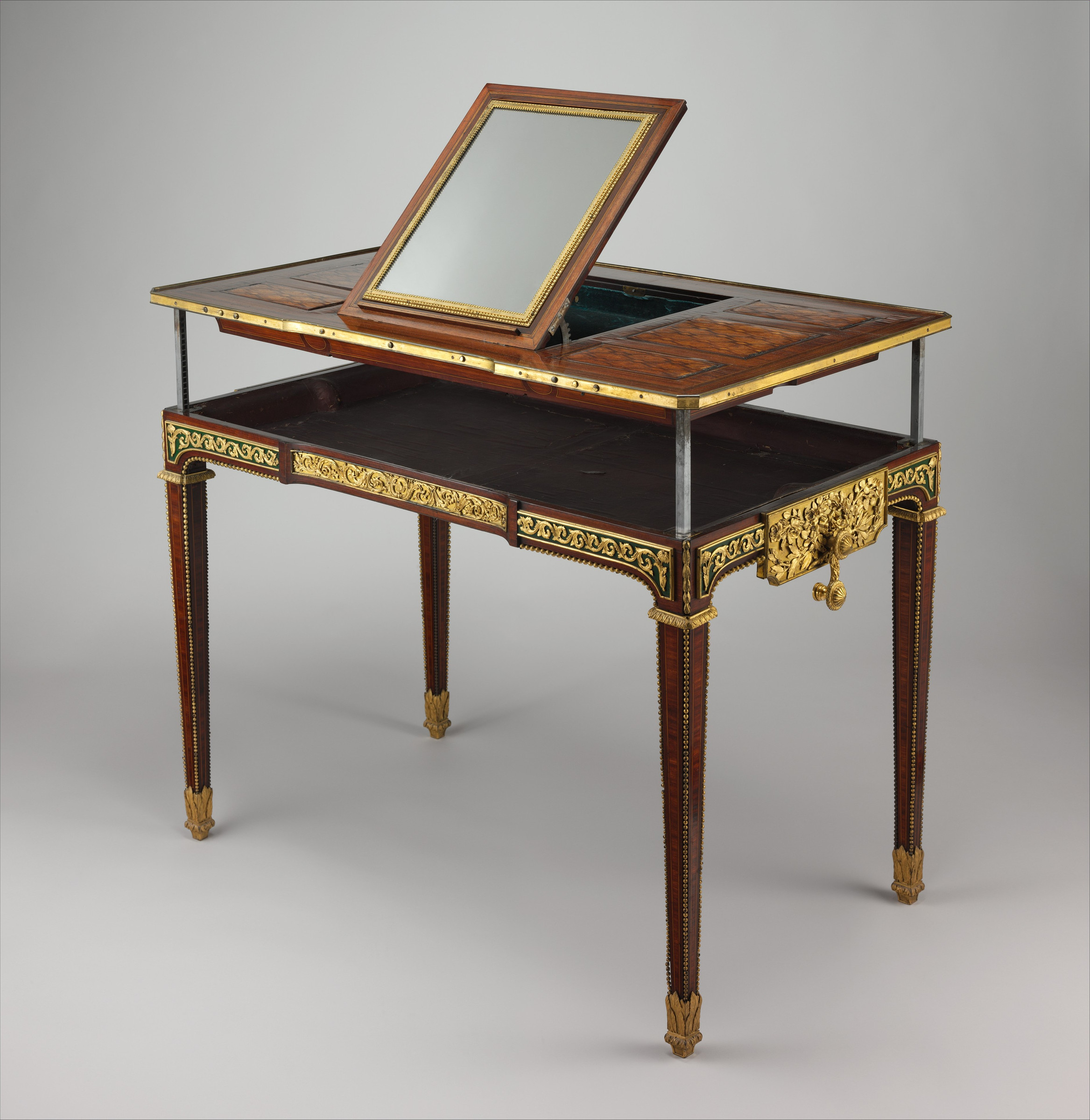
Changing height does not exhaust the table’s movement. The central panel lifts to form a lectern for reading or writing. Reversed, that same panel presents a mirror. Around it, discreet buttons release hinged lids over six compartments intended for cosmetic or writing equipment.1
The transformations are nested. First the entire top can move between seated and standing levels. Then a central rectangle can tilt, reverse and change function. Finally smaller lids open local storage zones. A flat marquetry composition becomes a sequence of working depths without acquiring a separate cabinet above or drawer bank below.
This is why the mirror view matters. The raised top makes the metal supports visible, while the reflective face replaces the patterned panel seen in the lectern view. Both images show the same object configured differently; neither should be treated as a permanent front.
A delivery date turns luxury into evidence
The table has a painted number, 2964, that The Met connects to the royal furniture ledger. The record states that it was delivered to Versailles on 12 December 1778 for Marie Antoinette, exactly one week before the birth of her daughter Marie-Thérèse-Charlotte.1
The museum explains the commission through the queen’s advanced pregnancy: the adjustable height was intended to ease the discomfort of long periods spent sitting. That account gives the mechanism a specific bodily problem, while the lectern, mirror and storage keep the table useful for several daily tasks. It should remain an attributed museum explanation, not a medical claim or a general origin story for height-adjustable furniture.
The date does more than lend royal atmosphere. It binds maker, intended user, place and object together. A later photograph can display the mechanism, but the inventory number and ledger connection explain why this table is more than an anonymous luxury object associated with Versailles by style.
The surface once spoke in stronger colours
Riesener’s cabinet work conceals motion beneath an unusually complex surface. The Met records an oak structure veneered with bois satiné, holly, amaranth, barberry, stained sycamore and green-lacquered wood. Gilt-bronze mounts frame the top and legs; steel, iron and brass fittings perform the less visible work. The current velvet is not original.1
Time has altered the marquetry’s palette. The museum notes that holly now read as golden brown was once white or stained black, barberry supplied bright yellow and sycamore a softer yellow. The present photograph therefore records the surviving object faithfully without recovering its original contrast.
That fading changes how the mechanism is perceived. Today the woods gather into warm browns while gold mounts and green panels stand forward. In 1778, light, dark and yellow veneers would have articulated the geometric surface more sharply. Colour history and mechanical history meet on the same moving plane, but neither can be reconstructed from appearance alone.
Luxury hides the machine, evidence sets its limit
The table’s achievement is not that it looks mechanical. It is that the mechanism appears only at the user’s request. Closed, the top reads as a controlled marquetry field. Turn the crank and its height changes. Lift or reverse the centre and the field becomes lectern or mirror. Press a button and storage opens where the pattern seemed continuous.
The Met’s object record and its Wrightsman Galleries entry allow those states to remain attached to 33.12.3 They document makers, materials, date, destination and functions with unusual precision. They do not expose every hidden component, preserve the original palette unchanged or tell us how every compartment was used after delivery.
That boundary is productive. It keeps the story centred on what survives and what is recorded: a detachable crank, four concealed ratcheted shafts, a convertible centre, six compartments and one dated royal object. The machine may be hidden, but the evidence for it does not need to be.