The outline arrives before the upholstery
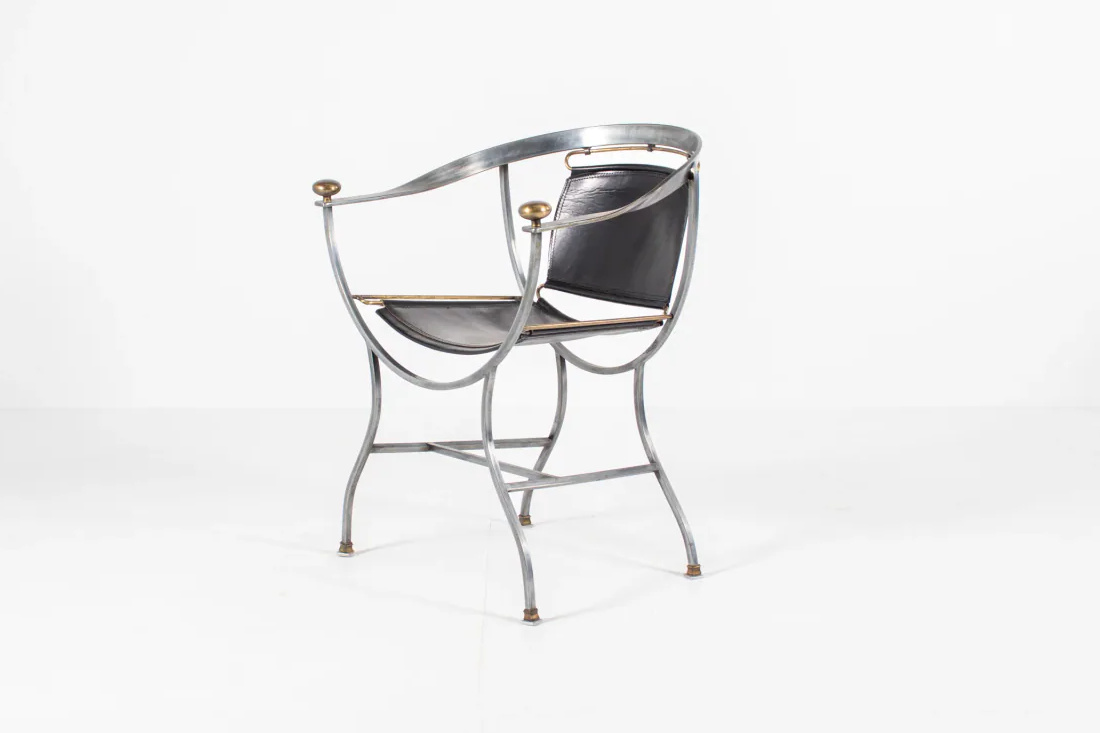
The Pompei Armchair first registers as a line drawn around a person. A rounded, open back continues toward the sitter's sides, where the same metal language becomes the arms. The chair therefore establishes its perimeter before it reveals its seat, legs or padding.
That reading is supported by two rather different catalogue descriptions. A 2021 Binoche and Cabinet Marcilhac entry describes a rounded open back, lateral arms, chromed metal strip and small brass spheres. Osenat's 2026 catalogue is more construction-specific: square-section steel, with the back forming the armrests in a matching strip.2 3
The result is neither a conventional four-legged armchair with parts added one after another nor a seamless shell. It is closer to a metal boundary holding several distinct surfaces in place. Empty space inside the boundary matters as much as the material itself. The open zone beneath the rail keeps a broad chair from becoming a solid block.
Leather turns volume into planes
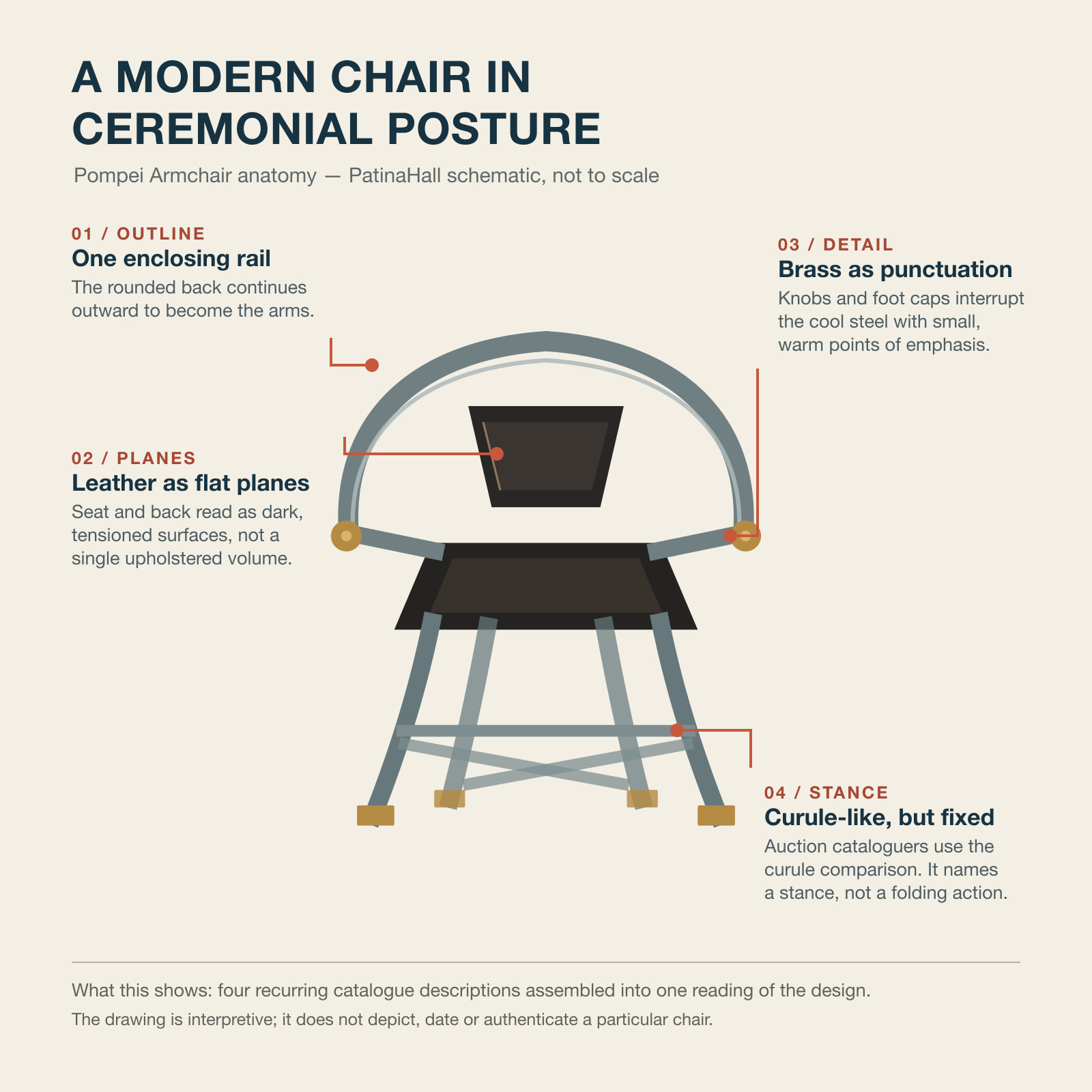
Many upholstered armchairs build comfort through depth: thick arms, a padded back, a generous seat and a base that visually absorbs them. Pompei separates those jobs. Its catalogued leather back and seat read as dark planes stretched inside a cooler metal outline. They make the body legible without making the whole chair look soft.
This is why the chair can appear both substantial and sparse. The back panel marks where the shoulders meet the chair; the seat marks where weight lands; the rail describes personal space around them. None has to pretend to be the other. The eye moves between outline, surface and void rather than across one upholstered mass.
The distinction also helps explain why a textile-covered set can still be recognisable. Dorotheum's 2018 group has red textile on the seat and back rather than the black or fawn leather recorded elsewhere, yet the brushed and bronzed steel construction preserves the larger visual grammar.1
Curule is a comparison, not a mechanism
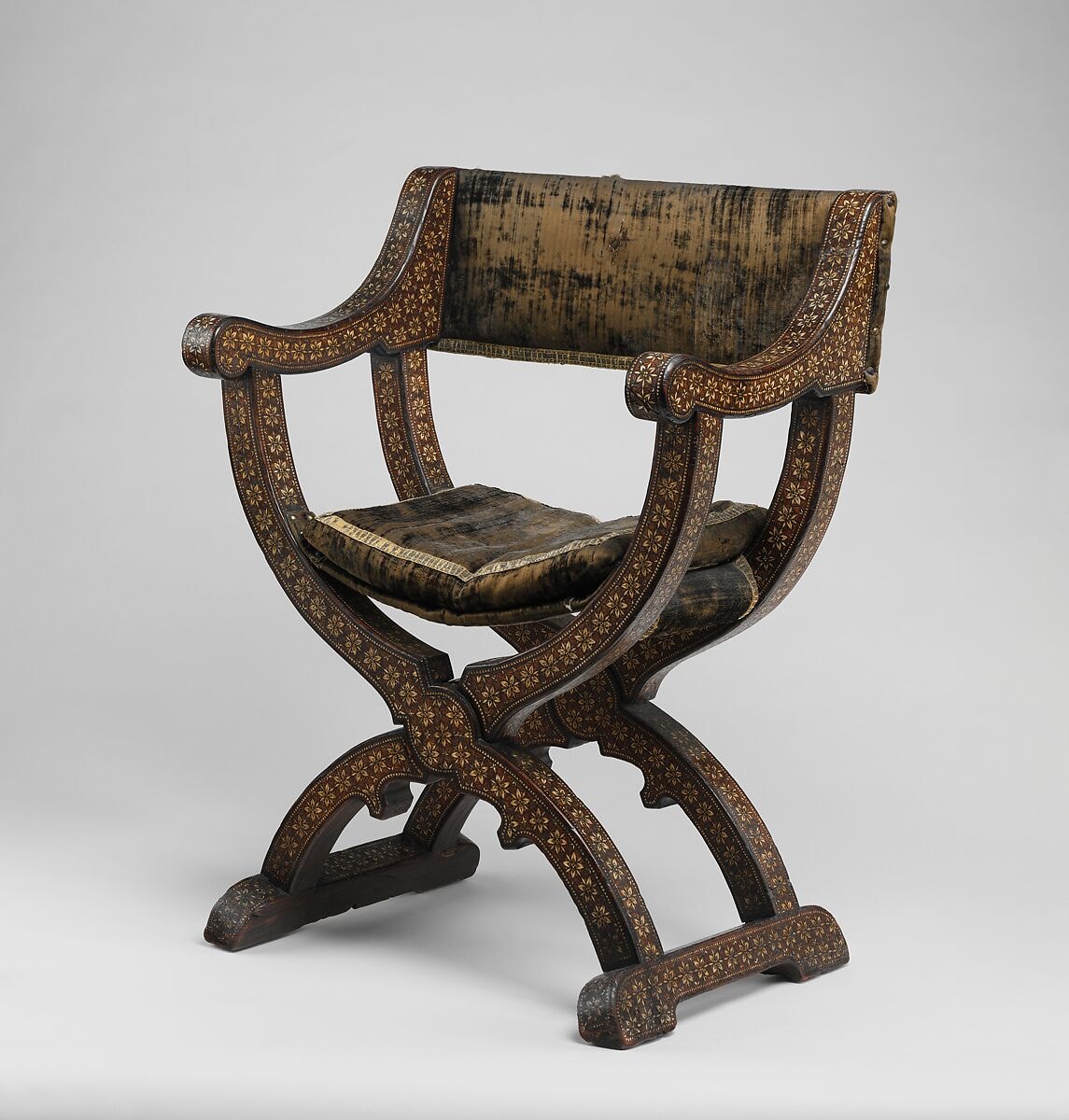
Osenat calls the catalogued groups fauteuils curules. The phrase brings an older furniture family into view. The Metropolitan Museum of Art explains the curule chair as an ancient Roman folding seat associated with consuls and high officials, and shows how later chairs could retain the crossed, ceremonial form even after practical folding had disappeared.4
That history clarifies the word's usefulness here. Pompei can borrow the visual poise of a curule seat without becoming an archaeological copy. Its splayed, braced lower structure makes the chair look balanced and formal, while the upper rail turns that stance into an armchair rather than a folding stool.
The comparison must stop before it becomes a claim about intention. The name Pompei and the curule label make an ancient reference tempting, but none of the reviewed sources records Alberto Orlandi explaining the design that way. We can describe what the silhouette allows us to see. We cannot turn that perception into a quotation the designer never gave.
Brass behaves like punctuation
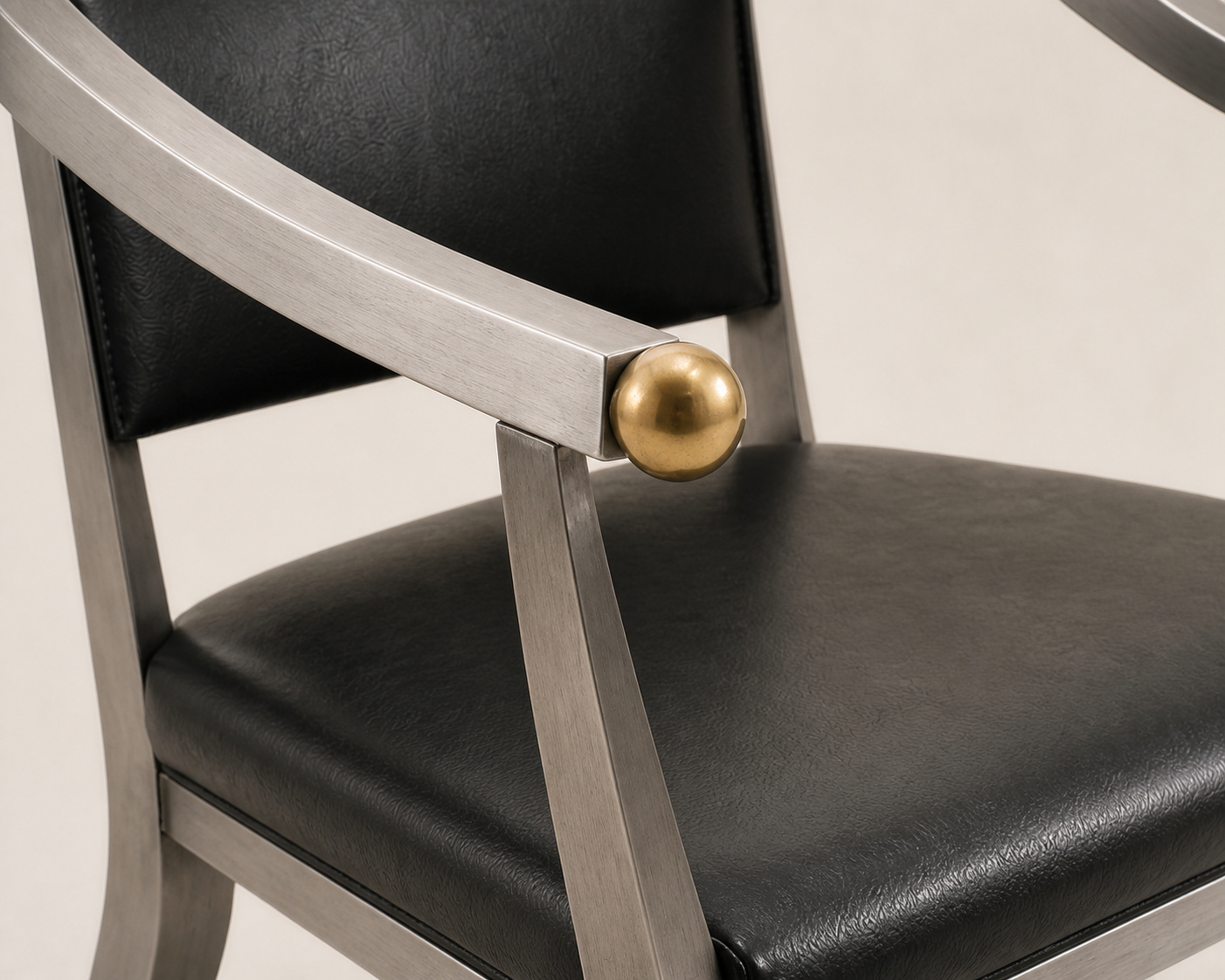
The small warm-metal details do not cover the frame. They interrupt it. The Marcilhac description notes brass spheres; Osenat records brass knobs and foot caps. Against steel and dark upholstery, each one works like punctuation at a terminal: the end of an arm, the end of a leg, the point where a long line should visibly stop.2 3
That restraint is crucial to the chair's ceremonial effect. A fully gilded frame would turn surface richness into the subject. Pompei instead concentrates warmth at a few joints and endpoints. Steel remains the structure; leather remains the place for the body; brass signals emphasis.
This is furniture jewellery with a structural rhythm. The details make a cool industrial material feel composed rather than merely fabricated, yet their small scale prevents the chair from becoming costume.
One name, several surviving versions
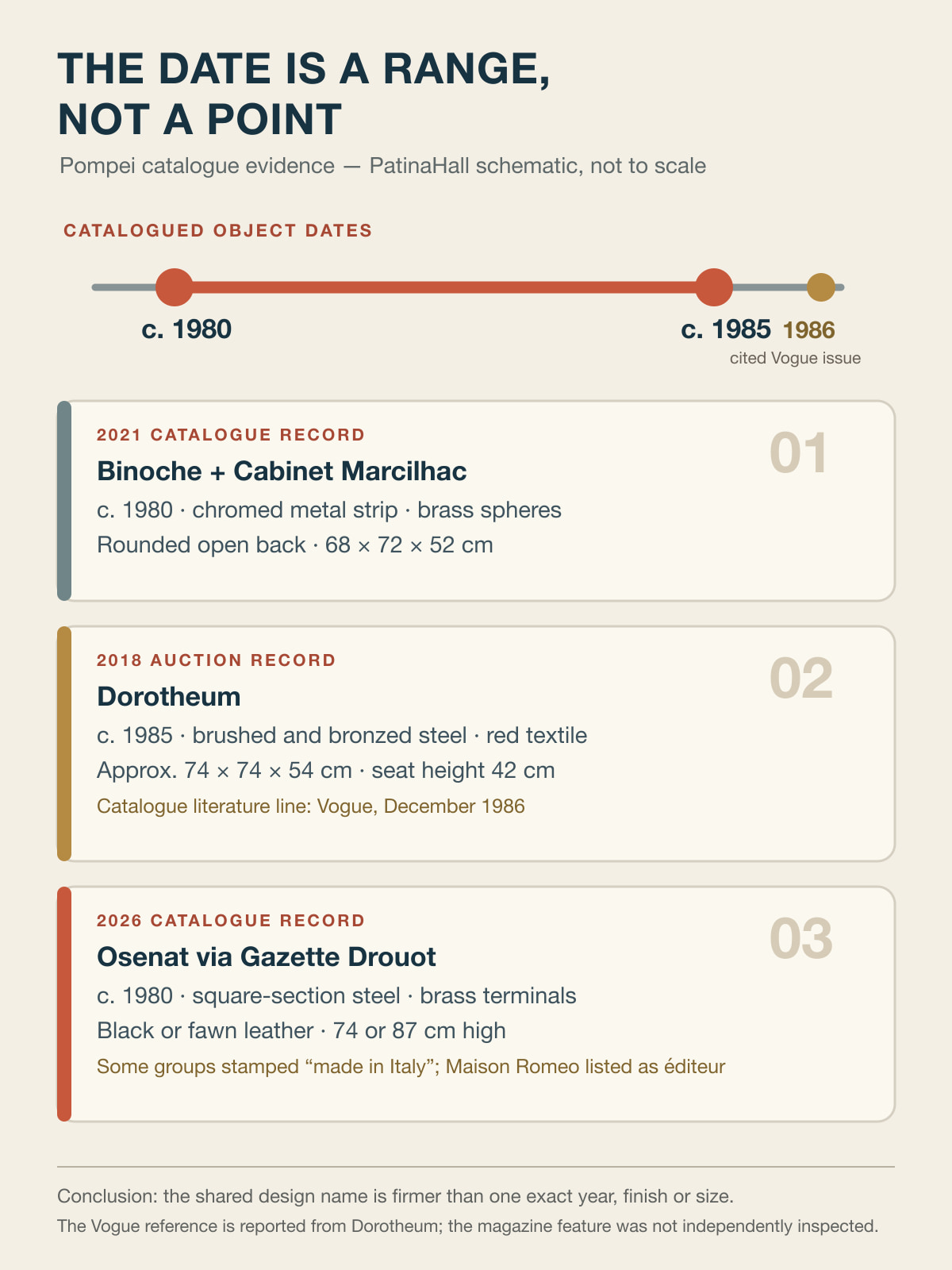
The name Pompei is more consistent than the specifications attached to it. The 2021 Marcilhac catalogue dates one chair to circa 1980 and gives dimensions of 68 by 72 by 52 centimetres. Dorotheum dates its red-textile set to circa 1985, at approximately 74 by 74 by 54 centimetres with a 42-centimetre seat height. Osenat dates three groups to circa 1980, but records both 74- and 87-centimetre heights, black or fawn leather, and made in Italy stamps on two of the groups. 2 1 3
Those differences should not be forced into a single ideal measurement. They may reflect variants, upholstery changes, cataloguing practice, measurement methods or physical histories that the available records do not resolve. What survives clearly is a family resemblance: enclosing metal rail, separate seat and back planes, poised four-legged structure, and warm-metal terminals.
The publisher history needs equal discipline. Osenat's catalogue lists Maison Romeo as éditeur; the other reviewed records do not supply the same line. It is useful attribution evidence, but not enough to silently translate publisher into a verified manufacturer or to invent a production chronology.
Famous in a smaller circle
Is the Pompei Armchair famous? Not in the broad, museum-canon sense established by designs that have extensive archives, retrospective exhibitions and a widely documented production history. The accessible record here is much thinner. It is built largely from later specialist catalogues.
Yet the chair is not anonymous. Three auction records across several years use the Pompei name and identify Alberto Orlandi, while their material descriptions keep returning to the same structural idea. That makes it a recognisable design within a narrower circle of dealers, auction specialists and collectors. Its interest does not depend on pretending that circle is larger than it is.
Dorotheum adds one tantalising lead: its literature line cites Vogue, December 1986.1 Because the magazine feature itself was not independently inspected for this article, the citation remains a lead reported by the auction house, not direct evidence of a specific page or statement.
The honest conclusion is therefore more useful than an inflated one. Later catalogues place Pompei examples around 1980–85 and show that the design was named consistently enough to travel through the specialist market. What makes the chair worth remembering is visible even within that limited record: modern materials arranged so that sitting acquires posture, outline and ceremony.