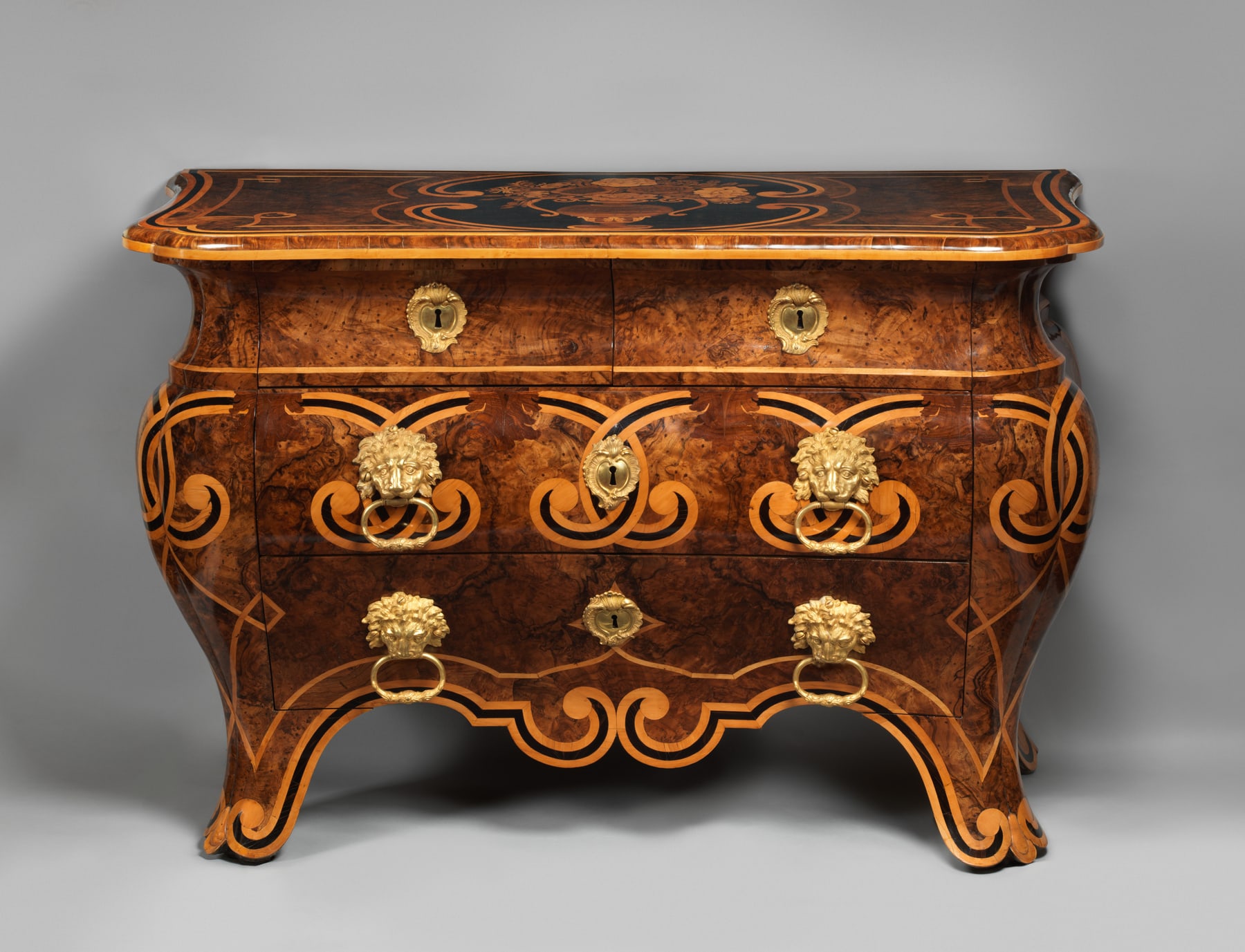
The fastenings stay in the picture
Start between the bronze handles. Small dark marks interrupt the lighter, cloudlike grain of the wood. They are easy to overlook because the surface is already so lively. The Met identifies them as wooden nails securing the briar veneer, and credits Piffetti with the technique. This is an unusually direct encounter with the work beneath a polished exterior.1
A veneer is a surface made from thin wood rather than the full thickness of the case. On a flat panel, its job is comparatively straightforward. Here the eye meets swelling drawers, receding corners and rounded ends. The small fastenings make sense when you follow those changes of direction.
A curve has more than one view
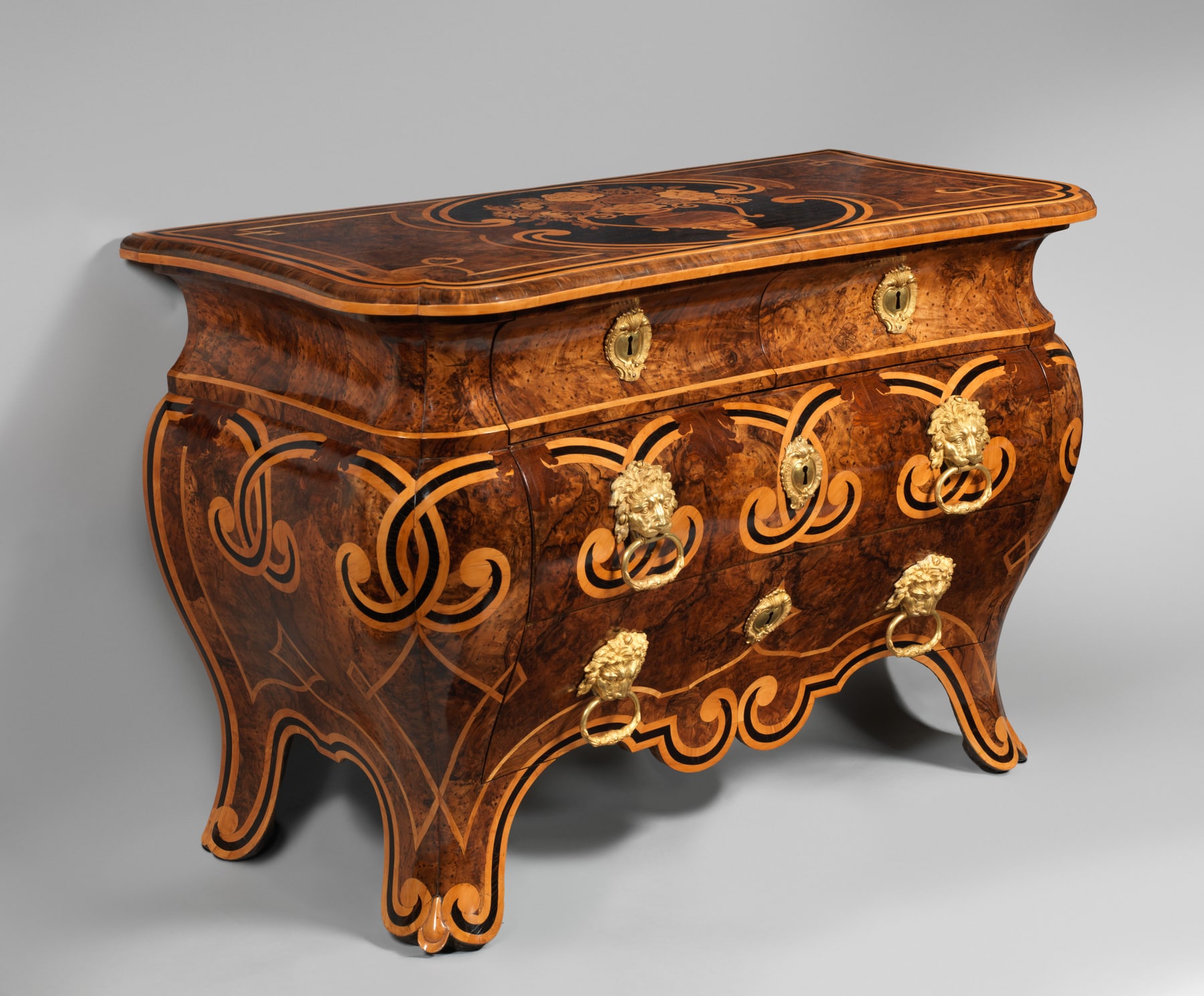
The front photograph gives the commode an almost symmetrical silhouette. The angled view changes the story: the side is a substantial rounded volume, not a narrow return hidden behind a grand façade. Follow the upper edge around the corner, then look down towards the feet. The curve continues through the body.
That continuity is the pleasure of this design. Grain, bronze and outline have different rhythms. The wood moves in broad patches; the metal concentrates attention around the handles and feet; the tiny nails create a much finer scale. None needs to imitate the others.
Pattern can be assembled in different ways
A useful comparison is Bernard II van Risenburgh’s Paris writing table of about 1755. Its floral wood marquetry makes a recognisable picture across the surface. Piffetti’s commode asks for a different kind of looking: the grain is expressive without becoming a bouquet, and its visible fastenings belong to the way that surface is held.2
These are two richly decorated pieces made within a few years of one another. Their visual effects do not imply an identical workshop method. Looking for how a pattern is constructed is more revealing than treating every elaborate wooden surface as the same kind of decoration.
Furniture for the maker’s own rooms
The commode was one of a pair intended for Piffetti’s apartment at Turin’s carpentry academy. That destination brings an imposing object into a specific domestic setting, although it does not tell us why he chose every detail.1
Return to the dots after taking in the whole chest. They remain visible among all the expensive-looking flourishes. The object rewards attention to a small joint between beauty and manufacture: a practical fastening can become something the finished surface invites you to see.