A cabinet before it is a house
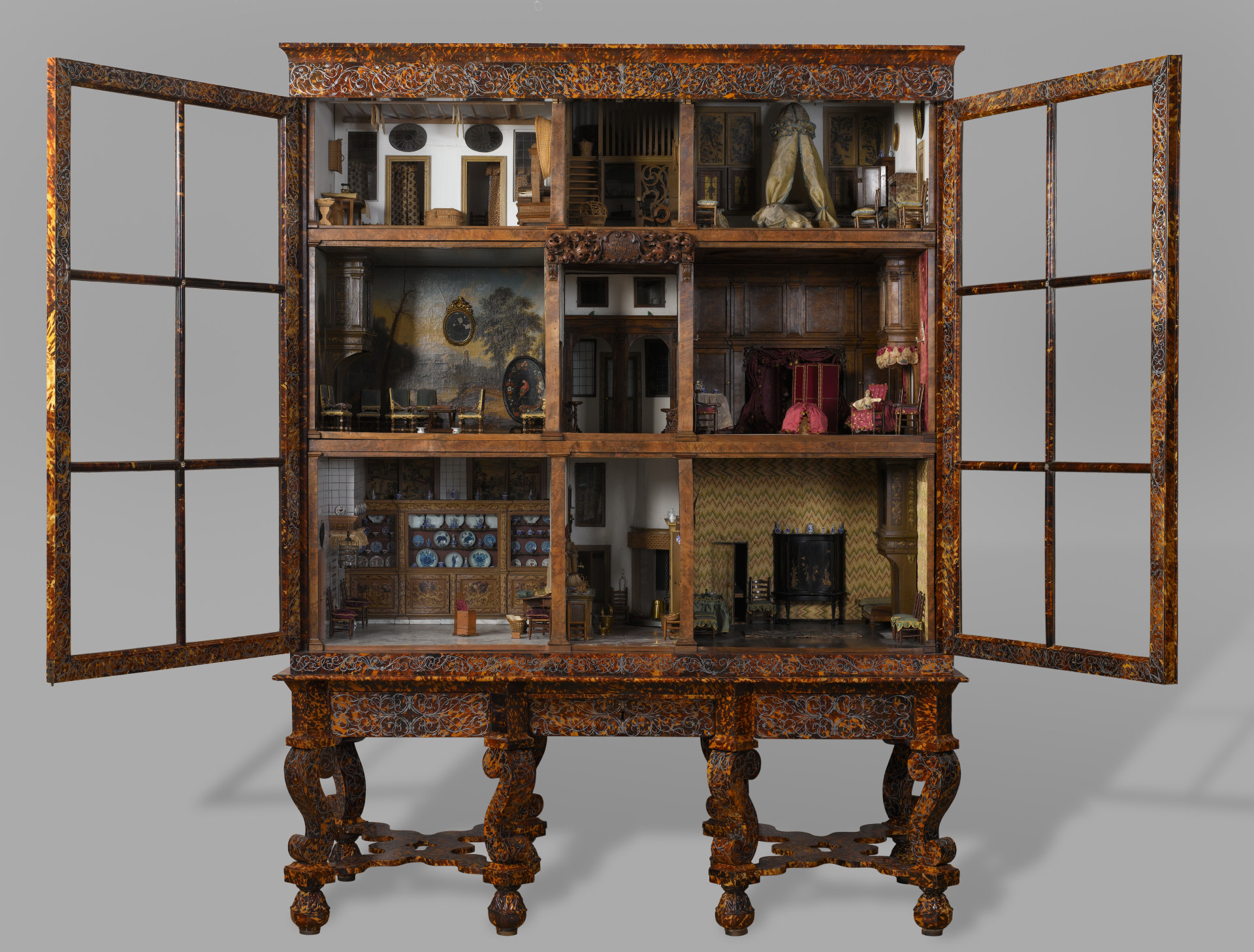
The quickest way to misread Petronella Oortman's dolls' house is to begin with the word “dolls”. Begin with the measurements instead. Rijksmuseum object BK-NM-1010 is 255 centimetres high, 190 wide and 78 deep. Its outer structure is an oak cabinet veneered with tortoiseshell and pewter, raised on paired carved supports and fitted with drawers below the rooms. 1
Two large glazed doors swing out to either side. When they are closed, the cabinet protects and partly withholds its contents. Open them and the frames become wings around three tiers of rooms. The change is architectural, but the object performing it is unmistakably furniture.
Thin pewter foliage runs across the warm, mottled veneer. The initials B O appear on the cabinet's sides, linking the elaborate container to Oortman and her husband Johannes Brandt. Nothing here has been reduced to child scale except the world inside.
Correct scale makes the rooms convincing
The Rijksmuseum stresses two linked facts: the contents use authentic materials and their proportions are correct. Wood is wood, silver is silver, glass is glass and textile remains textile. Marble, copper, silk, velvet, paper and porcelain do not merely appear as colours on a flat backdrop. 1
That material precision required a network of specialised makers. The museum lists woodcarvers, basket weavers, silversmiths and glassblowers among the trades commissioned for the miniatures. It also records working novelties, including running water, a fountain and 83 leather-bound books. The astonishing part is not that everything is small. It is that smallness did not excuse a substitute.2
The cost followed the same logic. The Rijksmuseum estimates that the house and its contents were valued at 20,000 to 30,000 florins, roughly the price of a real Amsterdam canal house at the time. That comparison does not make the miniature a second building. It shows the scale of collecting concentrated inside one cabinet.
The house separates display from work
The rooms do more than assemble attractive things. They assign activities to places. The Rijksmuseum identifies two kitchens: a show kitchen used for dining and displaying porcelain, and a working kitchen for tending the fire, fetching water, cooking and washing. Similar objects can therefore carry different meanings depending on which room contains them. 2
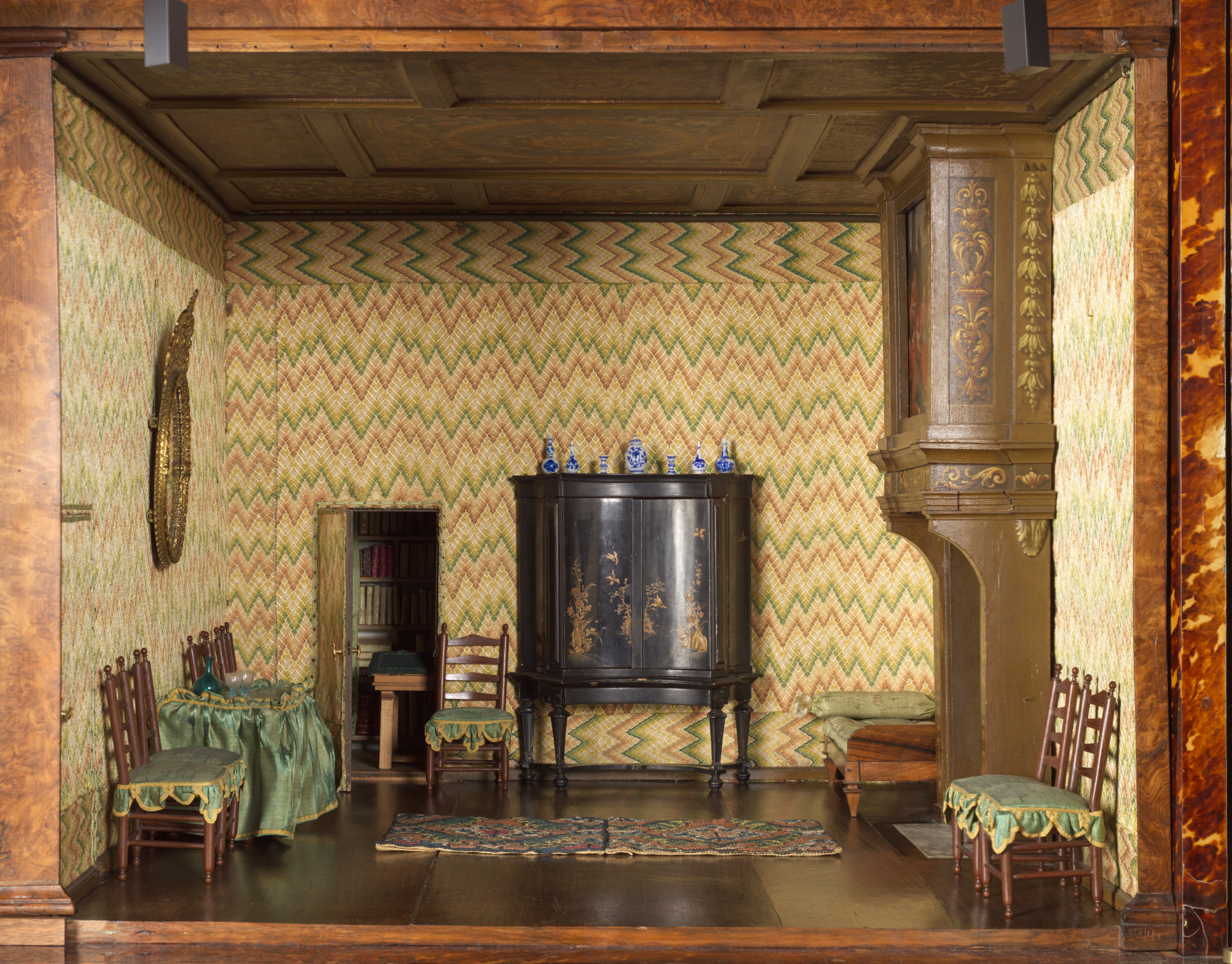
The lower-right room makes that coordination visible. Woven wall covering wraps around a fitted fireplace. A dark cabinet presents pale blue-and-white vessels; small chairs form a loose social arrangement; a rug marks the centre of the floor. Through a narrow doorway, shelves of books extend the room beyond its immediate boundary.
These details create a hierarchy of looking and labour. Some rooms receive guests and display prized things. Others support the work required to maintain them. The house turns that separation into an ordered view that can be taken in at once.
The lying-in room turns care into ceremony
The lying-in room gives domestic order a social audience. The Rijksmuseum explains that after giving birth a mother could remain in bed for as long as six weeks while friends and family visited. The room therefore had to support recovery, childcare and formal presentation at the same time. 2
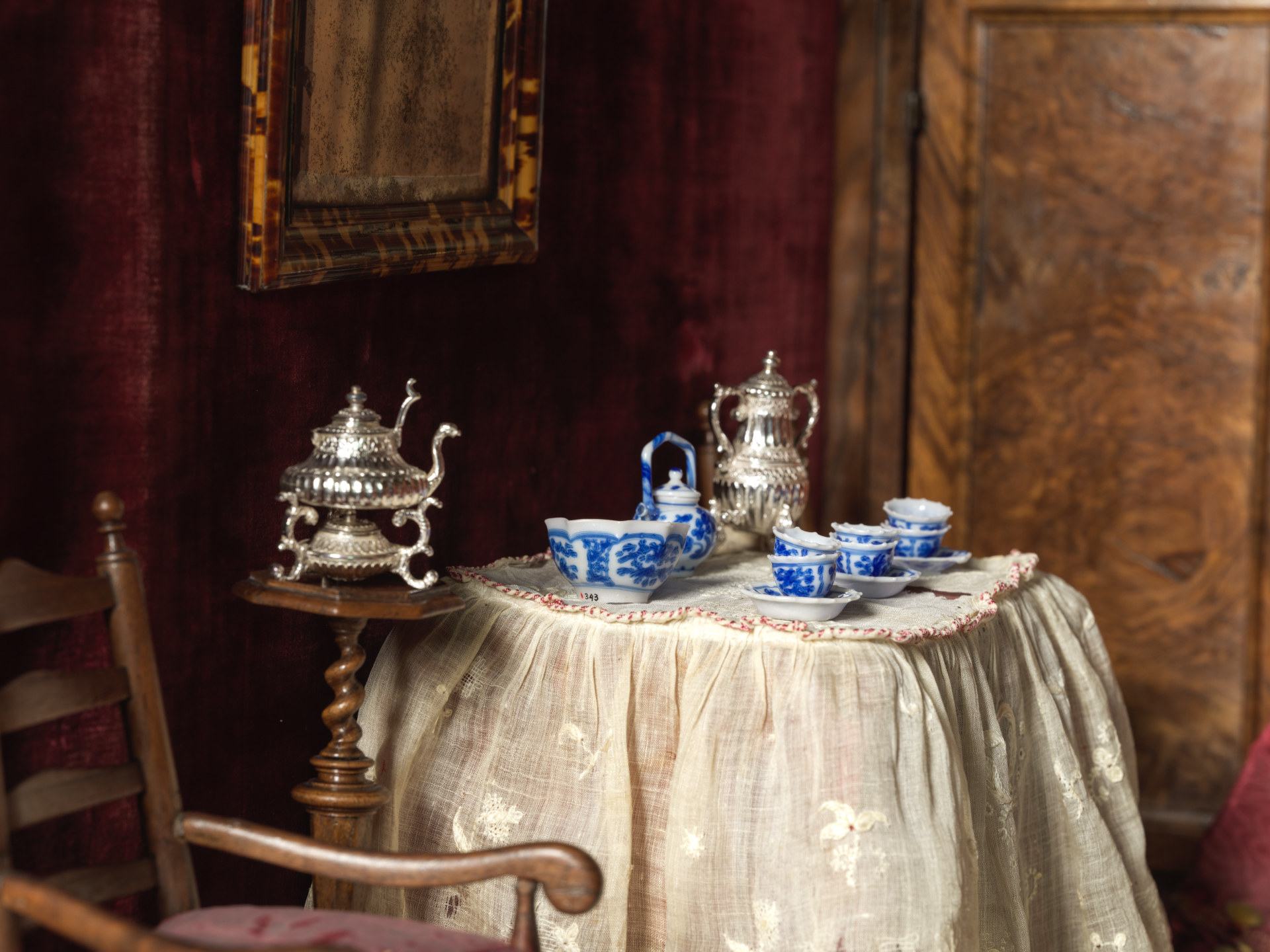
A close view of its table makes the point without a figure. Blue-and-white vessels sit beside miniature silver pots on embroidered linen. A wooden chair enters the foreground, while deep red textile and polished wood enclose the setting. Each material responds differently to light, so the scene feels prepared rather than merely represented.
The museum says one infant doll survives, swaddled in a silk christening gown; the other original dolls are absent. That loss limits any attempt to restage exact social positions. The furniture and table service still preserve the room's expectation of visitors.
Curtains controlled the reveal
Around 1710, Jacob Appel painted the dolls' house. The Rijksmuseum says the cabinet was expensive and unusual enough to merit its own portrait. More importantly, the painting records something the open museum display no longer does: yellow curtains once protected the front, and when closed they made the cabinet resemble a bedstead.4
The house therefore had more than open and shut doors. Curtains introduced another threshold. A viewer could meet an upholstered domestic form, then the glazed cabinet, then the miniature rooms. Revelation happened in stages.
That sequence changes how the object works as a collection. Permanently open shelves offer continuous inspection. Oortman's cabinet could withhold its contents and then present them deliberately. Looking became an event controlled by the person who opened it.
An ideal house is not a neutral house
The Rijksmuseum describes Oortman's dolls' house as both an art cabinet and an idealised domestic world. Amsterdam supplied the luxury materials, curiosities and professional expertise needed to assemble it, while Oortman's wealth made the commission possible.3
Idealisation is not innocence. The museum's record for Appel's painting notes that the household image included a Black servant. Because almost all the original dolls are gone, the present cabinet can look like a social order made only from rooms and beautiful objects. The painted record prevents that comfortable simplification.4
Nor is BK-NM-1010 a statistical model of how most people lived. Its exceptional cost, commissioned miniatures and display programme describe the aspirations of one wealthy collector. The two kitchens, lying-in room and service spaces can illuminate seventeenth-century household ideals, but they do not turn one cabinet into every Amsterdam home.
That evidence boundary brings us back to the physical object. Petronella Oortman's dolls' house matters because a full-size cabinet makes an ordered world available on demand. Its doors and lost curtains manage the reveal; its exact materials reward close looking; its rooms turn domestic hierarchy into a collection. A toy invites play inside an imagined house. This cabinet asks an adult audience to inspect the house itself.