The whole picture does not appear at once
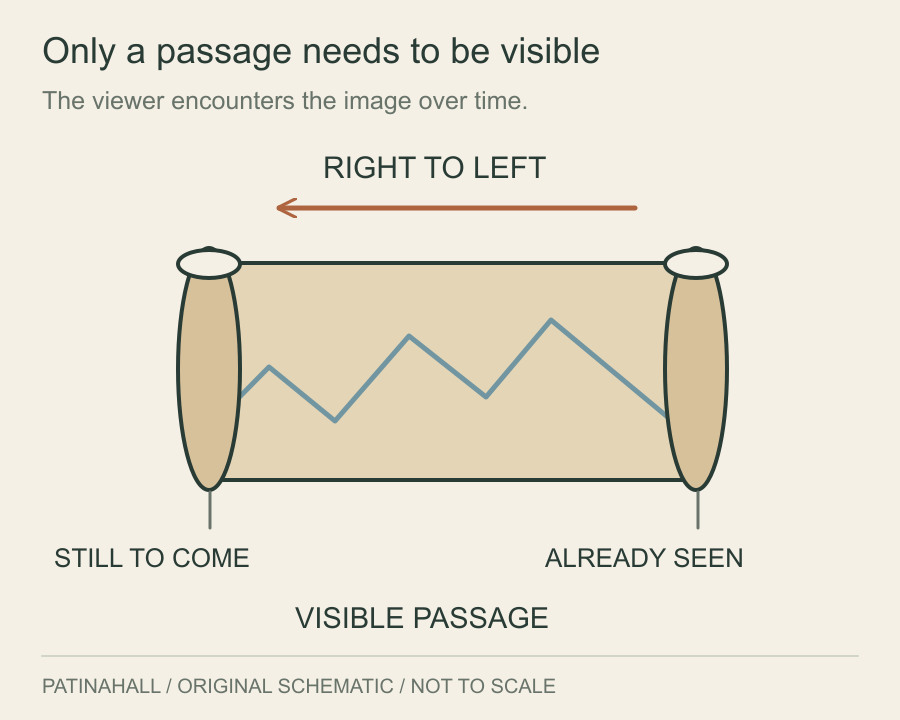
A framed painting generally presents its full rectangle at the same time. A handscroll offers a different encounter. The viewer opens a manageable section from right to left, then continues as the earlier passage is rolled away.
Dawn Delbanco’s Met essay describes this close viewing at a table, often with only one or two people able to see comfortably. The image is encountered through successive portions, and the viewer participates in deciding how quickly it advances.2
The difference changes the furniture’s role. A table is not merely somewhere to put an artwork temporarily. It supplies the horizontal space in which the picture’s sequence becomes visible.
A wide top keeps the action clear
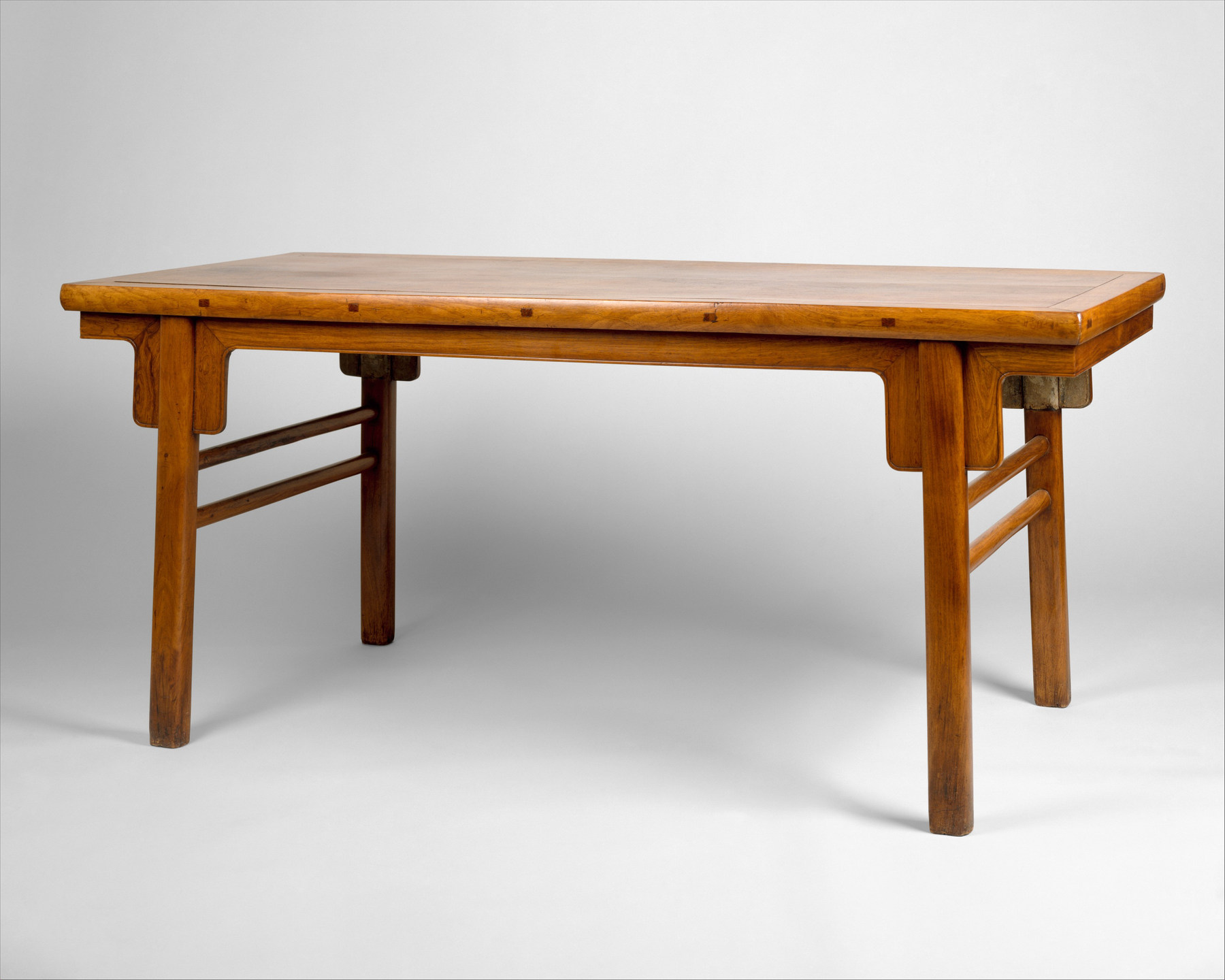
The Met dates this huanghuali table to the late sixteenth or early seventeenth century. Its top is approximately 186 centimetres wide and 76 centimetres deep, with an overall height of 80 centimetres. The museum records the wood as Dalbergia odorifera.1
The breadth is striking against the relative economy of the supports. There is room for an activity to spread sideways, while the upper surface remains visually uninterrupted by drawers, upright compartments or a raised back.
Seen empty, that openness can appear uneventful. Imagine a narrow band of painting moving across it and the clear top becomes purposeful. The furniture leaves the changing object above it room to command attention.
Looking could be a social occasion
The Met’s Elegant Gathering in the Apricot Garden, after Xie Huan, offers a separate view into the social setting of cultured activity. Dated around 1437, the handscroll represents a gathering of officials and includes an extensive written history around the image.3
It is not a record of this particular table. It does help place furniture within an encounter involving people, pictures and writing rather than within an empty display.
The written additions also broaden what it means to look. A scroll can ask a viewer to move between image and text, and between the original scene and later responses to it. Its contents need time as well as space.
The tabletop holds a changing present
During a handscroll encounter, most of the work may remain concealed. The part currently visible becomes the centre of attention, bounded by the portions waiting to open and those already seen.
That makes the apparently plain table an accommodating partner. It does not dictate one permanent arrangement. It supports a sequence of temporary ones.
Look once more at the empty surface. Its interest lies partly in what it allows to happen: hands moving, a picture advancing and a viewer choosing to pause. The next part of the story is still rolled up.