Begin with the recline
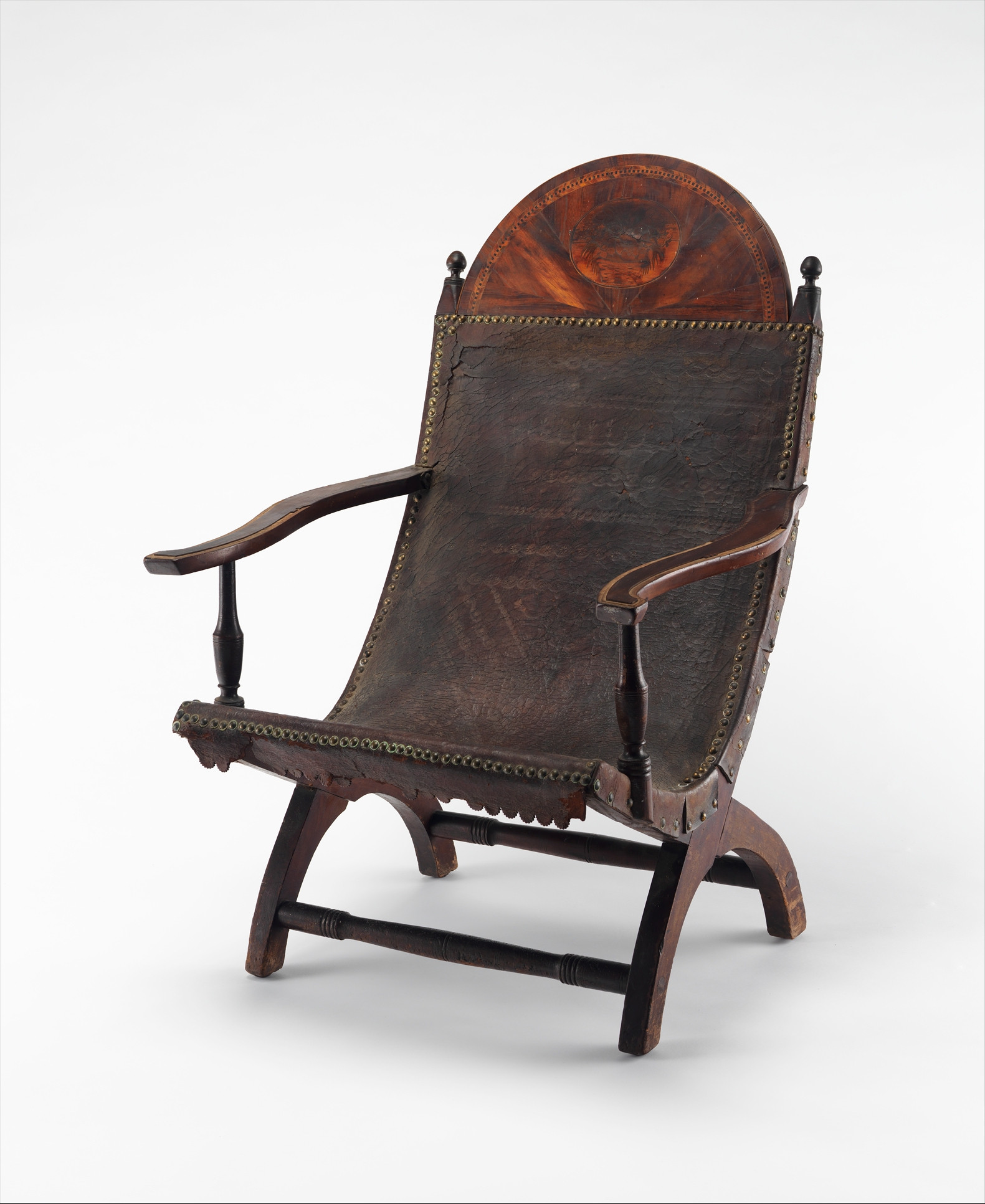
The chair leans back before anyone touches it. A single dark leather surface runs from the low front rail to a tall back, sagging into a deep trough between the sides. Long arms give a sitter something to push against when leaving that low position. Above the leather, a broad half-round crest rises like a small sun, its mahogany veneers radiating around a basket of flowers.
The Metropolitan Museum of Art currently dates exact object 2000.451 to about 1800–1810 and records it as made in New Orleans. It is just under a metre high, made from mahogany and mahogany veneer, light and dark wood inlay, and leather. The museum calls it a Campeche chair.1
What can one reclining chair tell us about movement between Campeche, New Orleans and American homes? Quite a lot, provided we do not confuse movement with a folding joint. The structure stays fixed. The form, the labour, the name, the copies and even the museum attribution are what travel.
An X that refuses to fold
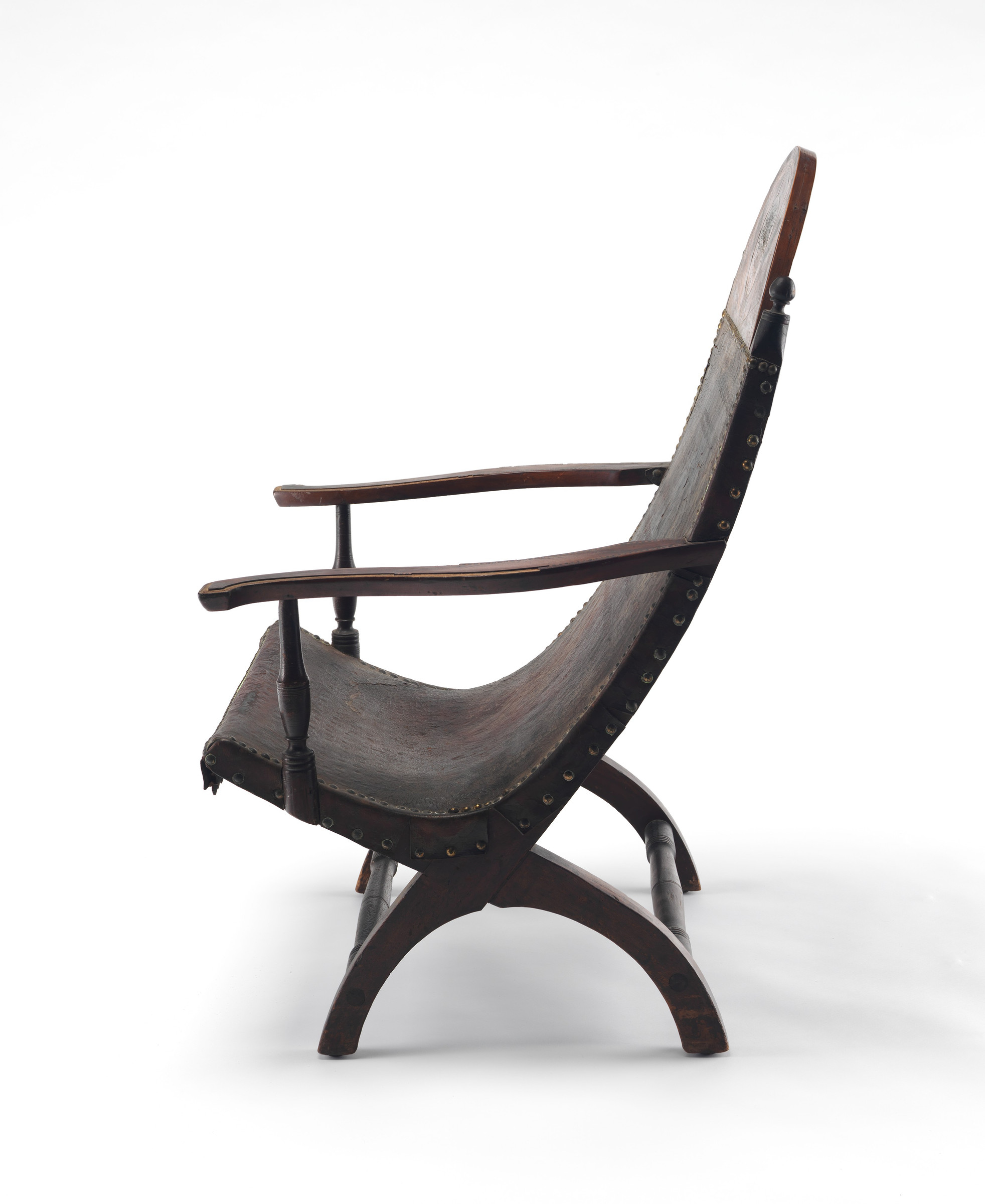
Seen from the side, the temptation is immediate: two wooden members cross beneath the leather, so surely the chair must close. It does not. The Met's study defines the Campeche type by a lateral nonfolding curule base and a reclining surface of leather or cane. The X is a profile, not a hinge. 2
Later construction research makes the logic easy to follow. On a typical Campeche chair, each side combines a longer S-shaped member with a shorter one. One carries the front leg upward into the back; the other connects seat and rear leg. They cross beneath the trough, while front and rear stretchers tie the two sides together. Rails at the seat front and back complete a small, stiff frame around one large hide.3
The profile photograph of 2000.451 makes those relationships visible. The crossing members do not meet at an exposed pivot. Two substantial stretchers span the chair's width. The leather does not perch on top like a cushion; it draws the body into the curve that the wood has already established.
This distinction matters beyond terminology. Calling every X-frame folding turns a useful geometry into a family myth. Here the fixed crossing lowers the seat and supports a long recline. The chair offers the relaxed posture of a sling without asking a mechanism to move.
The port is part of the design
The name points toward the Mexican port city of Campeche on the Yucatán Peninsula. The 2003 Met study also records the Louisiana term boutaque and notes early nineteenth-century cargo manifests listing chairs shipped from Campeche to New Orleans. The route is documented for the form, even when it is not a personal travel diary for this object.2
New Orleans was not a passive destination. The Historic New Orleans Collection describes early Louisiana furniture as a regional practice shaped by French, Anglo-American, Caribbean and Canadian influences, together with local and imported woods, inlay traditions, makers and port trade. That is a better model than imagining a pure style crossing one border intact.4
The chair form became at home in that exchange. Its low leather body made sense in warm interiors and on shaded galleries; its crossed silhouette retained older curule associations while serving a very direct bodily need. The port brought objects, materials and ideas together. Workshops and users decided what happened next.
None of this proves that 2000.451 itself arrived as cargo from Campeche. The current museum record says it was made in New Orleans. The shipping evidence explains a channel through which the type became familiar, not the precise route of every survivor.
The flower basket complicates the address
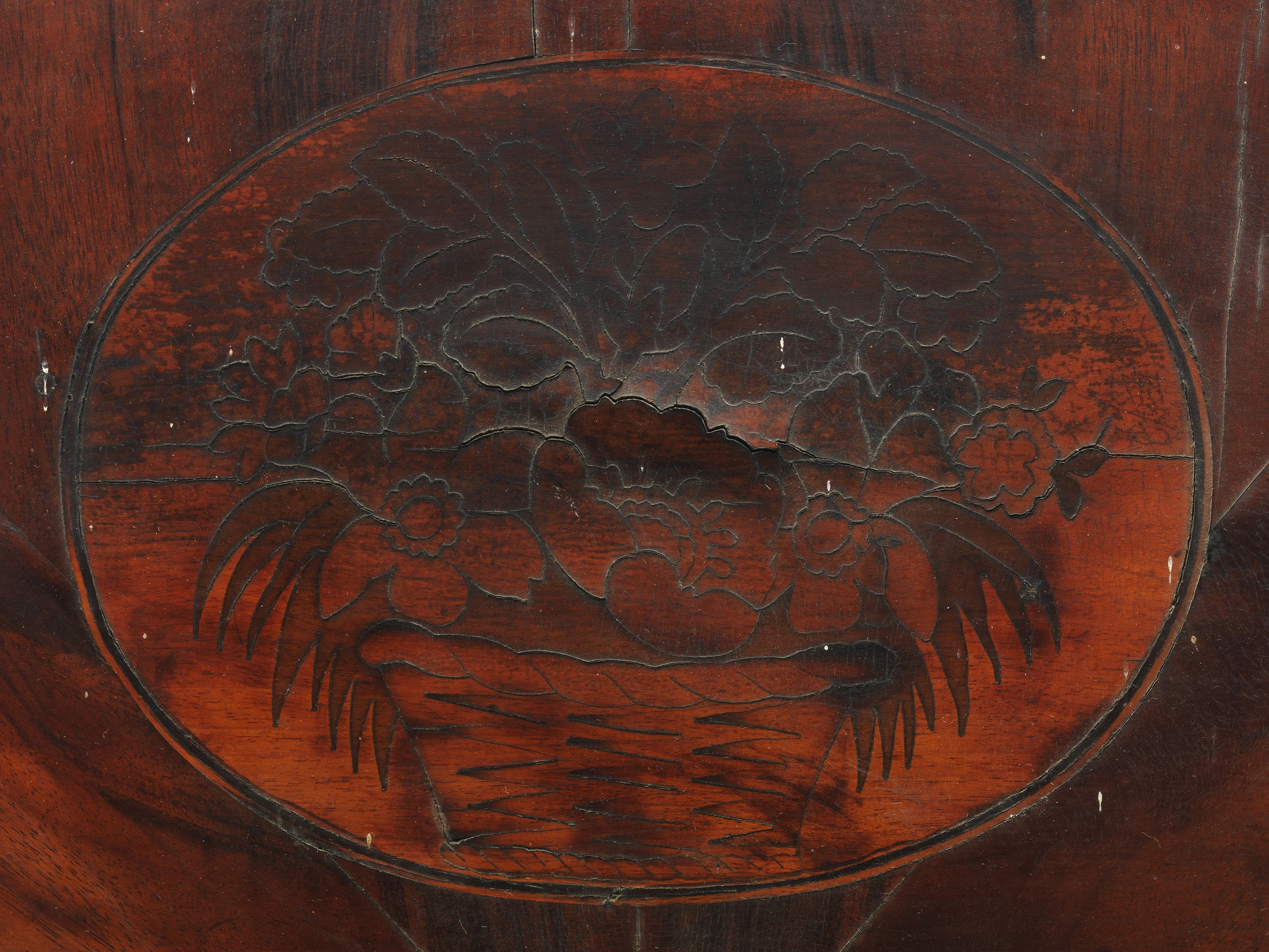
Move close to the crest and the structural chair gives way to cabinetmaking display. Wedge-shaped veneers spread across the demilune. A light-and-dark parquetry band follows its arc. In the centre, a marquetry basket holds an Oriental poppy, daffodils, a rosebud and palm foliage, as identified in the Met's detailed study.2
The current online record places this chair within a small group with related marquetry and parquetry crests and says they were probably made by one still unknown New Orleans chairmaker. That wording keeps the maker tentative while making the present geographic attribution clear.1
The same museum described the same accession differently in 2003. Figure 5 of the Metropolitan Museum Journal article labels it probably Mexican and about 1820, then argues that the flower-basket group appears Mexican. The current record instead says New Orleans and about 1800–1810. 2
Selecting whichever address makes the tidiest story would erase the most interesting evidence. The construction and inlay invited comparison in 2003; later cataloguing now lands elsewhere. The chair has travelled farther than its catalogue address could keep up. For this page, the current record leads, and the older institutional attribution stays visible rather than being smuggled out with the footnotes.
From famous copies to an ordinary porch
Campeche chairs later moved east through gifts, orders and copying. Research published by the Chipstone Foundation documents examples ordered in New Orleans for Thomas Jefferson and Elizabeth Trist in 1818. It also places the form inside the work of John Hemings, the enslaved joiner at Monticello who made adapted versions. That history joins comfort and invention to plantation slavery; it cannot be reduced to a famous owner's taste. 3
Object 2000.451 is not one of those chairs. No reviewed source connects it to Jefferson, Hemings or Monticello. Their story matters because it shows how a form arriving through New Orleans could become a prototype elsewhere, then change in the hands of another maker.
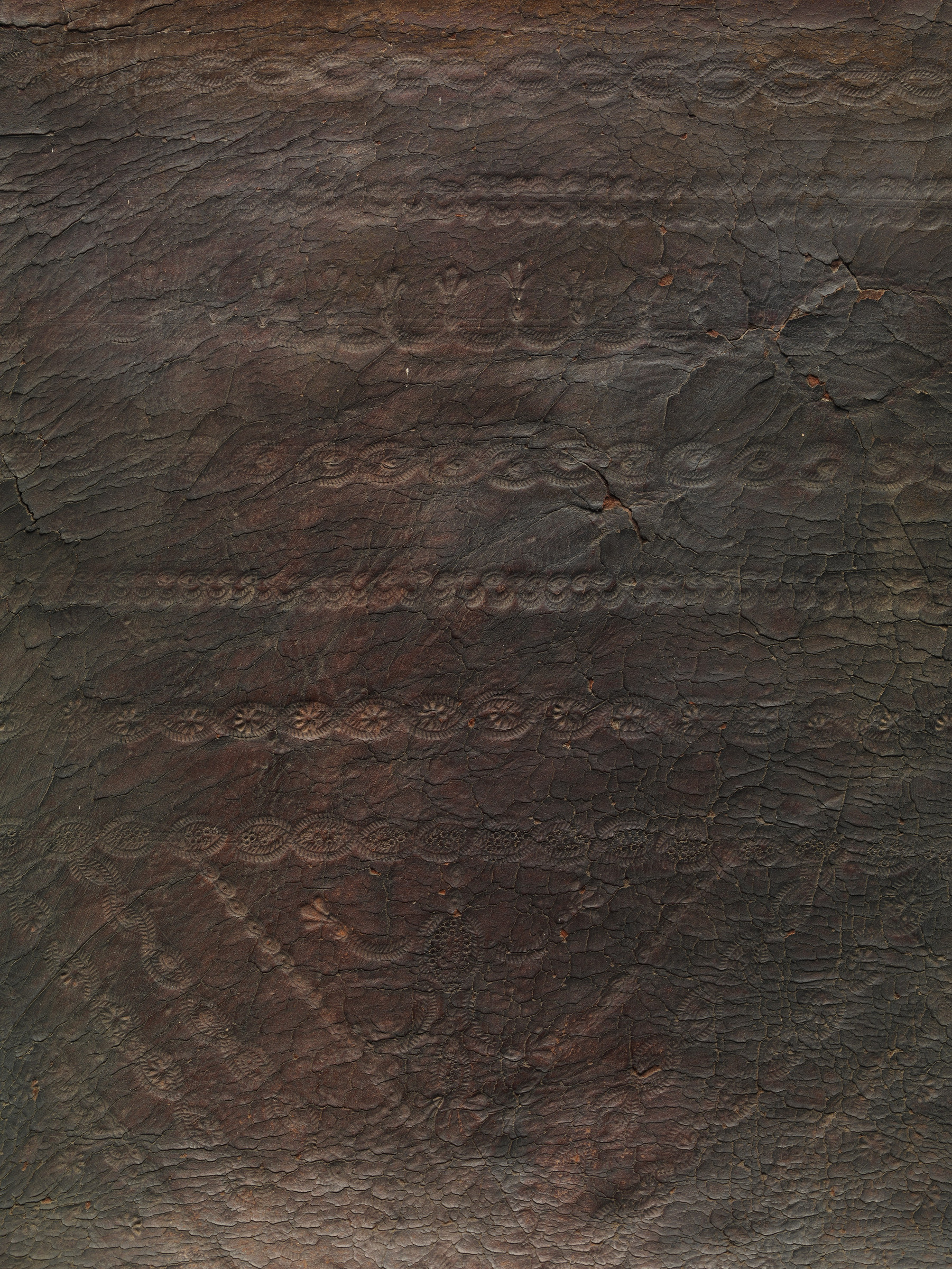
The exact Met chair has a less celebrated and more physical later biography. The museum says Emily and Robert de Forest, descendants of its original owner, used it for years both indoors and on the porch at their Cold Spring Harbor home. Its aged appearance is attributed to that long use. 1
The leather detail refuses a polished ending. Cracks cross the embossed field; the surface rises and falls around the pattern; rows of brass tacks hold its edge. A photograph cannot separate every original fibre from every repair, but it can show that this was furniture with a domestic afterlife, not a design idea preserved behind glass from birth.
One chair, several kinds of motion
Return to the profile. The fixed X does not move, and that is precisely what makes the rest of the story clearer. The long and short members hold a deep recline. The port history carries the type between regions. Workshops repeat and alter it. A flower-basket crest links the exact chair to a group whose address remains debated. Generations of use leave their own marks on the hide.
The current Met identity—New Orleans, about 1800–1810—should not be weakened merely because an older attribution exists. Nor should it be presented as if the evidence had never changed. Museum knowledge is also a made object: joined from comparison, documents and revision, with seams that deserve to remain visible.
That is why this chair rewards a second look. What first appears to be a folding mechanism is fixed. What appears fixed—a name, a place, a style—has been moving for two centuries. The Campeche chair carries its journeys in the parts that never close.