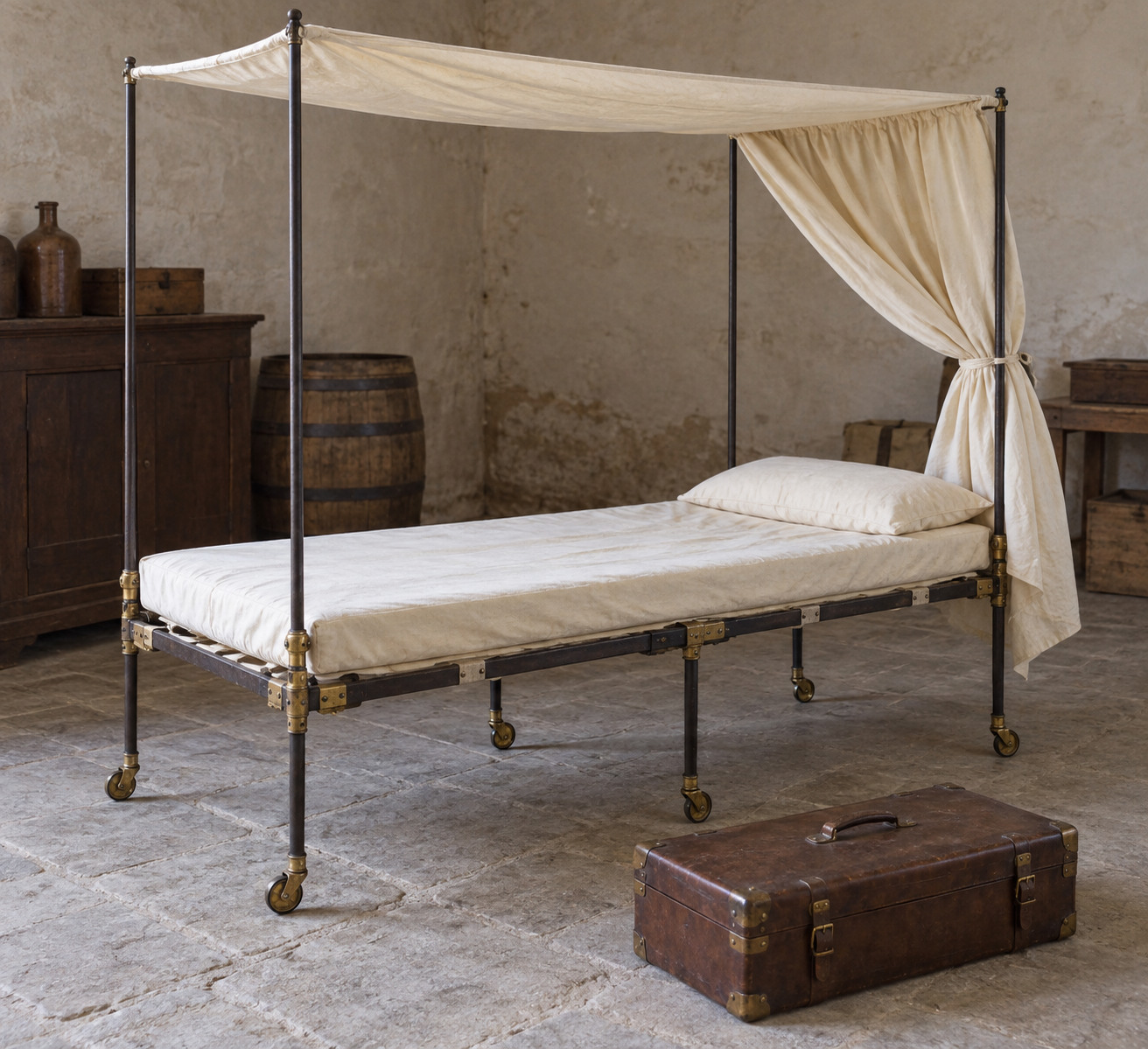
A bed with a second shape
An ordinary bed can spend its life occupying roughly the same volume. A camp bed has to surrender that volume regularly. Its long rails must break down or fold; projecting parts must become manageable; the bedding must leave the frame.
Musée de l’Armée teaching material dates Marie-Jean Desouches’s folding-bed patent to 1804. The system used a metal structure with hinged parts, small castors and fittings for the canopy. Fabric and mattresses completed the sleeping arrangement.2
The significant invention is not simply a hinge in a rail. It is the coordination of components that have to become a bed again after travelling separately or in a more compact form. A hinge saves space only if everything attached to it can move with it or be removed.
The frame was only half the luggage
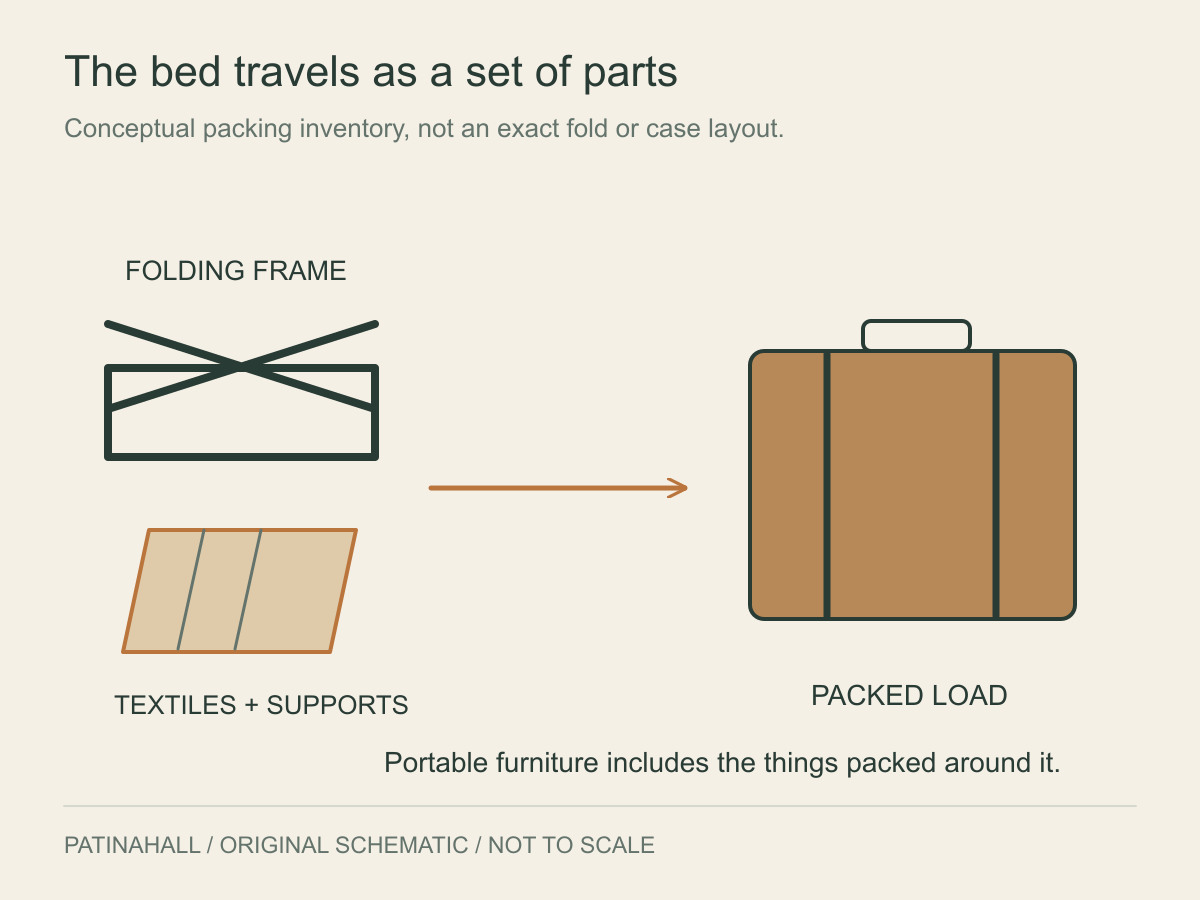
The museum’s visitor material describes leather cases and transport by mule. It also records the soft equipment, including bedding, that made the metal structure usable. The familiar image of a light frame can otherwise disguise how much accompanied it.3
That distinction helps explain a form of portability very different from carrying a modern folding chair. The owner’s comfort was supported by a system of packing, transport and reassembly. The furniture could move because people and animals did the moving.
The canopy belongs in that practical reading. It created an enclosure around a sleeping place assembled within another, temporary setting. Its poles and cloth increased the number of components, but they also helped the travelling arrangement feel like a room.
A packed case and an erected bed are therefore two views of the same undertaking. One emphasises logistics; the other presents the result to the person who will sleep in it.
Two beds at Saint Helena
Napoleon took two Desouches camp beds to Saint Helena. The Fondation Napoléon distinguishes the one now at the Musée de l’Armée, known as the lit Murat, from the example at Malmaison. Its account identifies the Army Museum bed as the one used at Longwood when he died on 5 May 1821, and records its gift to the museum in 1973.1
Keeping those objects separate matters. A repeated design can be associated with more than one episode in a person’s life. Similar-looking furniture and a famous owner make it particularly easy for the history of one specimen to migrate to another.
Comfort that could be reconstructed
A camp bed is often imagined as an emblem of austerity. The canopy, mattress and travelling cases suggest a more complicated ambition: familiar comfort recreated under changing circumstances.
Seen that way, the hinges are a small part of a larger arrangement. They allow the furniture to change shape; the people around it make the change useful. The bed could travel because a temporary room could be taken apart, carried and made again.