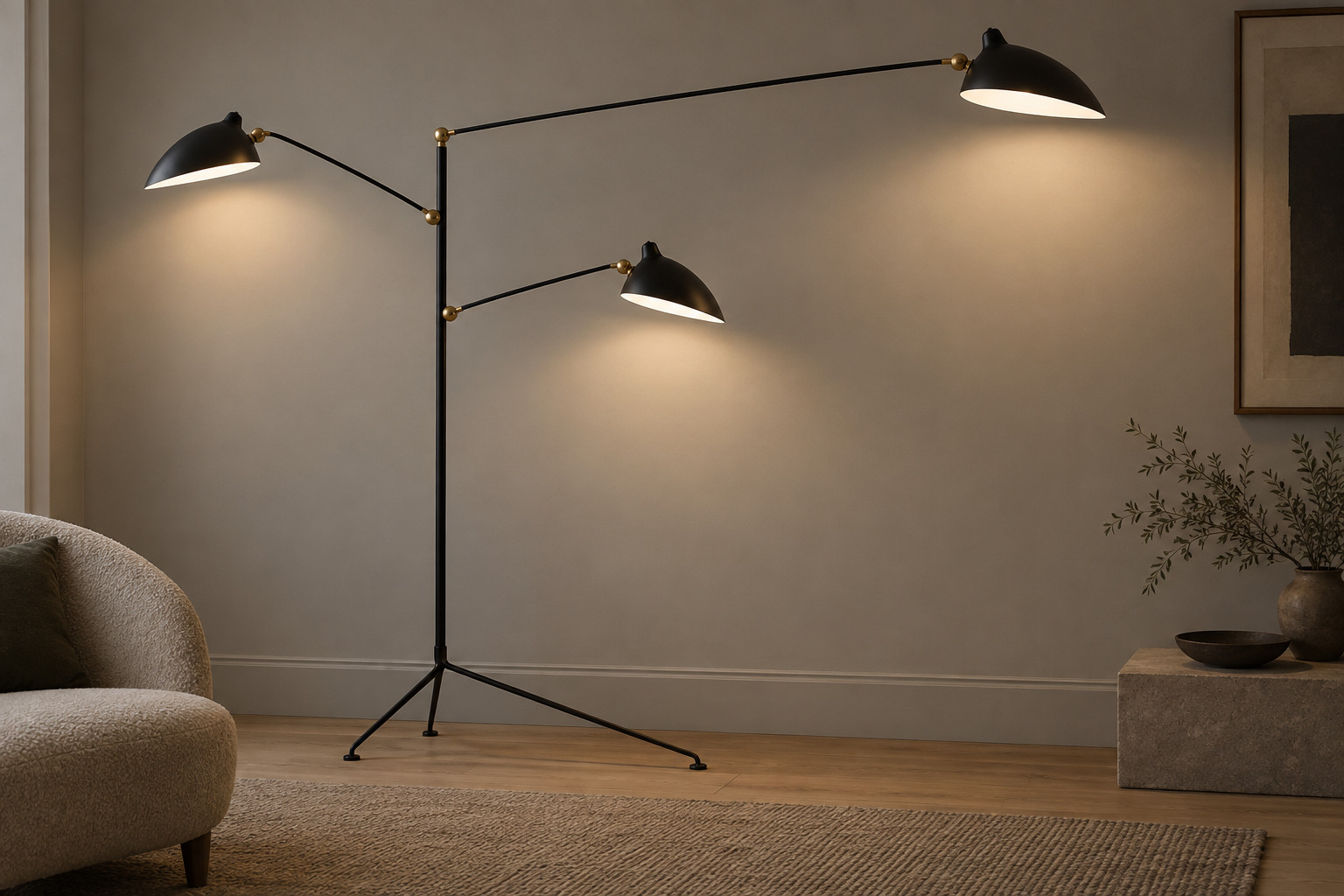
Black outside, white inside
The outside of the lamp is easy to follow against a pale wall. Thin arms travel outward from an upright stem, then end in broad, curved shades. Their different lengths prevent the three lights from collapsing into a single heavy cluster.
The manufacturer’s L3B sheet identifies a steel body, brass swivel joints and aluminium reflectors, with the inside of each shade painted white. These are separate materials with separate roles, even though a distant view can make the lamp seem uniformly black.1
Turn your attention to the rim of a shade. It marks the boundary between the visible outer shell and the surface surrounding the bulb. The lamp is designed to be read from more than one direction: an opaque shape from outside, a pale interior when viewed from below.
A small joint changes the direction
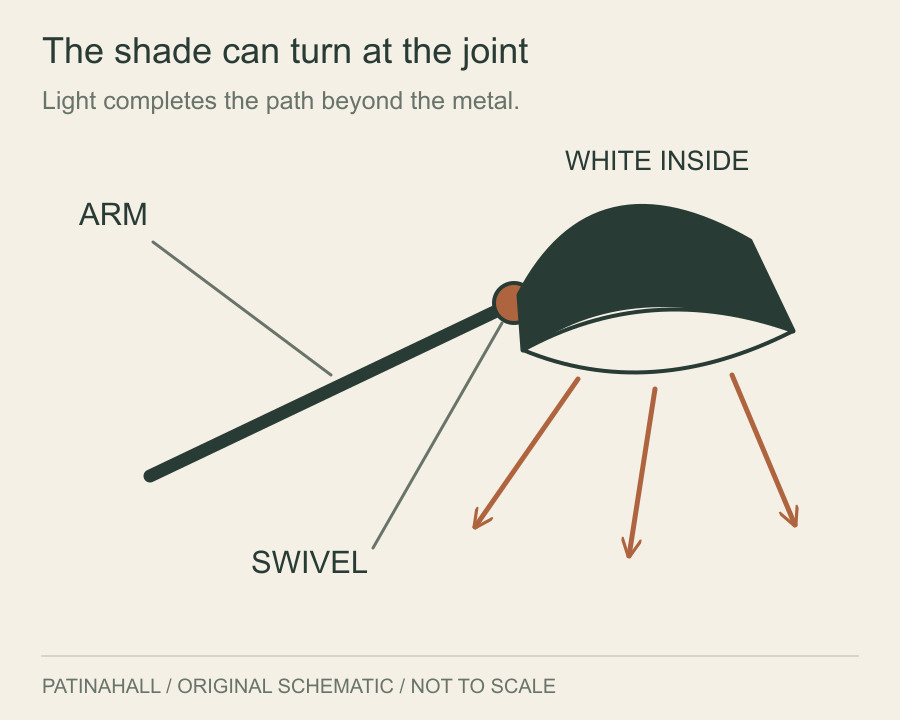
The joint is where the fixed outline gives way to adjustment. A shade does not have to continue the direction of its supporting arm; it can turn relative to it. That small interruption is responsible for much of the lamp’s expressive appearance.
Read the assembly backwards from the shade. First comes the shell, then the compact swivel, then the long arm that carries it. The change from a broad form to a tiny connector and back to a long line makes the connection easy to find.
An adjustable object can suggest many gestures without acquiring more parts. Three shades held at different angles give the branching body a different expression from three shades aligned in the same way. The familiar outline includes the possibility of variation.
The date belongs to the design
The French Center of Design catalogue dates the three-arm floor lamp to 1952 while identifying the example it lists as a re-edition. Jousse Entreprise’s archive also places an early three-arm lamp in 1952. Together they provide a useful chronology without treating every surviving lamp as an object made that year.23
That distinction matters particularly for a design whose silhouette has remained recognisable. A date in a product name may describe the first design, while the lamp itself belongs to a much later production run.
The most useful question for this story is what persists across that interval. The branching body, articulated connections and shaped reflectors still organise the encounter between object, room and light.
Follow the space between the arms
The lamp occupies a surprisingly large volume without enclosing it. You can see the wall, another piece of furniture or the edge of a window between its arms. The empty intervals are part of the composition.
Instead of looking only at its outline, follow one route from a splayed foot to a shade, then the route from that shade towards the surface below. Mouille’s lamp becomes easier to understand when you let the light complete the drawing.