Design story

Milk Bottle Lamp: a crate’s rhythm in the air

The bottle is still easy to recognise. What changes is its position and its company: Tejo Remy suspends repeated milk-bottle forms as a light. In the grouped version, the familiar spacing of a crate becomes an arrangement in the air.

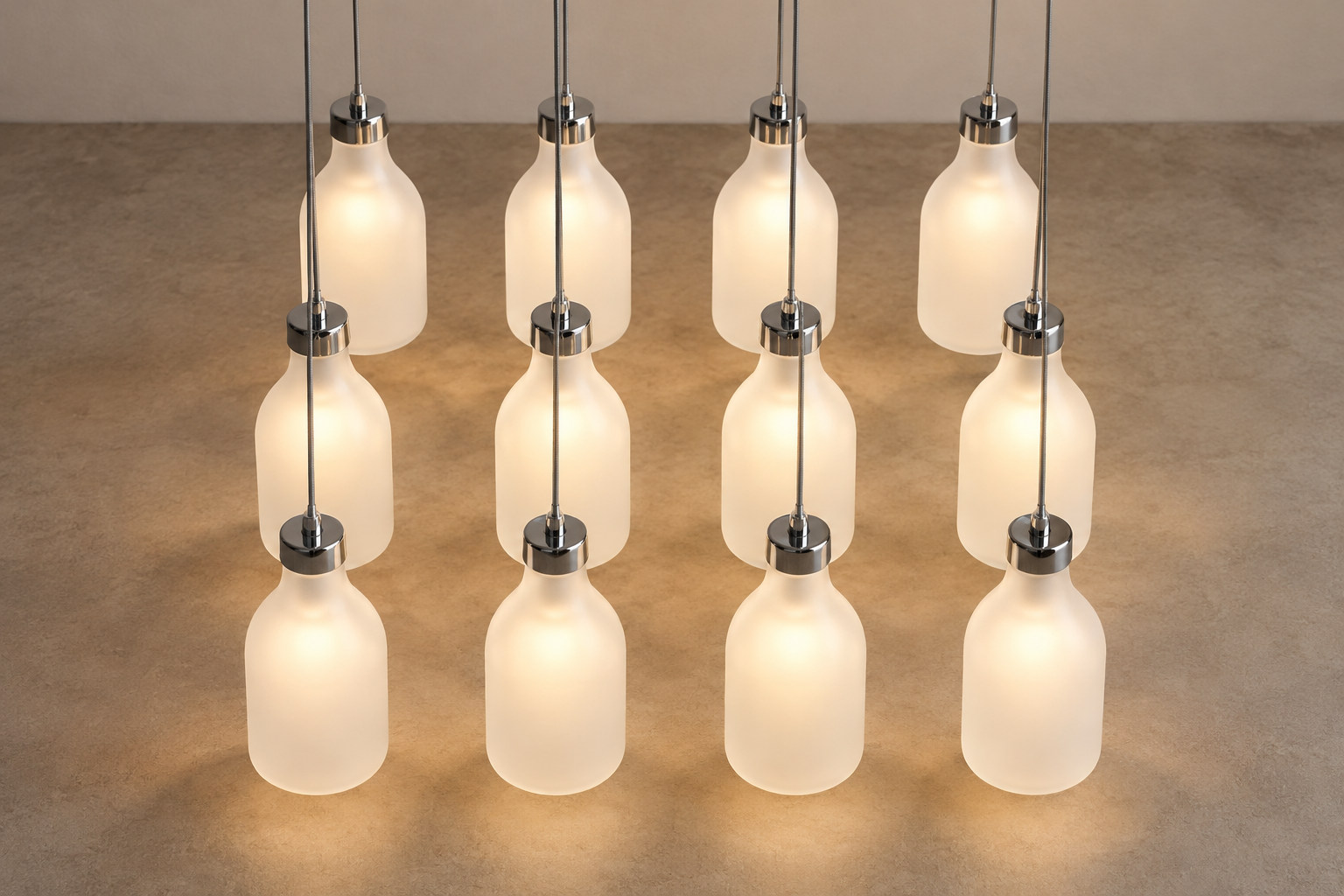
Twelve frosted bottle-shaped lights hang low above the floor in three rows of four.
PatinaHall editorial reconstruction. It is not a documentary photograph. Twelve bottle forms hover in a three-by-four arrangement close to the floor. Repetition and the gaps between them interpret Droog’s described group; this is not a documentary installation.
On this page
Key facts & takeaways

At a glance

Subject
Milk Bottle Lamp
Entry
Design story
Last reviewed
26 October 2026
Designed
1991documented

Three things to remember

  1. The bottle’s recognisable outline survives its new role.
  2. The grouped version has twelve bottles in a 3 by 4 arrangement.
  3. The gaps repeat as clearly as the bottle-shaped forms.

A familiar shape changes its job

Milk Bottle Lamp begins with a form that already carries an ordinary use in its outline. The shoulders narrow towards a neck; the body makes the idea of a bottle immediately available. The design lets that recognition survive the move into lighting.

Droog dates Tejo Remy’s design to 1991. Its account describes sandblasted glass, a cord and a metal top, allowing the bottle-shaped body to remain the main visible element.1

This is a transformation a reader can understand before learning the date or the designer’s name. The outline supplies the point of entry. Light and suspension then give the familiar form a different place in the room.

The crate leaves its outline behind

The grouped edition arranges twelve bottles in three rows of four. Droog describes them hanging just above the floor and connects their spacing with the way milk bottles stand together in a crate.2

A crate ordinarily gives repeated objects a common boundary. Suspended clear of the floor, spacing can perform some of that visual work by itself. The bottles form a group because the gaps between them repeat as clearly as their shapes.

That is why the air between the pendants deserves attention. One bottle establishes a recognisable unit; the neighbouring bottles establish a rhythm. The resulting light has a rectangular order without needing a literal crate to explain it.

An imagined bottle on its own would concentrate attention on the individual outline. The twelve-bottle group makes the repeated arrangement part of the subject, with each bottle retaining its place in the larger rhythm.
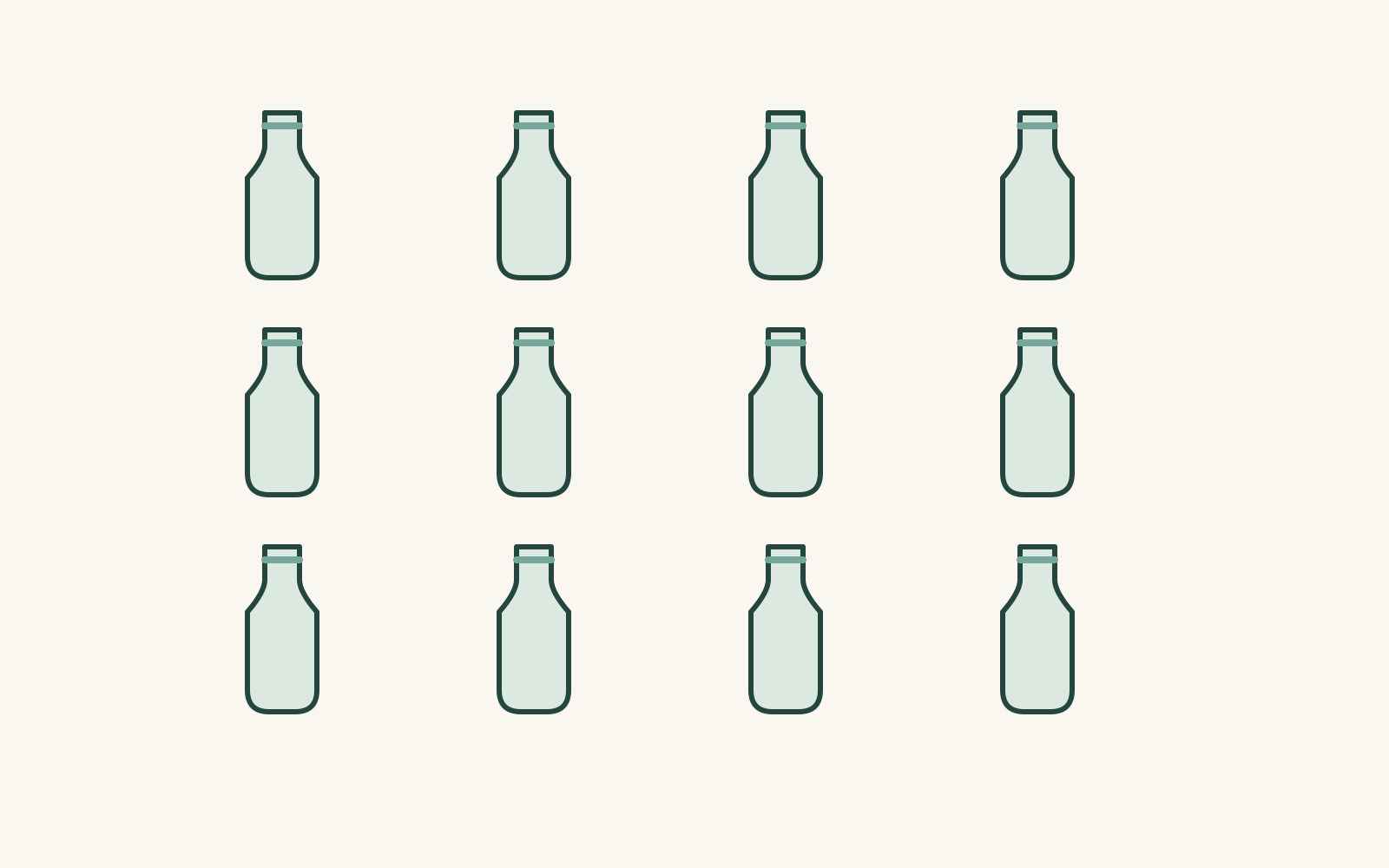
Twelve bottle outlines are arranged in three rows of four with regular gaps.
The repeated bottle shapes and repeated gaps make a group readable. The grid describes the selected twelve-bottle arrangement, without a crate or an electrical plan. Original PatinaHall schematic, not to scale.

Recognition travels with the object

MoMA records a 1991 Milkbottle Lamp credited to Remy and manufactured by Droog Design. Its material description names milk bottles, steel and light bulbs, keeping the everyday starting point visible in the institutional record.3

The pleasure of the design lies in carrying that starting point forward. A familiar container becomes something to look towards rather than something to pick up and pour from.

In the grouped light, the memory is also spatial. An arrangement associated with carrying bottles now hovers above the floor, leaving the bottle shapes and their regular intervals to tell the story.

Research notesEvidence, connections and limits

The twelve-bottle arrangement is the example discussed here. MoMA’s 431.1996 is a separately recorded example; its dimensions and materials do not establish every later specification or a universal reused-bottle origin.

Evidence map

Connected subjects and evidence

Reviewed facts

  • Designed 1991documented

    Droog says first created 1991 and MoMA dates Milkbottle Lamp to 1991. Museum object number 431.1996 is not a design year.

    Reviewed 26 October 2026 by PatinaHall editorial.
    • Source 1Tejo Remy; Milk Bottle Lamp 1991; glass, cord and chrome description
    • Source 3Title, 1991, manufacturer, medium and object 431.1996

Reviewed connections

  • Milk Bottle Lampdesigned byTejo Remydocumented

    Droog and MoMA credit Tejo Remy. Droog’s editions entry documents the twelve-bottle arrangement, which should not be reduced to a single bottle.

    Reviewed 26 October 2026 by PatinaHall editorial.
    • Source 1Tejo Remy; Milk Bottle Lamp 1991; glass, cord and chrome description
    • Source 2Milk Bottle Lamp entry, twelve bottles in3 by4 arrangement
    • Source 3Title, 1991, manufacturer, medium and object 431.1996
  • Milk Bottle Lampmanufactured byDroogdocumented

    MoMA names Droog Design as manufacturer of its recorded example; this does not describe every later edition’s electrical specification.

    Reviewed 26 October 2026 by PatinaHall editorial.
    • Source 3Title, 1991, manufacturer, medium and object 431.1996

Research trail

Sources and further reading

  1. Milk Bottle Lamp by Tejo RemyDroogAccessed 26 October 2026
  2. Rag Chair, editionsDroogAccessed 11 September 2026
  3. Milkbottle Lamp 1991, 431.1996The Museum of Modern ArtAccessed 26 October 2026

Last reviewed 26 October 2026. Found an error or a stronger primary source? Contact PatinaHall.