The furniture beneath the furniture
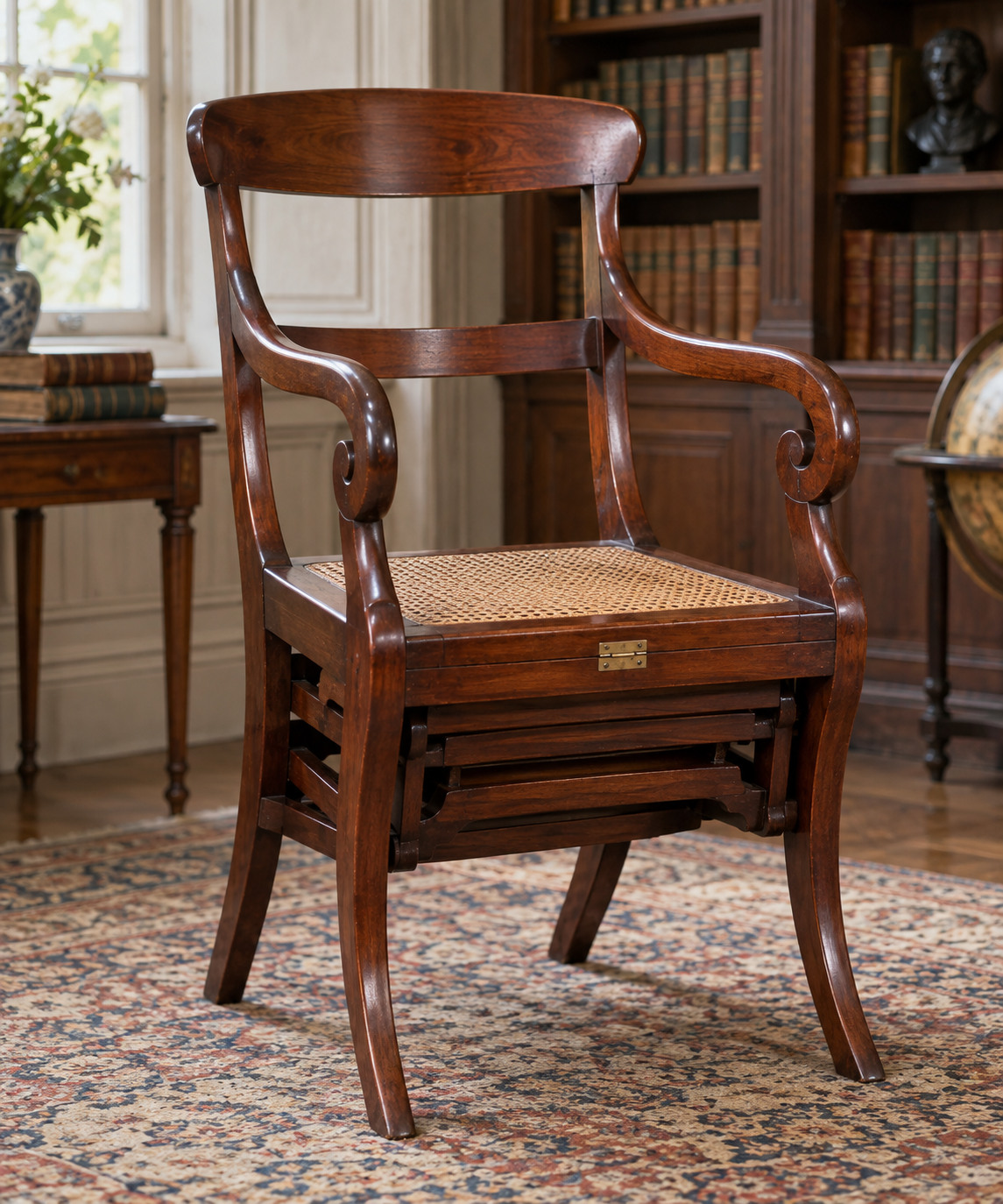
At first glance, the Blickling Hall chair belongs to a recognisable family: a curved top rail, scrolling arms, a caned seat and outward-sweeping legs. Look below the seat and the space is unusually busy. Parts that an ordinary chair would not need have been fitted inside its footprint.1
Those extra elements are the other half of its identity. A library needs to accommodate a seated reader and the act of reaching books above ordinary arm height. Keeping separate steps in the room solves that problem, but gives the room another object to store.
A metamorphic chair tries to share the space. The word sounds theatrical because the transformation is part of the appeal. Its usefulness and its capacity to surprise arrive together.
The front rail becomes the turning point
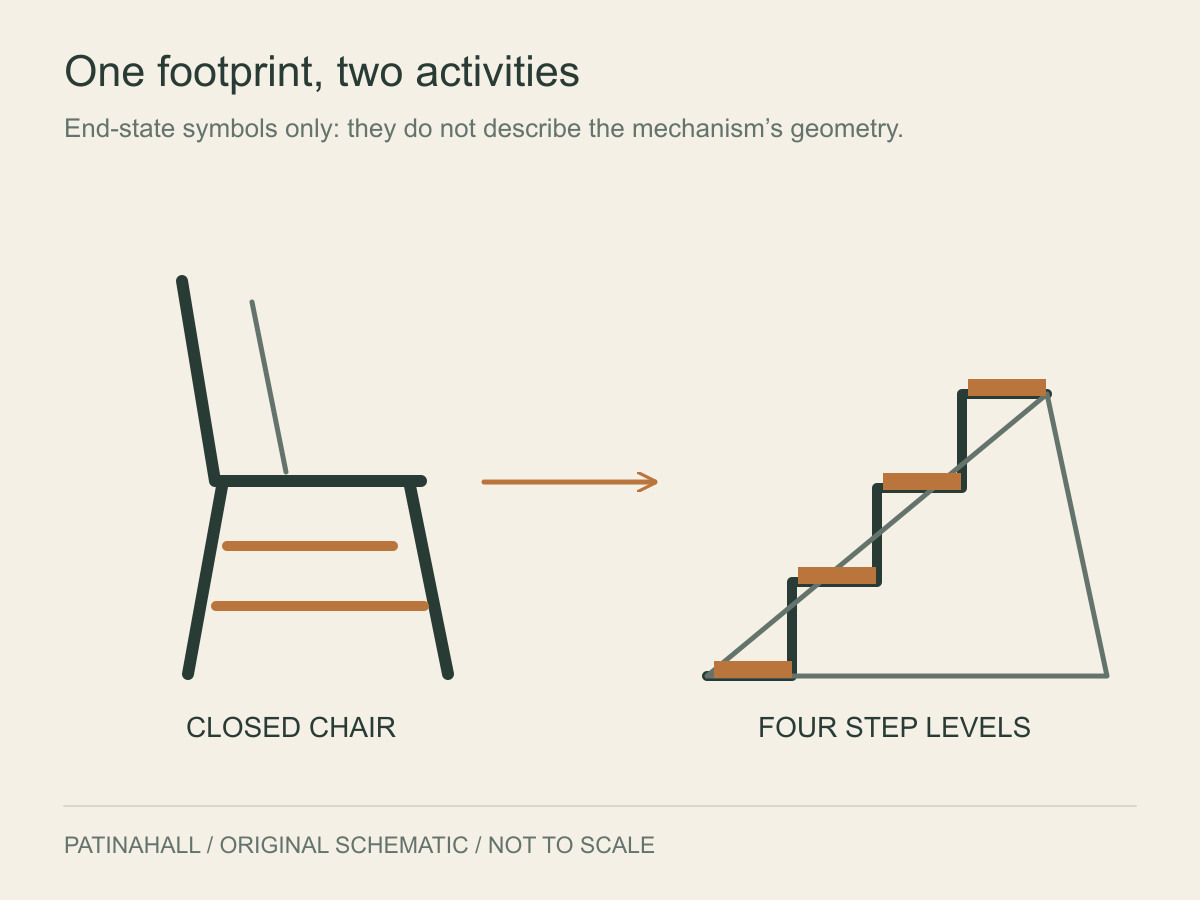
The National Trust describes a hinge at the front seat rail and four step levels with velvet insets. The chair’s upper and lower elements change their relationship as it opens. A seat and the compact structure beneath it become a rising sequence of surfaces.1
The crucial distinction is between hiding extra parts and making the same assembly perform another role. This furniture does both. Some of the staircase is stored within the chair, while the movement of the chair structure makes that stored equipment accessible.
The two states organise the room around different activities. In the closed state, the object is organised around a person remaining in one place. In the open state, it is organised around a person changing height. That difference explains the mechanism’s purpose before we try to follow every joint.
A printed idea and an uncertain signature
The museum dates the chair to around 1810 and attributes it to Morgan and Sanders. It notes a correspondence with a design published in Ackermann’s Repository of Arts in July 1811.1
A period publication helps us understand how an idea could circulate. Readers could encounter a novel piece of furniture through an illustration before seeing or commissioning an example. The printed image made a transformation communicable beyond the workshop.
It does not follow that every similar surviving chair came from the same maker. A design could be repeated or adapted. The attribution is therefore useful information that must keep its qualifying words.
Gore Place preserves another English metamorphic chair and presents it in both configurations. Its account places the transformation in the practical setting of a library, where an occupant needed access to high books. It illustrates the type’s purpose without becoming evidence for who made the Blickling example.2
The library gets its floor back
Convertible furniture always involves a negotiation. The second function adds joints and components; the first function must make room for them. Here the space beneath a seat becomes valuable storage for a future action.
The most satisfying moment is the return. Once the book has been brought down, the staircase can disappear back into a familiar chair. The room has gained reach without permanently giving up another piece of floor.