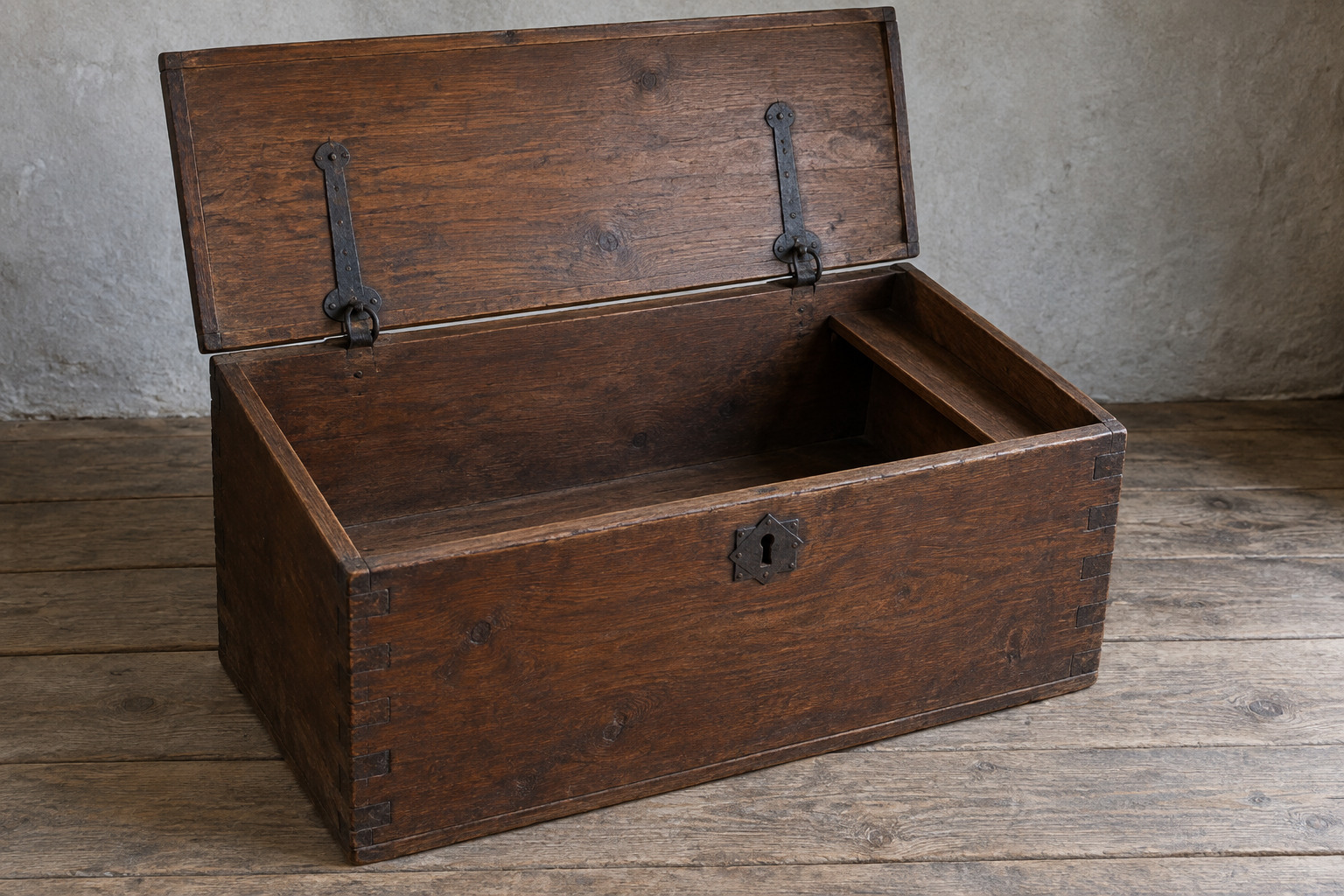
Three boxes, several parts of a life
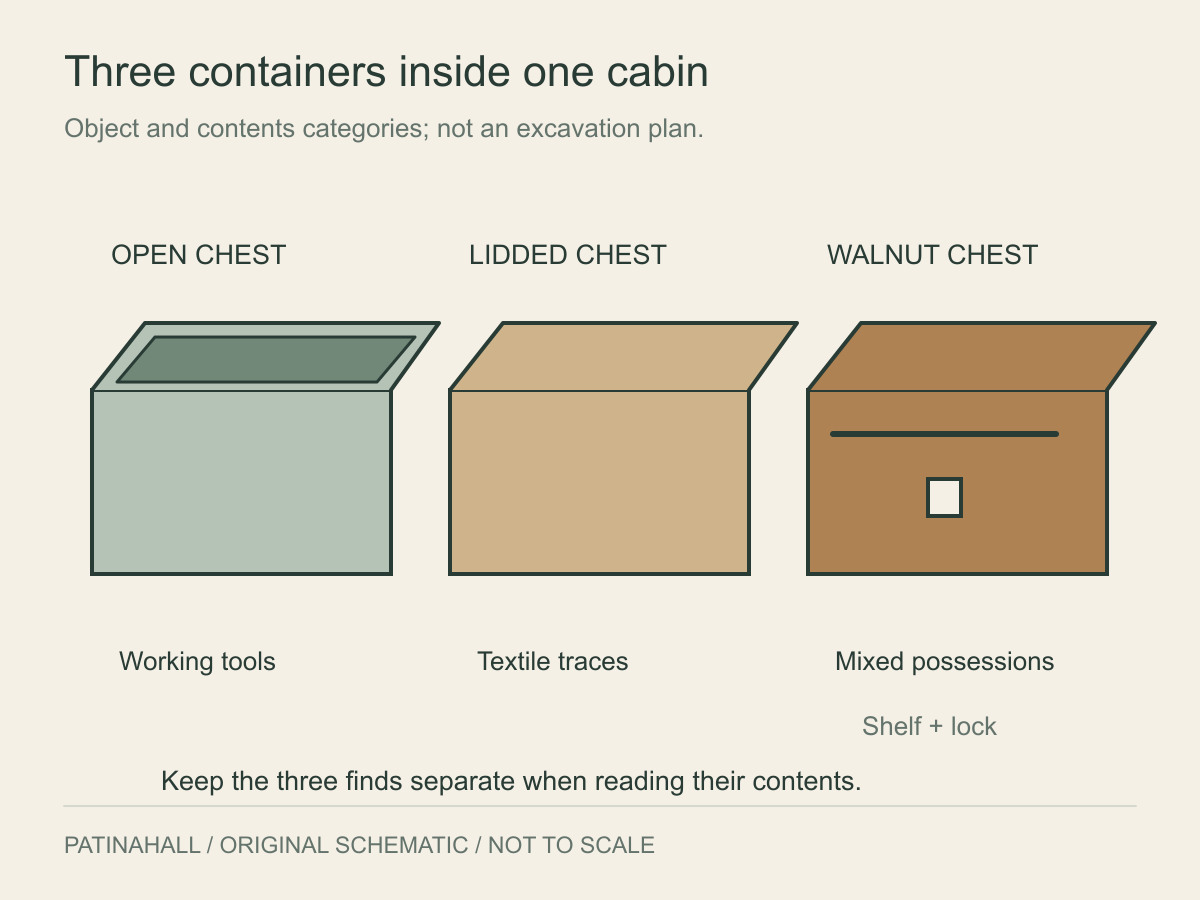
The first chest in the cabin was an open wooden container holding tools, including planes and rulers. Another, with a lid and fittings, preserved traces of textiles. The third was walnut, with dovetailed corners, a lock, ring hinges and a small internal shelf. Among its contents were pewter plates, coins, rings, a leather book cover and small tools.1
The differences make the group more revealing than an undifferentiated heap of finds. An open box puts working equipment within easy reach. A fitted lid provides separation from the surrounding cabin. A shelf divides a deep volume into more accessible places.
These are modest furniture decisions, but they describe a person managing space. Work, clothing, meals and private possessions had to find room within the same small environment.
A tool makes the hand easier to imagine
A surviving brace gives another way into the carpenter’s work. Its shaped wooden body allowed a user to turn a drill by hand. The Mary Rose Museum explains that the missing metal spoon bit would have cut into the timber as the brace rotated.2
Unlike a modern powered drill, the whole tool records the rhythm of an arm. Its crank-like form makes the movement legible even when the cutting part has disappeared. The object can be incomplete and still explain an action.
Place that imagined movement beside the chest. A tool comes out, a task is performed, the tool goes back. Storage is part of the work because it keeps the next necessary object findable. The chest’s interior belongs to the sequence as much as the cutting edge does.
Why the wood needs help after it is found
The survival of wooden furniture underwater can seem to promise extraordinary toughness. The Mary Rose’s conservation account explains a different situation. Low-oxygen burial helped organic material endure, but degradation left weakened wood whose spaces were filled with water. Uncontrolled drying could cause shrinkage and collapse.3
Conservation has to manage the transition from burial conditions to a museum environment. The museum describes polyethylene glycol treatments and freeze-drying among the methods used for waterlogged wooden finds. These are general conservation accounts, rather than a documented treatment prescription for this exact chest.
The process changes the meaning of survival. Recovering an object is one event; keeping it recognisable afterwards is another achievement, requiring time and specialist judgement.
The private shelf
The internal shelf is a good place to finish looking. It is a small intervention in a plain box, but it changes the relationship between the upper and lower contents. Something can be reached without searching through everything else.
We do not need to invent a diary or give the carpenter imagined thoughts. The arrangement is already human enough. Someone wanted certain possessions close, others put away, and a few things kept apart. The chest turns those ordinary preferences into a form that has outlasted the shipboard day.