Design story

Bombo: the bar stool that grew a pedestal

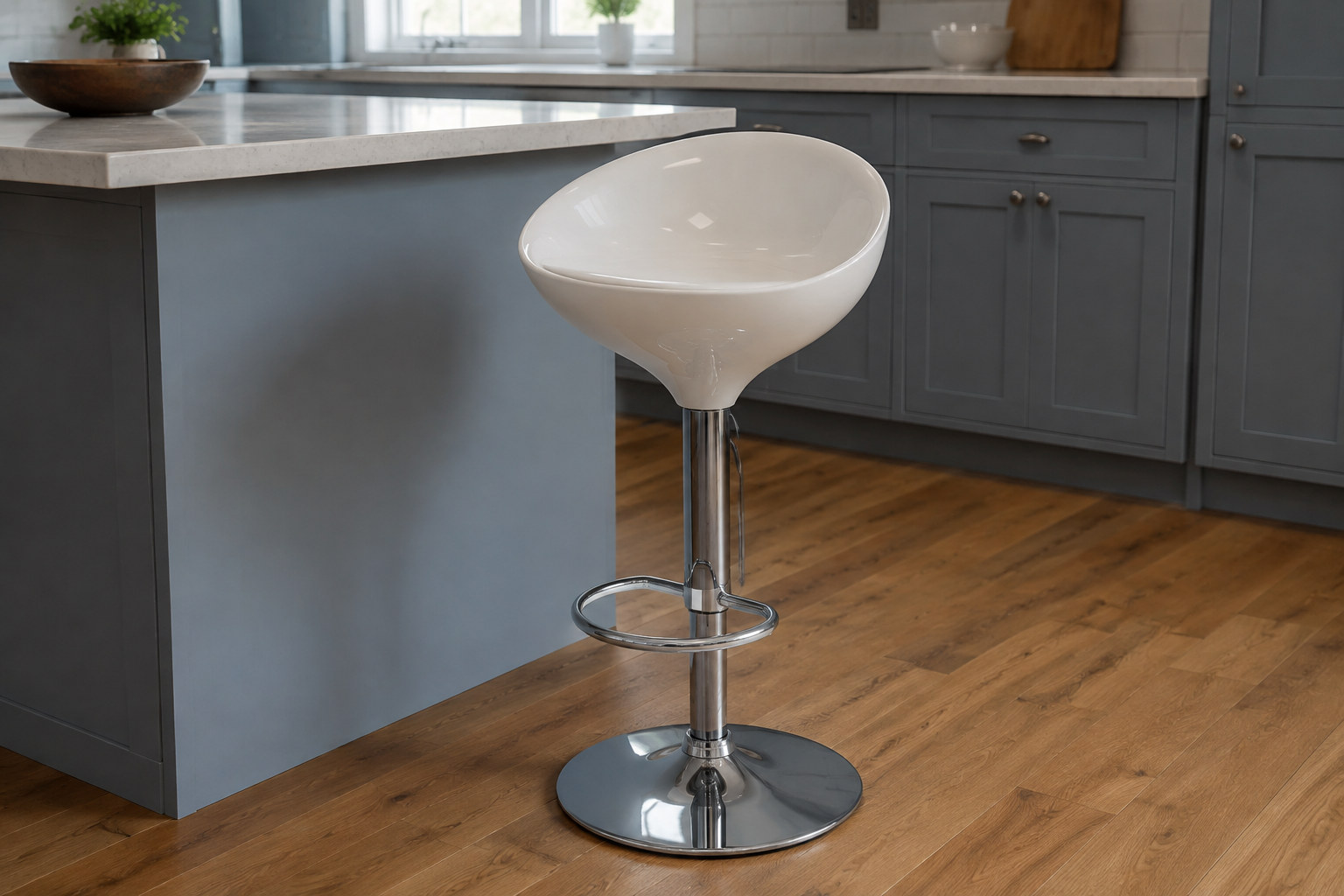
Bombo gathers a bar stool around one central column. The rounded seat seems to hover above its base, while a footrest gives the sitter a second point of contact well above the floor.

Reconstruction: A glossy white scooped stool seat on a chrome pedestal, with a metal footrest and circular base beside a kitchen counter.
PatinaHall editorial reconstruction. It is not a documentary photograph. A Bombo-inspired scene separates the sculpted seat, footrest and central support. It does not identify a particular edition or prescribe a seating height.
On this page
Key facts & takeaways

At a glance

Subject
Magis Bombo stool
Entry
Design story
Last reviewed
7 September 2026

Three things to remember

  1. The seat, lift, footrest and base each perform a different job.
  2. Magis’s chronology contains both 1996 and 1997 labels.
  3. Fixed-height and adjustable Bombo versions require separate identification.

A tall seat needs somewhere for the feet

Raise a dining chair to counter height and an ordinary problem appears: the floor becomes too far away. Bombo makes foot support a visible part of the stool. The seat sits above a central column, with a metal footrest below and a broad base at floor level.2

The result has a different presence from four long chair legs. Its structure is concentrated at the centre. Space opens around the pedestal, while the seat becomes the most expressive part of the outline.

That contrast explains much of Bombo’s character. The rounded body and narrow support look unlike one another because they are doing unlike jobs.

Plastic above, steel below

Magis credits Stefano Giovannoni and lists injection-moulded ABS for the seat of the reviewed adjustable version. Steel supplies the base, column and foot-support elements; the height adjustment uses a gas piston.12

The material split is useful to see. The moulded seat can take a continuous, scooped form around the sitter, while the metal below handles the concentrated support and moving mechanism. The shiny pedestal is therefore more than an applied decorative accent.

A counter or kitchen island gives this arrangement a natural setting. The stool occupies a pause between standing and settling into a dining chair. The person can face the worktop, turn towards a conversation and make use of the footrest without needing a large upholstered back.
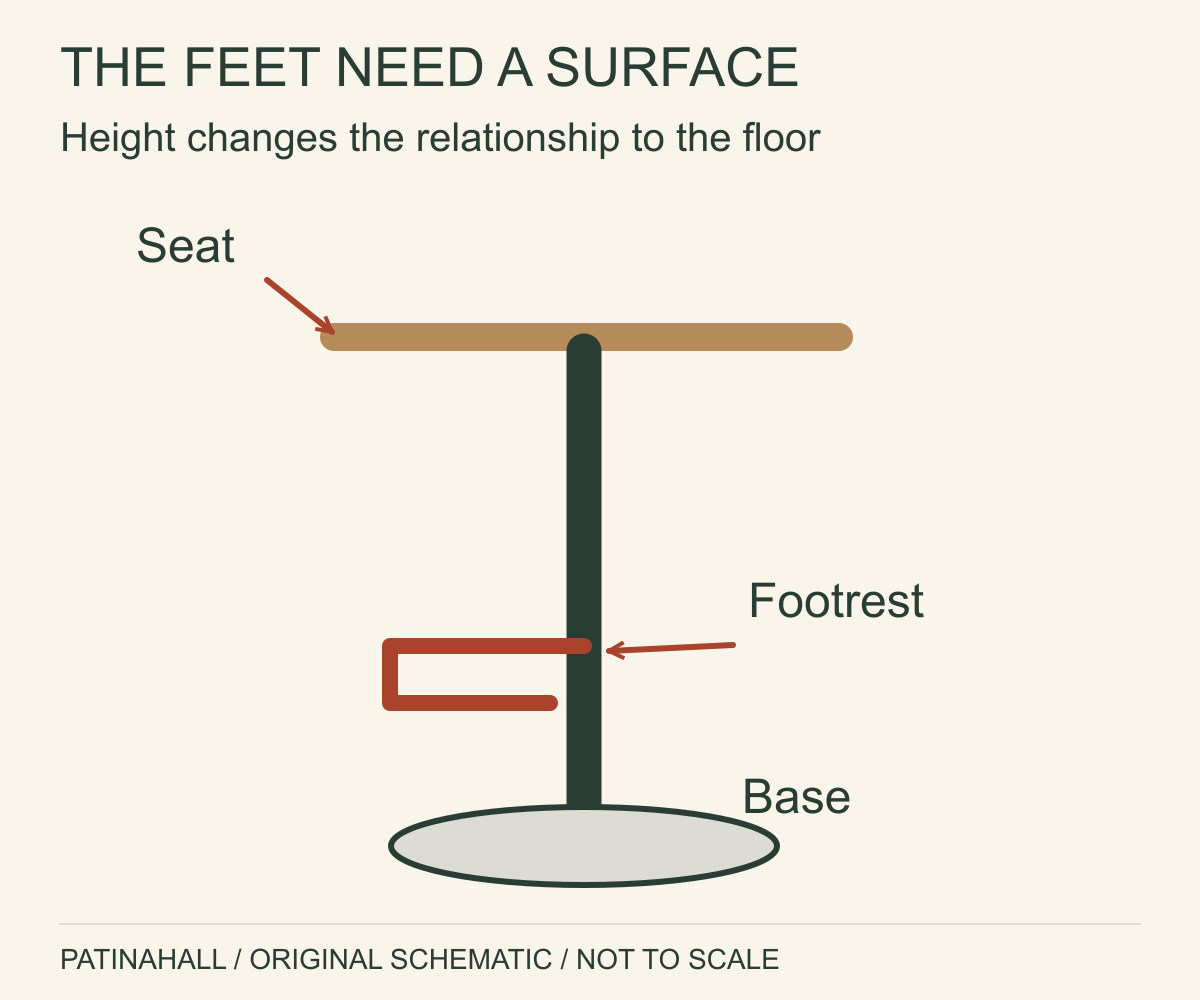
An abstract pedestal section highlights the footrest as a separate support between a raised seat and the floor.
The footrest supplies support below the high seat. The drawing explains the arrangement without specifying an ergonomic setup or lift mechanism. Original PatinaHall schematic, not to scale.

The late-1990s moment

Bombo belongs to Magis’s late-1990s work, although the manufacturer’s sheet is not perfectly consistent about the year: its heading uses 1997/2014, while the accompanying account mentions 1996. A precise launch story would need further evidence to reconcile those labels.2

The broader design is easier to read than that dating problem. It combines the vocabulary of a sculpted plastic shell with an openly mechanical pedestal. Both halves remain visible rather than being concealed inside upholstery or a wooden case.

One name, more than one stool

A Bombo listing may describe a fixed-height stool, an adjustable version or a particular finish. The familiar seat shape does not make the bases and mechanisms identical. The useful description is the one that names the actual configuration.1

For the history reader, the detail to remember is the footrest. It turns a high sculpted seat into an object organised around a whole seated person. The stool’s appeal is not confined to its silhouette: it lies in the relationship between the surface above, the support below and the distance from the floor.

Research notesEvidence, connections and limits

Magis’s sheet labels Bombo 1997/2014 but its body mentions 1996. Use late-1990s development without inventing a resolution. ABS, steel and gas adjustment describe the reviewed adjustable stool, not all fixed or outdoor variants.

Evidence map

Connected subjects and evidence

Reviewed connections

  • Magis Bombo stooldesigned byStefano Giovannonidocumented

    Magis’s sheet labels Bombo 1997/2014 but its body mentions 1996. Use late-1990s development without inventing a resolution. ABS, steel and gas adjustment describe the reviewed adjustable stool, not all fixed or outdoor variants.

    Reviewed 7 September 2026 by PatinaHall editorial.
  • Magis Bombo stoolmanufactured byMagisdocumented

    Magis’s sheet labels Bombo 1997/2014 but its body mentions 1996. Use late-1990s development without inventing a resolution. ABS, steel and gas adjustment describe the reviewed adjustable stool, not all fixed or outdoor variants.

    Reviewed 7 September 2026 by PatinaHall editorial.

Research trail

Sources and further reading

  1. Bombo Stool: Stefano GiovannoniMagisAccessed 7 September 2026
  2. Bombo Stool data sheet: 1997 / 2014 and materialsMagisAccessed 7 September 2026

Last reviewed 7 September 2026. Found an error or a stronger primary source? Contact PatinaHall.