Artefact story

A Luba royal seat made to hold authority

This Luba royal seat was associated with the preservation of authority rather than ordinary sitting. A kneeling woman supports its circular top, giving kingship a human form beneath it. The seat’s meaning lies in that relationship between the office above and the figure that sustains it.

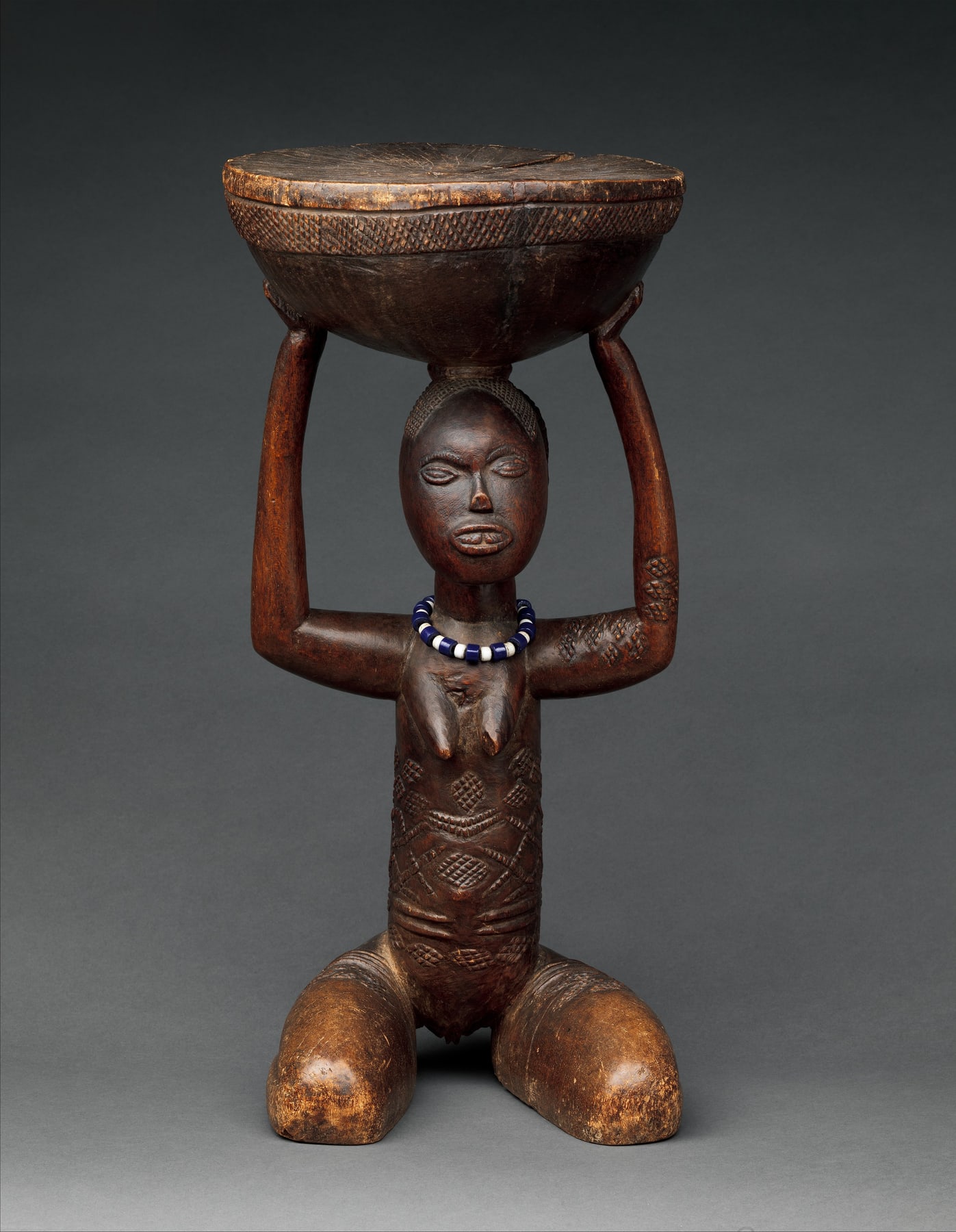
Luba royal seat with a kneeling female figure supporting a circular top and a band of blue and white beads.
Luba royal seat with a kneeling female figure supporting a circular top and a band of blue and white beads. Accession 1978.412.317. The Metropolitan Museum of Art. Public domain (CC0).
On this page
Key facts & takeaways

At a glance

Subject
Lupona (royal seat) 1978.412.317
Entry
Artefact story
Last reviewed
6 September 2026

Three things to remember

  1. The museum describes this royal seat as regalia, rather than an everyday stool.
  2. The kneeling figure and the circular seat must be read together.
  3. The interpretation belongs to a specific Luba historical context, not to all African seating.

The body makes the support visible

The figure kneels below a broad circular seat, with arms raised towards it. From the front, the composition is almost a stack of three forms: the base, the body and the disc above. The angled view reveals how the limbs connect those levels.

The Met identifies the object as a lupona, a Luba royal seat, attributed to an artist of the Shankadi in the Lovoi River region. Its date falls between the late nineteenth and early twentieth centuries.1

A seat could preserve an office

The museum describes this kind of royal seat as an emblem retained for its relationship to kingship, rather than used as ordinary seating. The important occupant is therefore an office and its continuity, not simply a body needing rest.1

That interpretation changes the way the carving is read. The woman beneath the top is not an incidental flourish on a practical stool. Her supporting position helps express what the object was understood to maintain.
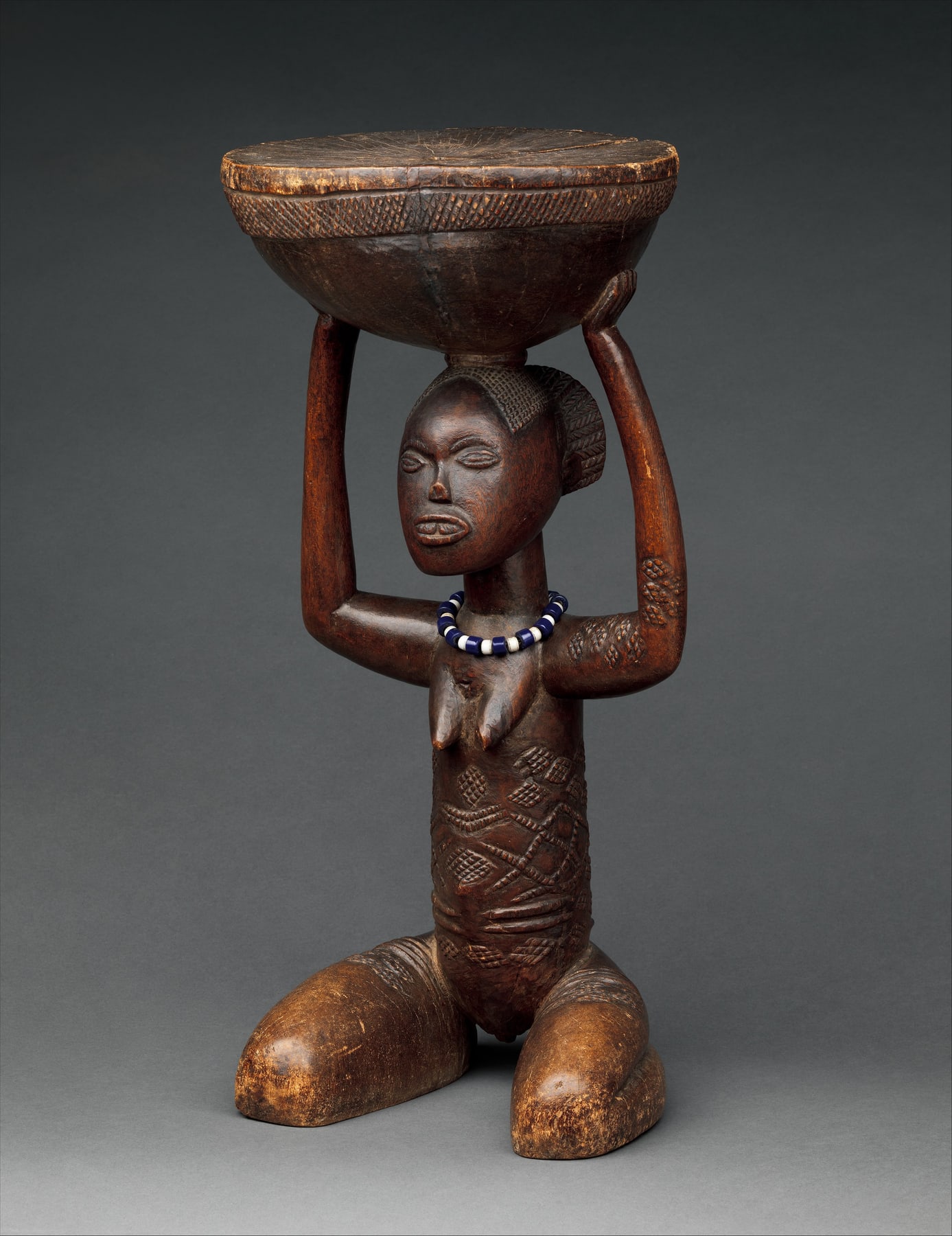
Angled view of the Luba seat, making the figure’s raised arms, bent legs and relationship to the top easier to follow.
Angled view of the Luba seat, making the figure’s raised arms, bent legs and relationship to the top easier to follow. Accession 1978.412.317. The Metropolitan Museum of Art. Public domain (CC0).

Female figures carried political meaning

Elaine Ericksen Sullivan’s Met account of Luba royal arts places lupona among regalia kept in a royal compound. It explains the importance of female forms in expressing continuity and notes that the Kiluba concept of royal authority, bulopwe, is not itself gendered.2

That context makes a purely decorative reading inadequate. It also resists a simplistic division in which a male political role is merely embellished with a female ornament. The relationship between embodied figures and authority is part of the work’s historical meaning.

Beads interrupt the wooden surface

Blue and white beads draw the eye to the figure’s neck. Against the dark wood they establish a small but emphatic band of colour. The museum connects these beads with courtly status and protective significance.1

The photographs let us see the shift of material without requiring the beads to explain the entire object. First follow the carved body carrying the seat; then notice how the coloured band changes the point of attention.

This is a seat whose purpose becomes clearer when its physical form and cultural account are held together. The empty top does not make it inactive or incomplete. In the interpretation preserved by the museum, the object’s work was to carry and safeguard a conception of authority across time.

Research notesEvidence, connections and limits

The record supplies a regional attribution and ceremonial interpretation, but does not name the individual artist or the ruler associated with this seat. Described protective meanings are cultural beliefs, not claims about supernatural effects.

Evidence map

Connected subjects and evidence

Reviewed connections

  • Lupona (royal seat) 1978.412.317uses materialWood, glass beads and possibly cotton fibredocumented

    The primary record lists these materials for this subject. The full material list and object dating remain in the cited accession record; listed replacement or uncertain materials retain their qualifiers.

    Reviewed 6 September 2026 by PatinaHall editorial.
  • Lupona (royal seat) 1978.412.317associated with placeDemocratic Republic of the Congodocumented

    The Met records this geographic association for the exact artefact.

    Reviewed 6 September 2026 by PatinaHall editorial.

Research trail

Sources and further reading

  1. Lupona (royal seat) — 1978.412.317The Metropolitan Museum of ArtAccessed 6 September 2026
  2. Royal vessel: Luba arts of kingshipThe Metropolitan Museum of ArtAccessed 6 September 2026

Last reviewed 6 September 2026. Found an error or a stronger primary source? Contact PatinaHall.