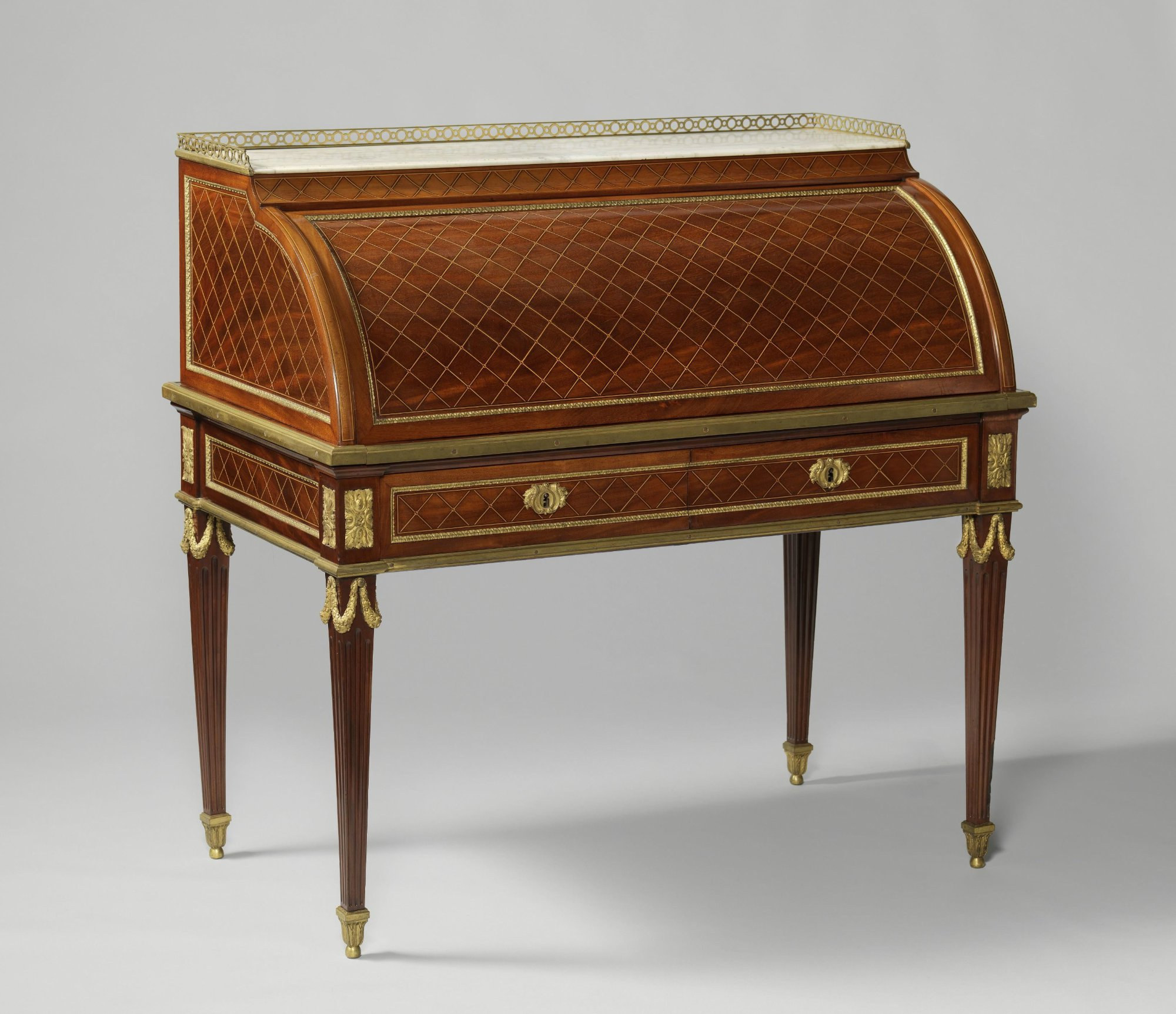
Closed, the desk withholds its purpose
At first glance, Jean François Leleu's cylinder-top desk looks more guarded than ingenious. A broad mahogany curve seals the upper case. Fine trellis marquetry crosses that curve and continues around the sides and frieze, while gilt-bronze borders make every edge appear settled in place. There is no loose roll of slats and no open shelf advertising where the paperwork goes.
The scale reinforces the impression. Rijksmuseum object BK-14854 is 115 centimetres high, 117 wide and 68 deep, with a recorded weight of 92 kilograms. Its oak structure is faced with mahogany, boxwood and ebony; gilt bronze marks the corners and legs; a Carrara-marble slab and pierced gallery finish the top. This is a substantial piece of furniture, not a portable trick box. 1
Closed, the desk divides into three calm bands: marble, curved cylinder and straight table frame. The tapered, fluted legs keep that mass off the floor. Its function is present but compressed, waiting behind one continuous wooden surface.
One pull performs two movements
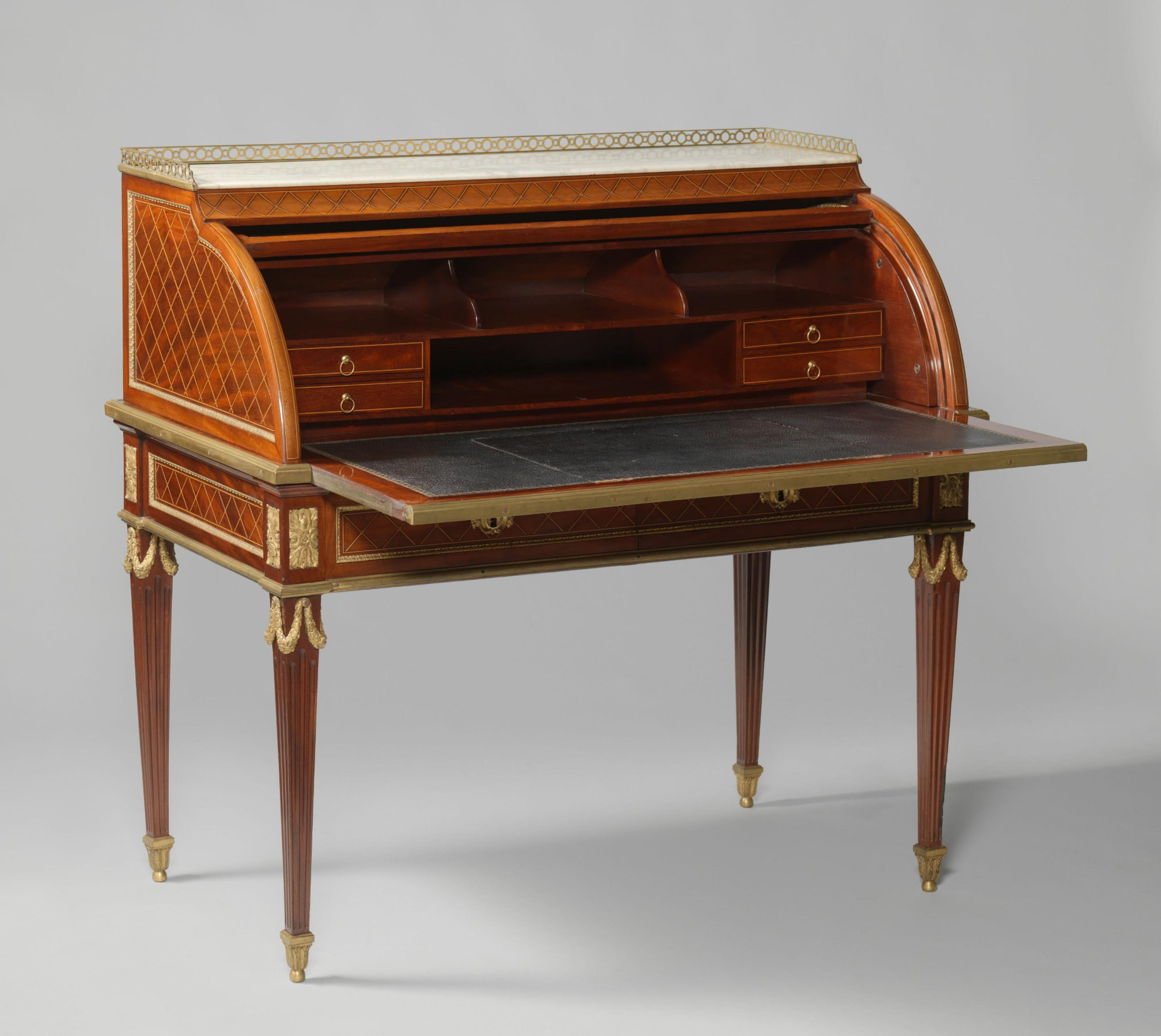
The Rijksmuseum gives the essential operating sequence in one sentence. When the writing slide is drawn out, the cylinder automatically disappears into the superstructure and the interior is revealed. The user's hand asks for a larger work surface; the same action removes the barrier in front of the shelves.1
That coordination matters more than theatrical speed. A conventional sequence could require opening a cover and then pulling out a surface. Here those tasks are coupled. The front edge moves towards the seated user while the curved front moves away. Access and distance change together.
The photographs establish the before and after, not the machinery between them. In the closed view, the cylinder fills the upper front. In the open view, it has withdrawn above the fitted compartments and the leather writing plane projects beyond the frame. We can describe that documented result precisely without assigning unseen rods, springs or counterweights to the desk.
The desk makes a room for work
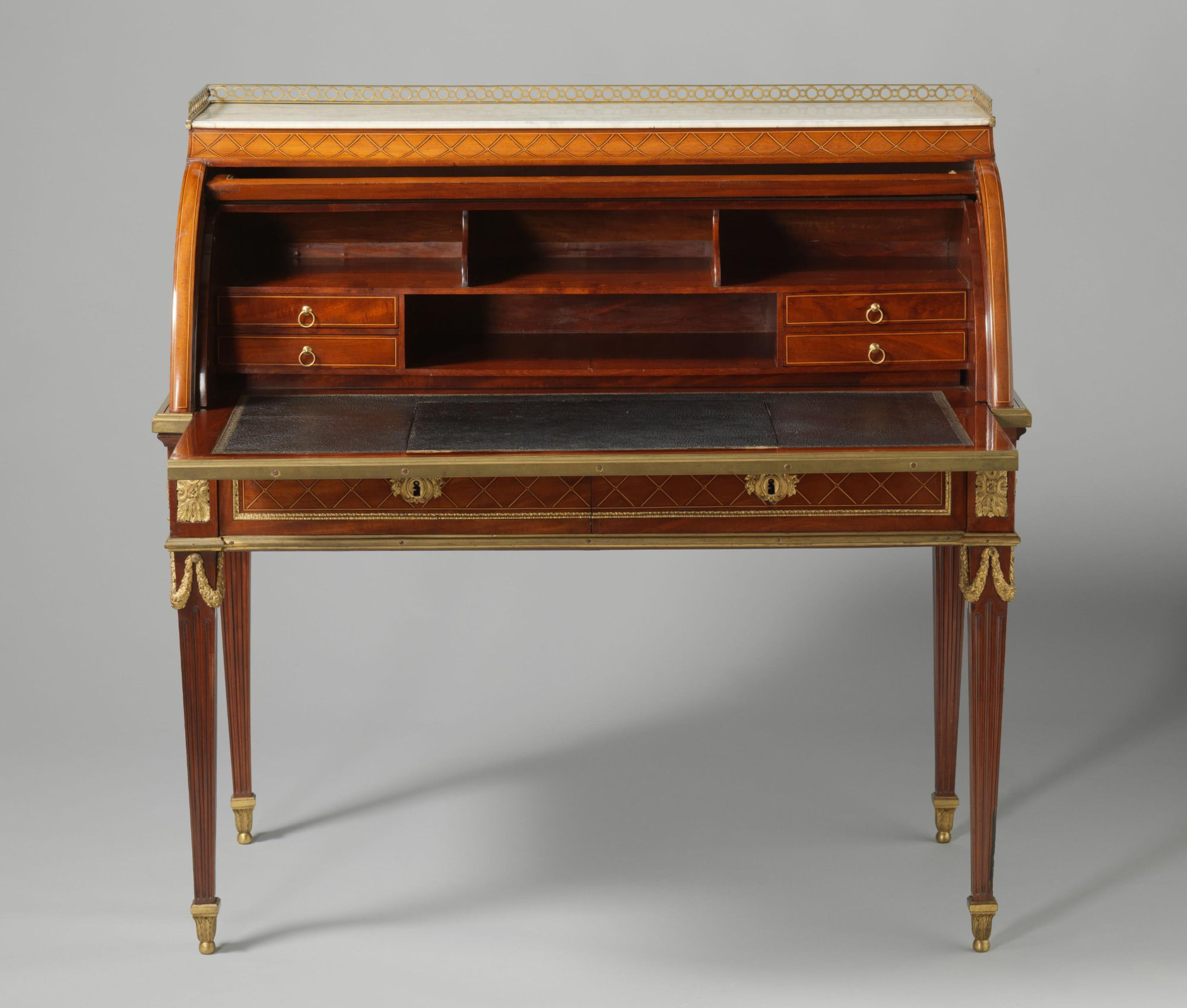
Opening replaces one large surface with a small architecture. Three upper compartments sit beneath the withdrawn cylinder. Below them, a long central shelf is flanked by two pairs of small drawers. The leather writing area is divided into three panels and framed by a narrow wooden border.
The change is not simply from hidden to visible. It rearranges reach. Papers can occupy the leather plane; frequently handled items can sit in the small drawers; material waiting for attention can be separated across the shelves. The curved cover that previously occupied the eye line has moved out of the way. A shallow private interior now faces the sitter.
Nothing in the reviewed record tells us which papers an owner placed in each compartment. The usefulness lies in the physical hierarchy itself: broad work surface below, small storage at hand and less immediate material above. The desk creates order without needing labels.
Mechanism belonged to Leleu's workshop language
The Rijksmuseum identifies Leleu as a pupil of Jean-François Oeben, a maker noted for ingenious mechanical furniture. The Met adds that Leleu trained in Oeben's workshop alongside Jean-Henri Riesener and became a master cabinetmaker in 1764. Its record of a different Leleu writing table places him among the elite Paris makers of the later eighteenth century.4
A Getty catalogue describes another secrétaire attributed to Leleu whose reading and writing surface rises through its own unusual mechanical method. The publication treats complicated arrangements and marquetry as recurring parts of Leleu's practice after Oeben.3 That is workshop context, not a parts diagram for BK-14854.
The distinction is useful. A recent Getty close-looking feature calls furniture dynamic while demonstrating the pop-out writing surface of yet another secrétaire attributed to Leleu. It shows why movement can be central to reading such furniture, but the Getty object has a different form and mechanism. 2
Restraint makes the surprise sharper
The Rijksmuseum describes BK-14854 as relatively sober and connects its mahogany exterior with contemporary English taste. Sober does not mean bare. The trellis pattern changes angle as it crosses the curved front and flat side panels. Gilt-bronze festoons hang at the tops of the legs, rosettes punctuate the frame and a pale marble top catches light above the dark wood. 1
Yet no pictorial marquetry announces the mechanism. Repetition does the visual work: diagonal lines, straight borders, tapered legs and the circular rhythm of the marble gallery. The closed desk looks controlled because each decorative element reinforces its geometry.
That restraint gives the opening more force. The interior does not emerge from an object already shouting about novelty. A composed outer shell suddenly becomes a place for hands, paper and small tools. Leleu's trick is not hidden because decoration distracts us; it is hidden because the cabinetmaking looks complete before anything moves.
The hidden linkage stays hidden
The attribution of this exact desk does not depend on resemblance alone. The Rijksmuseum records a J.F.LELEU stamp on the underside of the left rail, as well as the Paris maker, c. 1775–85 date range, materials and dimensions. 1
What the record does not supply is equally important. There is no reviewed internal drawing showing how the writing slide and cylinder are connected. We have not tested whether the museum object is currently operated, and the sources do not name its original patron or describe daily use. Mechanisms on other furniture associated with Leleu cannot fill those gaps.
The surviving evidence is enough for a strong claim. BK-14854 makes opening part of writing: one pull enlarges the work surface and clears the interior. The desk's exterior prepares no fanfare for that event. It simply keeps a second, more useful state folded inside the first.