Design story

Louis Ghost: an old chair outline in a transparent body

Louis Ghost is easy to recognise and easy to see through. Philippe Starck kept the oval back, arms and upright presence of a historical chair, then gave those familiar signals a transparent plastic body.

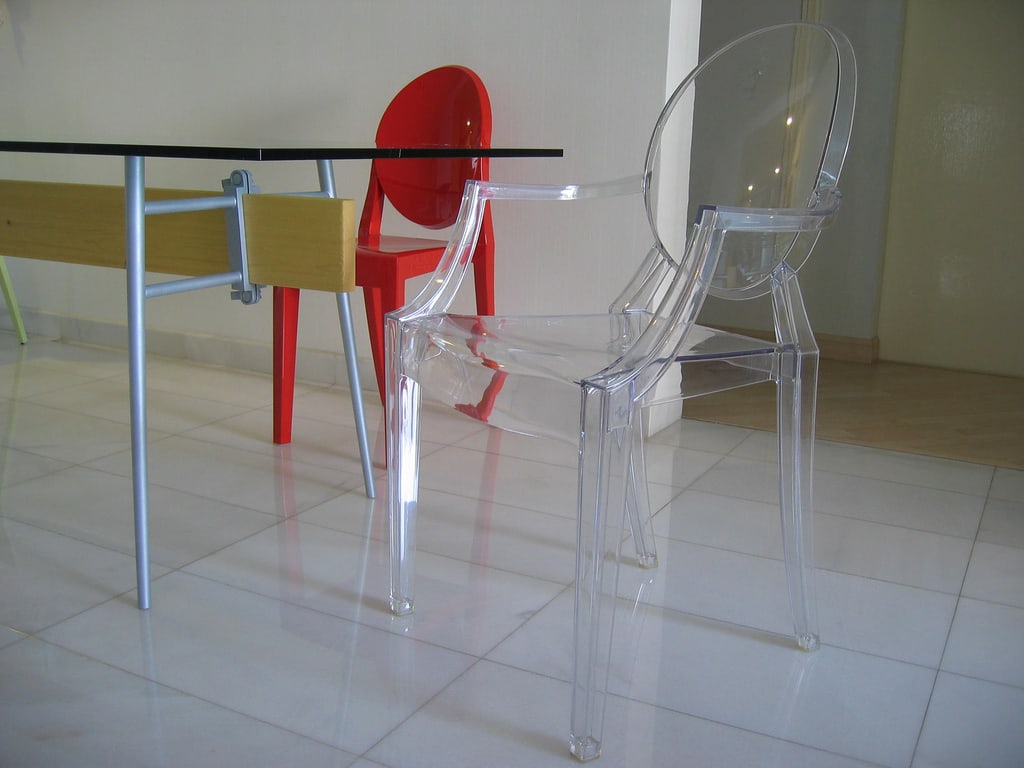
A clear Louis Ghost armchair beside a glass-topped table, with a red armless Victoria Ghost chair behind it.
The clear armchair in front is Louis Ghost; the red armless chair behind is Victoria Ghost. Their shared oval backs do not make them the same model. Starck Ting, CC BY 2.0. JPEG re-encoded; metadata removed. Source: Table & Chairs by Philippe Starck.
On this page
Key facts & takeaways

At a glance

Subject
Kartell Louis Ghost chair
Entry
Design story
Last reviewed
6 September 2026

Three things to remember

  1. Kartell dates Louis Ghost’s introduction to 2002.
  2. The historical reference is carried by the outline.
  3. Transparency and stackability are different parts of its domestic usefulness.

The chair your memory recognises

You can recognise Louis Ghost before deciding exactly what it reminds you of. The oval back, curved arms and upright stance carry signals from older furniture. In the clear version, the wall or table behind it remains visible through those signals.

Kartell’s tenth-anniversary account dates Philippe Starck’s Louis Ghost to 2002 and connects its inspiration to Louis XV seating. The result is a deliberately loose conversation with historical form, carried by a contemporary industrial material.1

A transparent chair could have been reduced to a barely noticeable outline. This one keeps enough familiar shape to stir a memory. That tension is the source of its character.
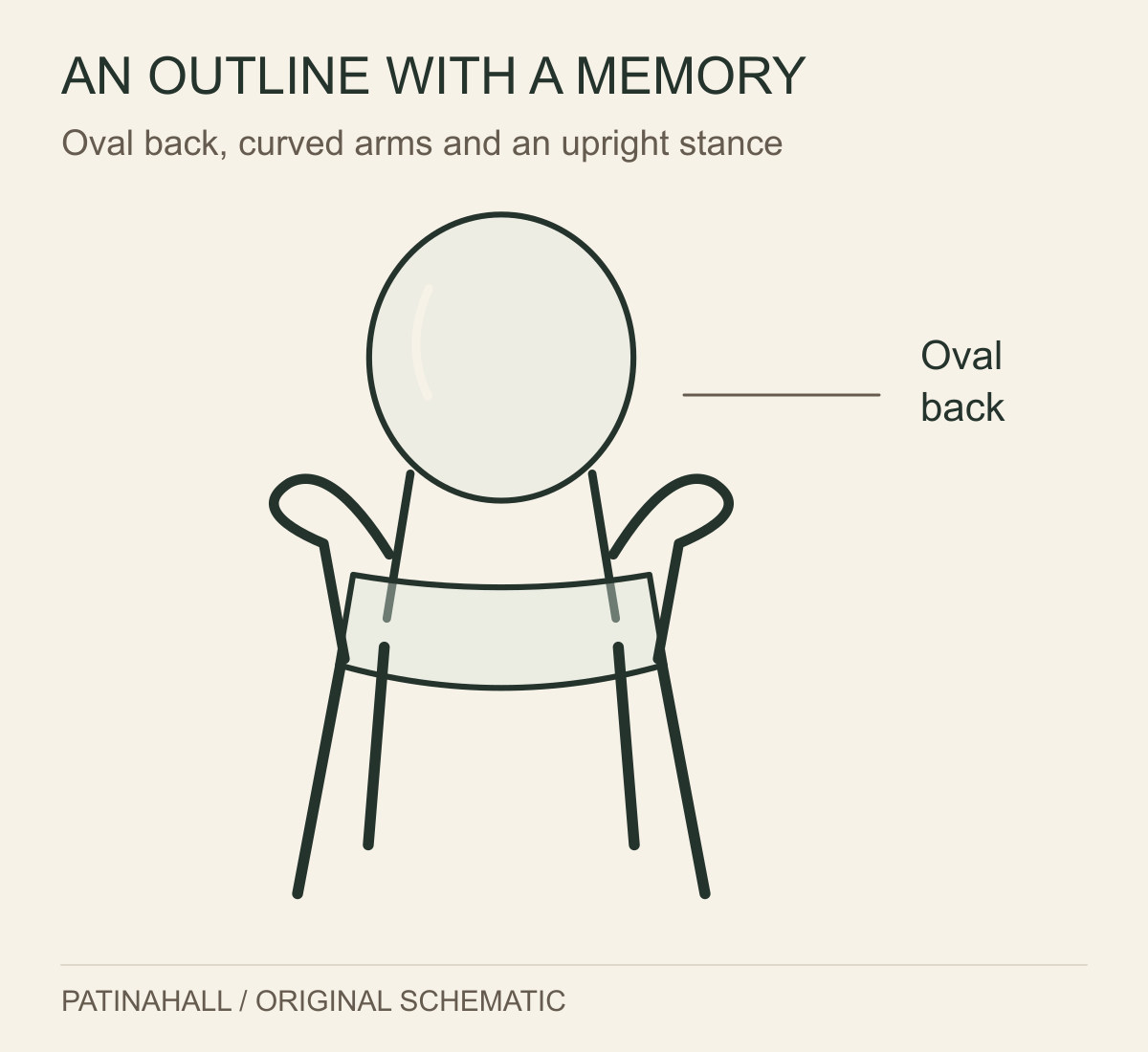
A transparent-looking armchair schematic uses an oval medallion back, curved arms and four slender legs.
An oval back and curved arms carry Louis Ghost’s historical reference into a moulded chair. Original PatinaHall schematic, not to scale.

An oval carries a lot of history

Consider the back on its own. Its medallion outline provides a clear centre above the seat. The arms curl away from the body and return towards the front supports. Those gestures give the chair a composed, almost formal presence even when its surface is completely plain.

Kartell’s anniversary text describes the back and arms as particular challenges in producing the chair through polycarbonate injection in a single mould.1

That is where the historical reference becomes more than a styling exercise. A shape associated with joined wooden parts has to become a continuous moulded body. The old visual vocabulary is being asked to obey a different method of making.

A chair you can see through

Transparency changes the relationship between a chair and the room around it. An upholstered back interrupts the view with an opaque surface. A clear back leaves colours, edges and patterns visible behind it, while its own curved edges catch the light.

This does not make the chair physically smaller. Arms still extend into the surrounding space; the seat still occupies its footprint. The change concerns what the eye can see through the object.

Kartell’s current crystal version makes that quality explicit, while the same design is also offered in other finishes. The clear material is one expression of the form rather than the whole definition of the model.2
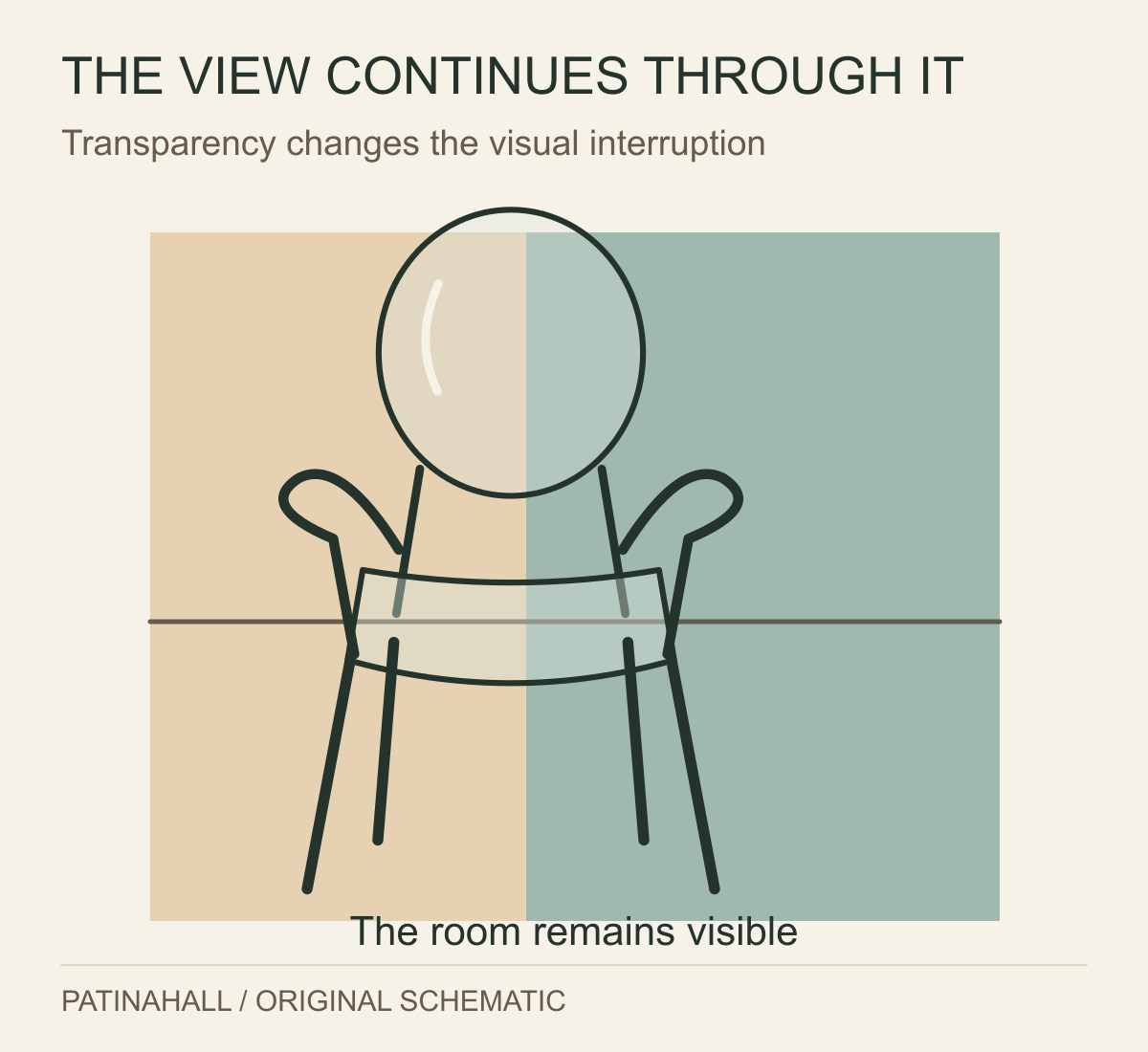
An outline of a clear armchair sits over two wall colours and a horizontal room line that remain visible through its back and seat.
Background colours and a room line stay visible through the chair in this invented scene. Original PatinaHall schematic, not to scale.

Formal enough to stack

There is an enjoyable practical detail beneath the grand name: Kartell specifies that Louis Ghost can be stacked up to six chairs high. Its current listing places the design in both domestic and professional settings.2

A chair with arms and a ceremonial-looking back can therefore also take part in the ordinary business of putting extra seats away. The historical outline and industrial usefulness belong to the same object.

That combination helps explain why the design remains interesting when encountered as a single used chair. It contains a recognisable memory of furniture, an ambitious moulded shape and a practical role around a table. The ghost is in the outline; the chair itself is there to be used.

Research notesEvidence, connections and limits

The chronology and production account come from Kartell. Its Louis XV reference describes inspiration rather than a demonstrated copy of one antique. Current product claims do not certify a used chair’s condition, identity or suitability for a particular setting.

Evidence map

Connected subjects and evidence

Reviewed connections

  • Kartell Louis Ghost chairdesigned byPhilippe Starckdocumented

    Use Kartell’s tenth-anniversary account for the 2002 introduction, the single-mould challenge and its Louis XV reference. Avoid presenting an exact antique prototype, total sales or promotional strength promises as tested fact.

    Reviewed 6 September 2026 by PatinaHall editorial.
  • Kartell Louis Ghost chairmanufactured byKartelldocumented

    Use Kartell’s tenth-anniversary account for the 2002 introduction, the single-mould challenge and its Louis XV reference. Avoid presenting an exact antique prototype, total sales or promotional strength promises as tested fact.

    Reviewed 6 September 2026 by PatinaHall editorial.

Research trail

Sources and further reading

  1. Louis Ghost: tenth anniversary, 2002–2012Kartell, hosted by Philippe StarckAccessed 6 September 2026
  2. Louis Ghost: Philippe Starck, crystal chairKartellAccessed 6 September 2026
  3. Table & Chairs by Philippe Starck.jpgWikimedia CommonsAccessed 6 September 2026

Last reviewed 6 September 2026. Found an error or a stronger primary source? Contact PatinaHall.