Design story

Gastone: the drinks trolley that knows when to leave

A drinks trolley can spend more time waiting than serving. Gastone treats that quiet interval as part of the design: its surfaces fold, reducing the space the trolley claims once the occasion is over.

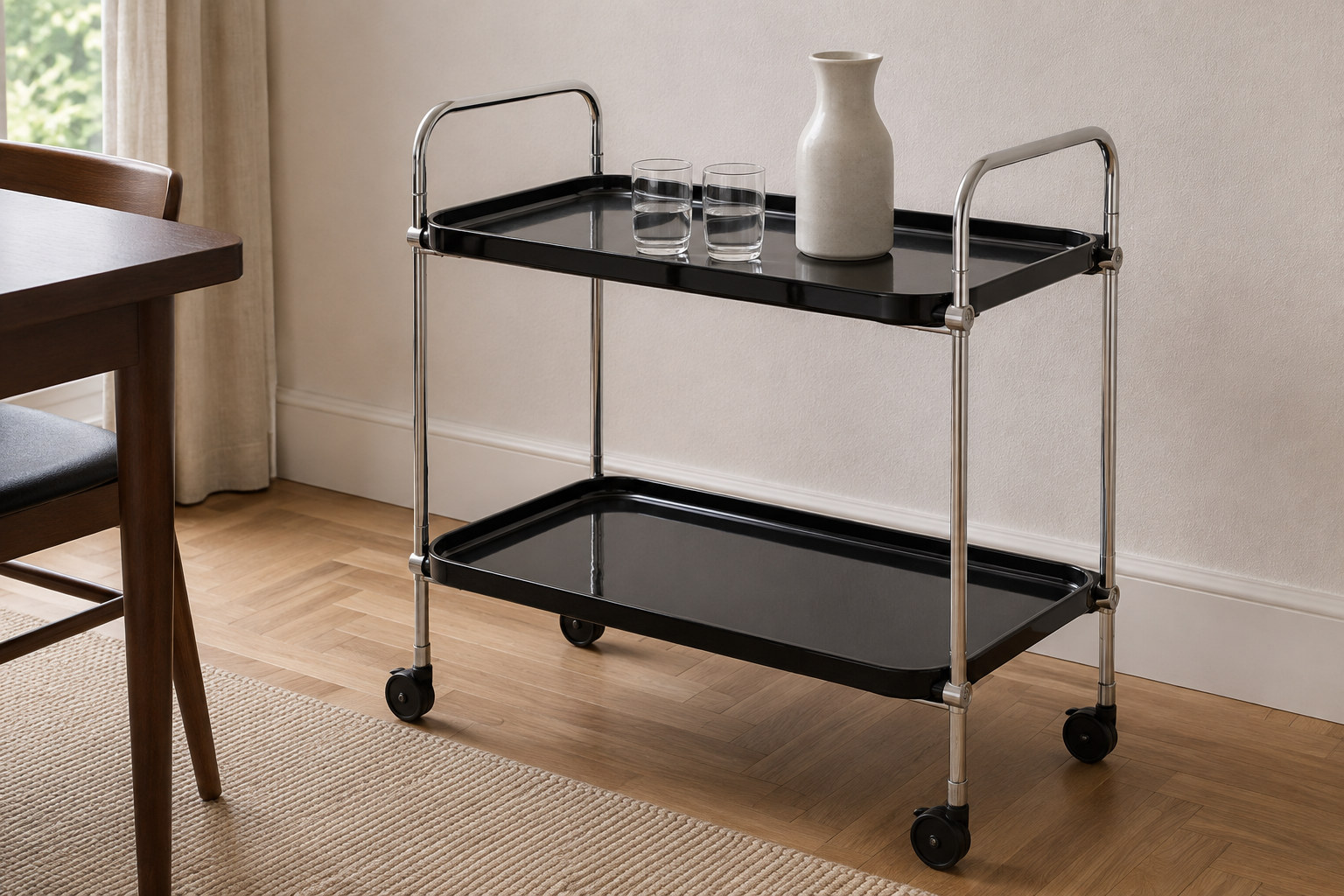
Reconstruction: A black two-tier serving trolley with a slender metal frame, raised handles, four castors and a few glasses.
PatinaHall editorial reconstruction. It is not a documentary photograph. This Gastone interpretation shows the open serving arrangement. The folding principle is explained separately; the image does not reproduce its exact hinge or handle construction.
On this page
Key facts & takeaways

At a glance

Subject
Kartell Gastone trolley
Entry
Design story
Last reviewed
7 September 2026

Three things to remember

  1. Kartell Museo dates Gastone to 1991.
  2. Two trays and a folding frame support temporary use.
  3. Gastone is distinct from Kartell’s Battista folding table.

Furniture for an occasion

A trolley brings things together before it carries them anywhere. Glasses, bottles or cups can occupy one small piece of furniture, leaving the main table available for people. Gastone gives that arrangement two levels and a set of wheels.2

Its more revealing feature comes afterwards. When the surfaces fold, the trolley becomes a shallower object. The room does not have to reserve the full serving footprint throughout the week.

This makes the closed position part of the original brief. A folding trolley has to look and work convincingly during use, but its hinges and frame must also negotiate the moment when it is put aside.

Citterio and Löw’s 1991 trolley

Kartell Museo dates Gastone to 1991 and credits Antonio Citterio and Oliver Löw. Its guide describes a combination of plastic components and metal, including chromed steel and die-cast aluminium.1

That mix is visible in the object’s hierarchy. Broad surfaces hold the contents; narrow structural members connect them to the wheels. Small joints allow the relationship to change when the trolley closes.

The furniture does not need to imitate an old wooden tea trolley to perform the same domestic job. It keeps the useful sequence—gather, move, serve—while using a more open frame and a compact storage position.

Follow the hinges

In a still photograph, Gastone can look like two trays held inside a light frame. The hinges reveal why it is more than a fixed shelving unit on castors. A surface that folds needs clearance, and its supporting members must leave a path for that movement.

Our diagram isolates the difference between an open serving volume and a folded one. It is a schematic explanation of the design, not an assembly instruction or a measured footprint for every edition.

The important observation is simple: the trolley’s useful shape changes over time. The larger form belongs to serving; the smaller form belongs to waiting.
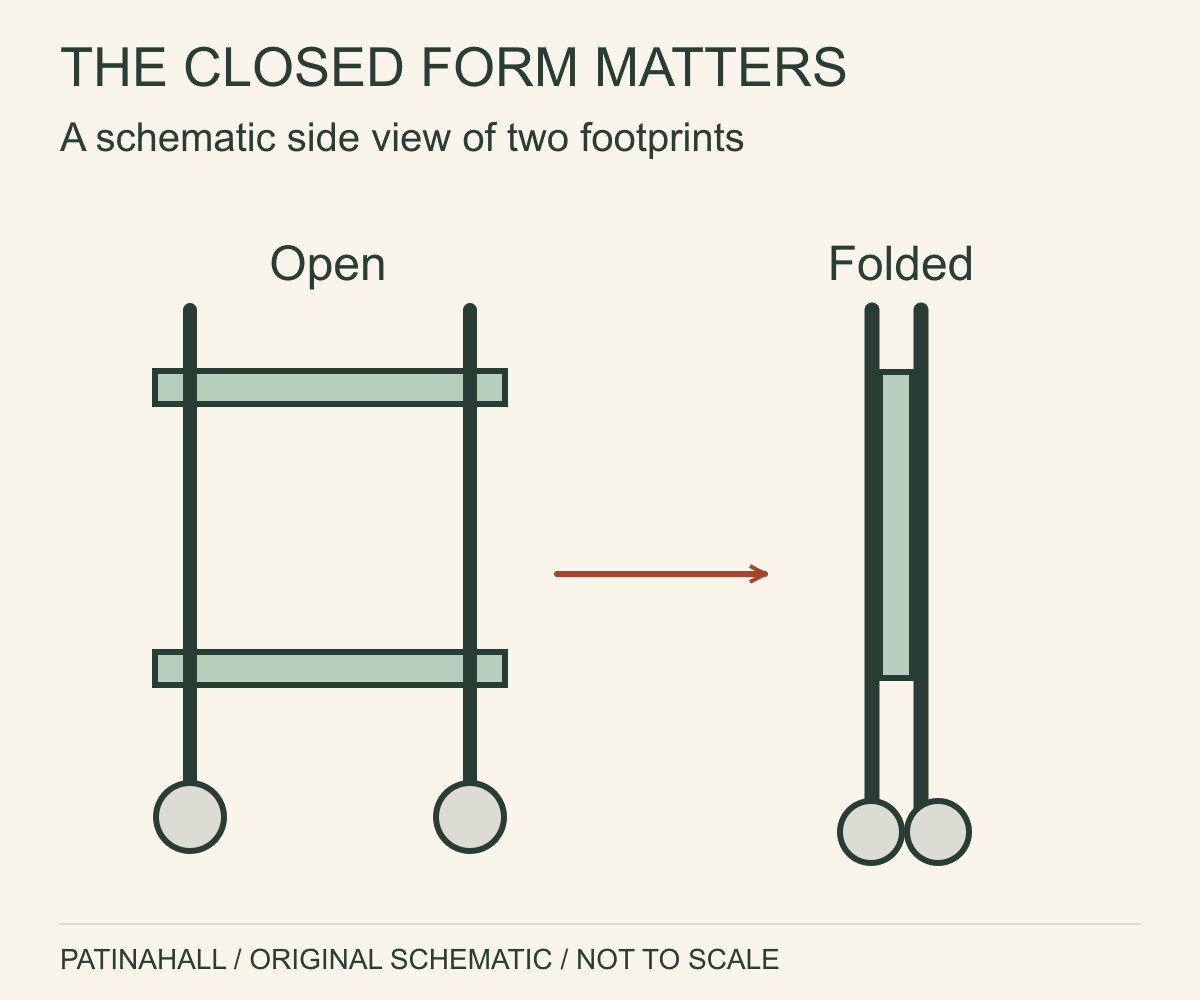
Side-view abstractions compare an open two-level trolley with a much narrower folded volume.
The comparison explains why storage between uses belongs to Gastone’s design. It is not a folding sequence or a dimensional product drawing. Original PatinaHall schematic, not to scale.

The name on a second-hand trolley

Kartell’s related folding furniture can make resale descriptions confusing. Gastone is the two-level trolley discussed here; Battista is a separate folding-table design. A shared maker, designers or period does not make the names interchangeable.12

An ordinary second-hand Gastone therefore has a story beyond its colour and condition. It belongs to furniture designed around intermittent need. A home may want a small service station for a few hours and clear floor space for the rest of the day. The ability to become less furniture is precisely what makes this trolley interesting.

Research notesEvidence, connections and limits

Kartell Museo dates Gastone to 1991 and credits Citterio and Löw. Its material list and current finishes are source-specific; Gastone and the related Battista folding table are not interchangeable identities.

Evidence map

Connected subjects and evidence

Reviewed connections

  • Kartell Gastone trolleydesigned byAntonio Citteriodocumented

    Kartell Museo dates Gastone to 1991 and credits Citterio and Löw. Its material list and current finishes are source-specific; Gastone and the related Battista folding table are not interchangeable identities.

    Reviewed 7 September 2026 by PatinaHall editorial.
  • Kartell Gastone trolleydesigned byOliver Löwdocumented

    Kartell Museo dates Gastone to 1991 and credits Citterio and Löw. Its material list and current finishes are source-specific; Gastone and the related Battista folding table are not interchangeable identities.

    Reviewed 7 September 2026 by PatinaHall editorial.
  • Kartell Gastone trolleymanufactured byKartelldocumented

    Kartell Museo dates Gastone to 1991 and credits Citterio and Löw. Its material list and current finishes are source-specific; Gastone and the related Battista folding table are not interchangeable identities.

    Reviewed 7 September 2026 by PatinaHall editorial.

Research trail

Sources and further reading

  1. Kartell Museo: Gastone, page 67Kartell MuseoAccessed 7 September 2026
  2. Gastone: folding trolley by Antonio Citterio and Oliver LöwKartellAccessed 7 September 2026

Last reviewed 7 September 2026. Found an error or a stronger primary source? Contact PatinaHall.