
The workshop needed a better lamp
Jieldé’s French history begins in 1950 with Jean-Louis Domecq working in his workshop and finding the available lamps poorly suited to the job. His answer was a solid articulated light that could be directed towards a task.1
That origin makes the design easier to understand. A workshop light must reach around the work, hold a useful position and tolerate repeated adjustment. Its joints are central to the job rather than details to conceal beneath a decorative outer shape.
The shade’s surrounding ring reinforces the same impression. It gives the head a distinct outline and a visible place around which it can be handled, making the lamp read as a working tool even when it stands in a living room.
Electricity through the elbow
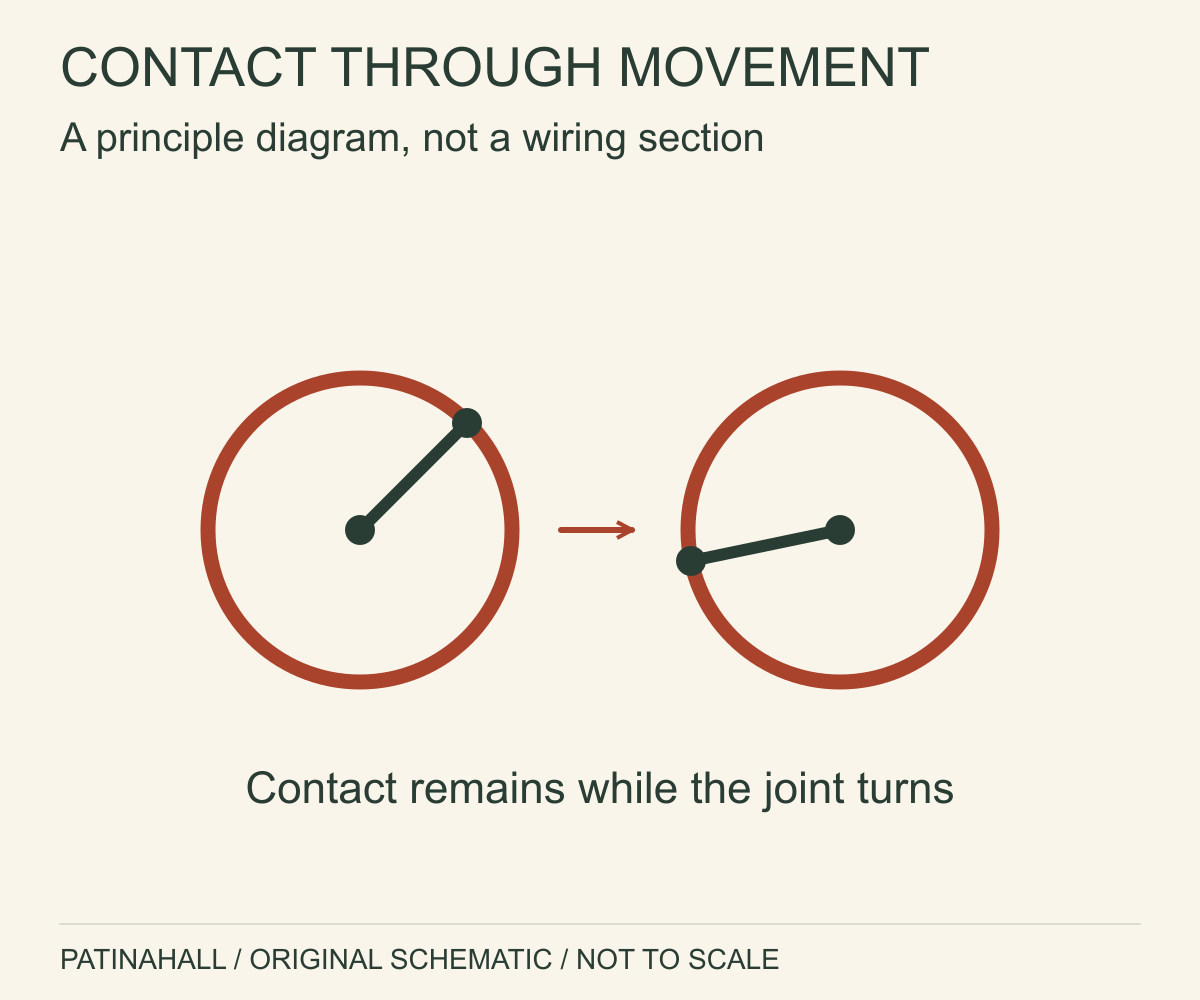
The maker’s current Loft description explains circular contacts within the articulations, allowing movement without a cable flexing inside each joint. The historical account also treats the electrical joint system as a defining part of Domecq’s design.32
This does not mean the lamp contains no wiring. It means the moving connection is solved differently at the elbow. That distinction is the interesting part: a mechanical joint and an electrical connection have to coexist in the same small space.
Our contact drawing is an abstract explanation of the principle. It is not a section through a specific surviving lamp or a wiring diagram. The actual electrical assembly belongs to the manufacturer’s design and a particular lamp’s service history.
Standard becomes part of domestic life
Jieldé USA’s chronology distinguishes the early Standard from the later Loft range and the smaller Signal family. The French maker likewise describes the lamp’s passage from workshops into homes while retaining its articulated character.21
That change of setting is easy to picture. A lamp once positioned around a machine can direct light towards a desk, a reading chair or a bedside surface. The visible joints retain their practical origin even when the surrounding work is different.
Colour can soften the industrial association, but it does not erase the mechanism. The elbows and shade ring remain the parts by which the family is recognised.
More useful than the word industrial
“Industrial lamp” is a broad resale description. Jieldé’s story gives the reader something more specific to notice: the relationship between articulation and electrical continuity.
An old Standard, a later Loft and a Signal can all belong to that wider history without sharing a production date or identical parts. The memorable feature is the elbow itself—a small place where the lamp’s need to move and its need to carry current had to be designed together.