Open the doors before naming the style
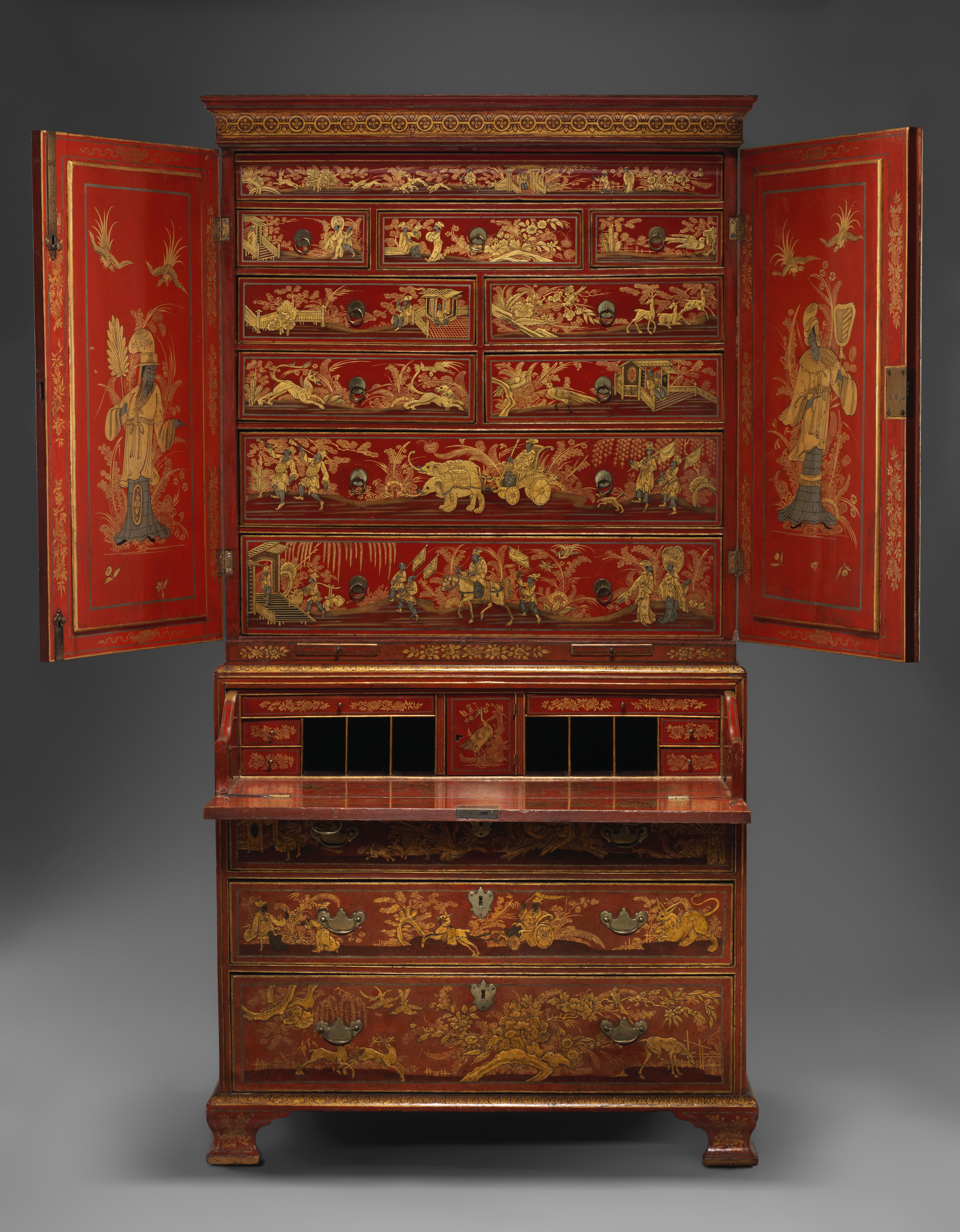
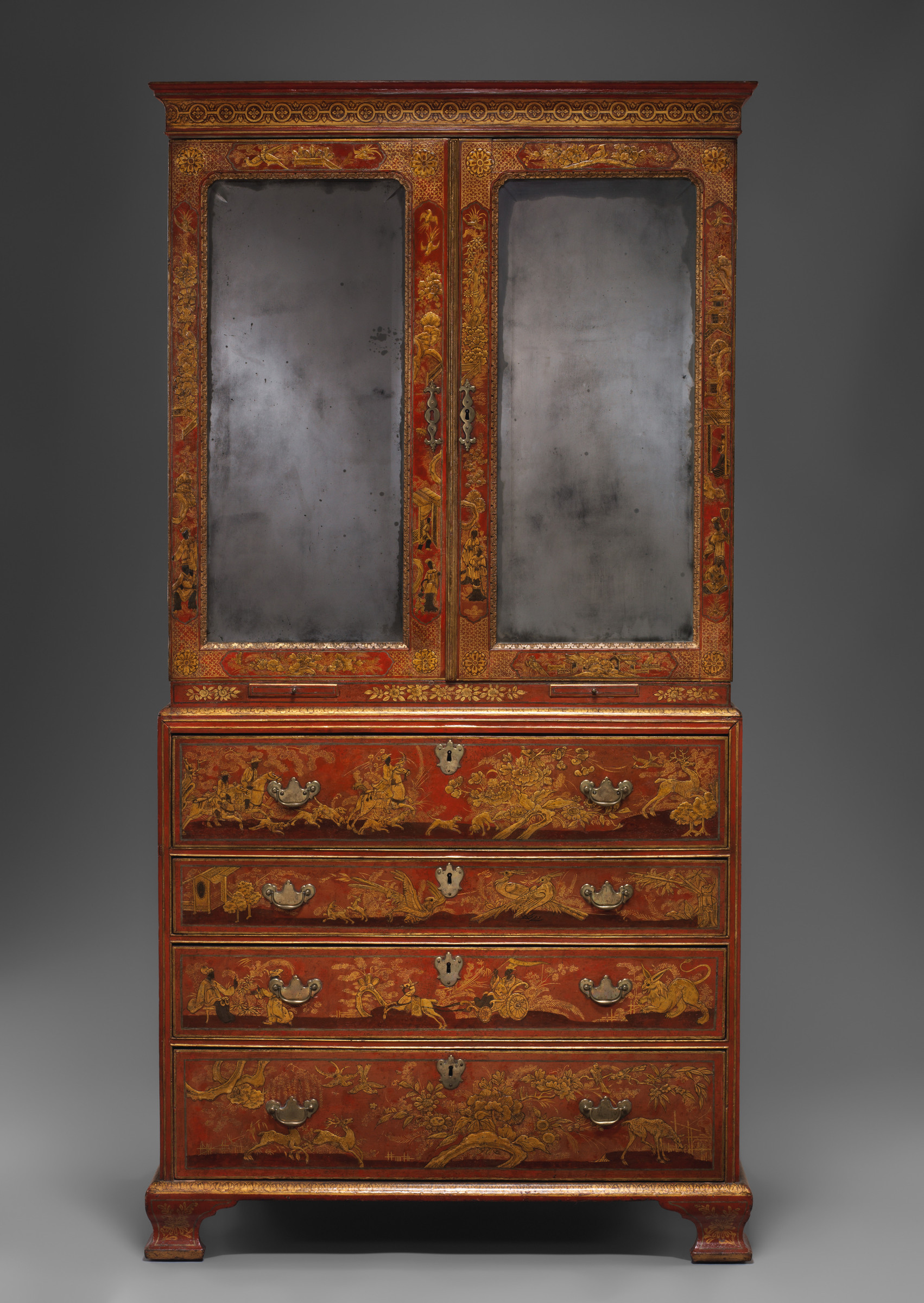
Closed, the upper half of this cabinet offers two tall mirrors above a red chest of drawers. Open the doors and restraint disappears. Eleven painted drawer fronts crowd the upper case. Below them, a sloping leaf falls forward to become a writing surface, exposing smaller drawers and pigeonholes. Gold figures, birds, plants and buildings occupy almost every red panel still left available.
The Metropolitan Museum of Art dates exact object 2014.186 to about 1735 and classifies it as British. At 205.7 centimetres high, it has the scale of a small piece of architecture. Its recorded materials are oak, pine and walnut decorated in red, gold and silver japanning, with brass and mirror glass. 1
How did a practical writing cabinet turn imported lacquer, substitute varnishes and printed patterns into an imagined East Asia? By making distance work at several levels at once. Trade supplied admired objects. European materials supplied an imitation surface. Engraved designs made motifs portable. The secretary form then brought that broad fantasy into the daily business of opening drawers, finding paper and writing letters.
The closed photograph is essential because it shows how much the object can withhold. Mirrors replace the painted inner drawers. The red-and-gold surface becomes a frame rather than a flood. Furniture changes the argument simply by moving two doors.
Japanning is not East Asian lacquer
The period name can blur the distinction it ought to preserve. East Asian lacquer is made from the refined sap of lacquer trees and built through a highly controlled material process. European japanning sought a related dark, lustrous or coloured effect with varnishes available to European makers. It is imitation lacquer, not a European application of the same substance.
The Victoria and Albert Museum explains the practical divide. Lacquered goods from East Asia became coveted in Europe, but the key raw material hardened during the long sea journey and could not simply be shipped as a workshop supply. European craftspeople developed substitutes using ingredients such as sandarac or shellac, with results that varied considerably. 2
Those are general examples, not a laboratory report for cabinet 2014.186. The Met records the surface as japanning but supplies no resin analysis, recipe or coat count. Saying that European makers could use shellac does not prove that this object did. The useful conclusion is narrower: its effect was made through a European imitation process, and the exact formula remains unstated.
That boundary also keeps this secretary distinct from Chinese carved lacquer. Both may reward close looking at built surfaces, but they are not interchangeable techniques and should not be gathered under one vague word merely because both can gleam.
A luxury surface becomes a recipe
European demand did not begin with a pattern book. Portuguese trade routes, followed by Dutch and English East India Company networks, brought Chinese and Japanese lacquered goods into European collections. Cabinets made for export were especially prized. Their supply and cost helped create a market for local imitations.2
Print then changed the scale of participation. In 1688 John Stalker and George Parker published A Treatise of Japanning and Varnishing. The Met's copy records both authors, the London publication and its engraved illustrations. 3
The book did two jobs: it described ways of making lacquer-like finishes and supplied designs that could be transferred to objects. By about 1700, japanned bureau-cabinets had become popular in Britain, often using bright red grounds and gold or coloured decoration. A desirable imported surface had become a teachable local practice.2
That does not make the exact secretary a known illustration of Stalker and Parker. No source identifies its maker or proves that one plate directed one drawer front. The manual matters because it documents a system through which materials and motifs could circulate separately from the objects that first prompted European desire.
The cabinet is precise; its geography is not
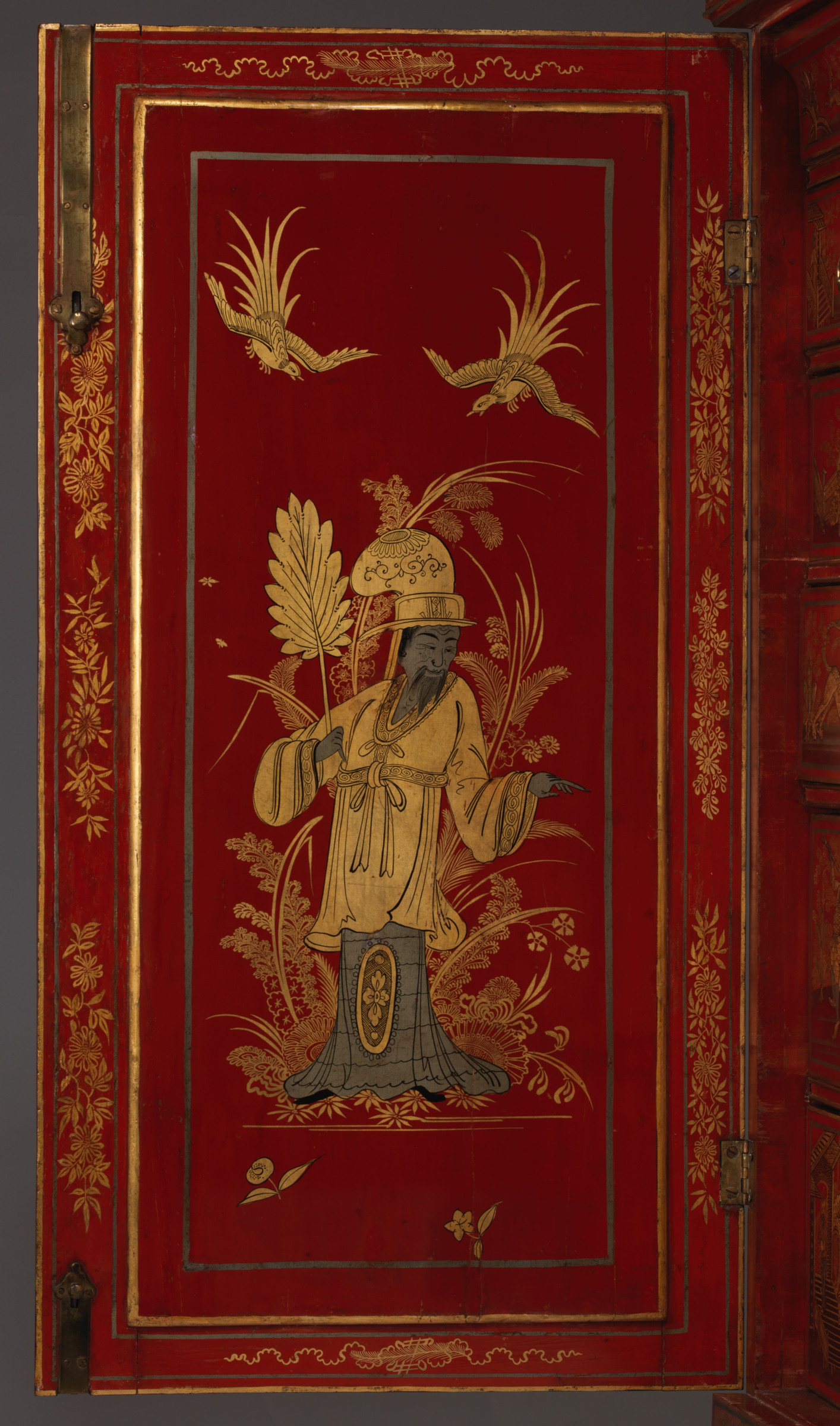
Look closely at one inner door. A large robed figure stands among plants while birds pass overhead. Fine borders enclose the scene. Hinges and a lock plate remain plainly visible, so the imagined landscape never escapes the practical door carrying it.
The names used around such decoration were far less precise than the cabinetmaking. The Met's research on a related British embroidered panel notes that Stalker and Parker praised Japan, advised readers by reference to “Indian” work and provided motifs that travelled across furniture and textiles. The museum describes that lack of cultural and geographic specificity as typical of the period.4
Modern readers should not repair that confusion by confidently identifying every figure as Chinese, Japanese or Indian. Nor should we pretend that “Asian-inspired” is a complete explanation. The imagery records a European market's broad construction of distance, assembled from imported objects, prints and expectation.
The cabinet is exact about where a letter should go and remarkably loose about the map on its surface. That imbalance is not a minor flaw in the label. It is part of what the object can now teach: technical ingenuity and cultural misrecognition can occupy the same beautifully organised piece of furniture.
Storage turns pattern into routine
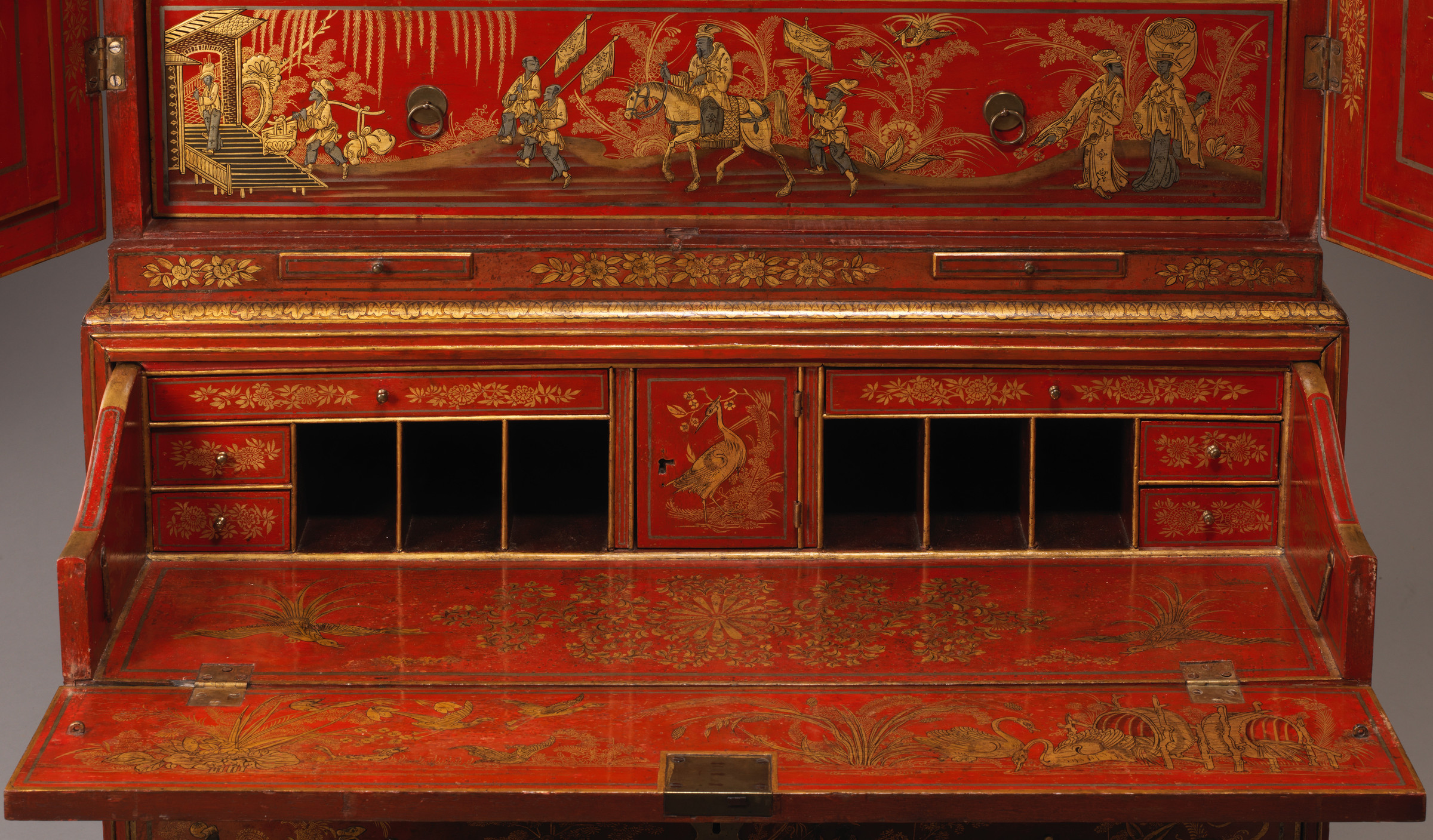
The writing compartment brings the story down from global trade to elbow height. The fall front becomes a work surface. Pigeonholes divide papers. Small drawers separate supplies or correspondence. Pulls, locks and hinges turn a painted world into a sequence of daily gestures.
Decoration continues through that working zone. Red panels run across the leaf and drawer fronts; gold scenes sit around empty compartments. The user did not approach the imagery only as a distant picture. It appeared whenever a letter was written, filed or retrieved.
That is why the secretary form matters. A plain chest could have carried a japanned exterior, but this cabinet repeatedly changes state. Closed, mirrors face the room. Open, dozens of painted compartments appear. Lower the leaf and the viewer becomes a writer inside the composition. Function gives the surface a rhythm.
The images cannot tell us who used this cabinet, what papers it held or which room it occupied. The Met does not name a maker or original owner. Describing the visible sequence is enough; inventing a household would only make the cabinet's already crowded interior less honest.
Look again at the red ground
Return to the whole open view and two kinds of order now separate. The joinery and fittings organise doors, drawers, mirrors and a desk. The japanned surface organises a European idea of elsewhere—technically resourceful, visually abundant and historically imprecise.
Neither story cancels the other. Calling the cabinet mere fantasy ignores the material experiment and disciplined furniture beneath it. Admiring the finish without naming imitation and conflation turns trade history into atmosphere. The object earns attention because usefulness, desire and misunderstanding remain joined.
About 1735, a British cabinetmaker whose name is not recorded built an exceptionally practical place for paper. Other hands covered it with a world assembled at a distance. Open the doors and both achievements become visible: one tells us where everything goes; the other shows how uncertain Europeans could be about where everything came from.