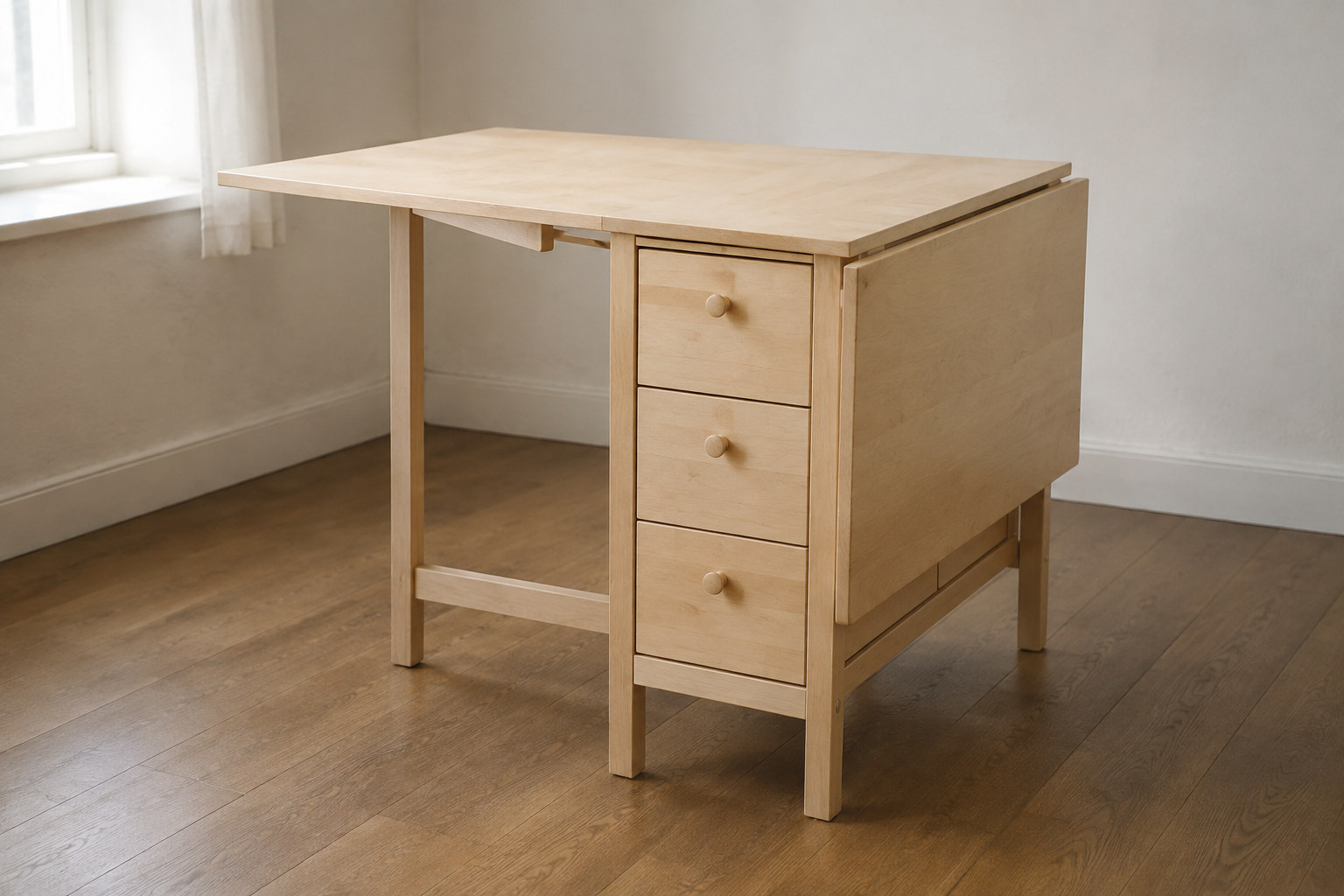
The table has more than one size
A kitchen table spends much of its life between meals. NORDEN makes that ordinary fact part of its construction. On the current birch version, the two leaves can hang beside a narrow central section, or one or both can be raised. IKEA lists lengths of 26, 89 and 152 centimetres, with an 80-centimetre depth.1
Those are different arrangements of the same object, rather than extra leaves fetched from another cupboard. The folded table still occupies floor space, but it asks the room for less of it until a larger surface is useful.
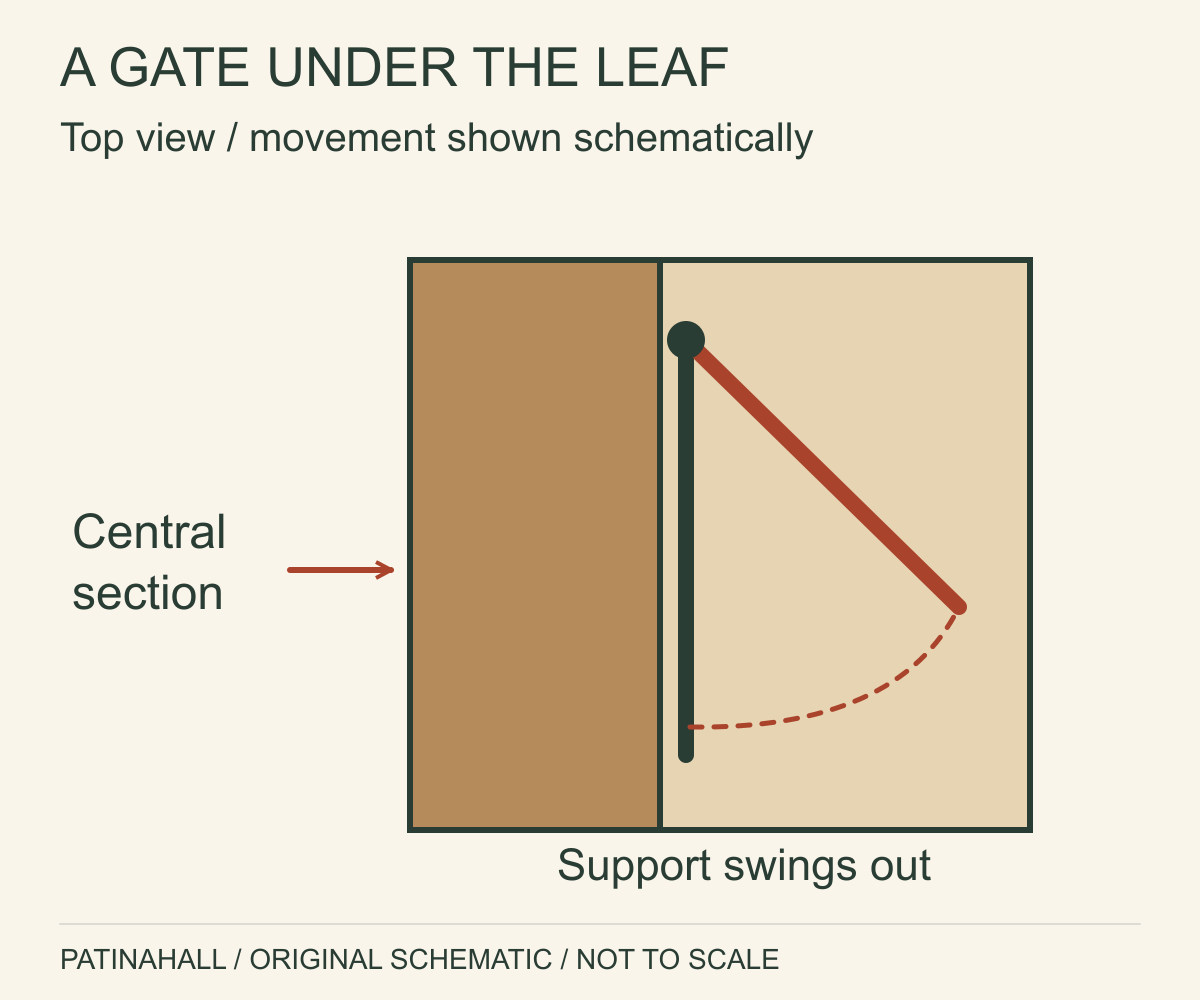
A gate underneath the leaf
A drop leaf names what the tabletop does. A gateleg names what one kind of support does. The leg assembly pivots out beneath the raised surface, rather like a small gate swinging away from its closed position.
That distinction is worth seeing because folding tops do not all work alike. Ercol’s separate 7384 drop-leaf table, for example, belongs to its own construction and product history; sharing a folding principle does not make it the same mechanism or family as NORDEN.2
In NORDEN, the tabletop and support change position together. A raised panel is only half the story. The space underneath it must also accommodate the support, which helps explain why the table’s open footprint matters as much as the width of its top.
Six drawers stay in the middle
The central drawers give the compact table an additional role. IKEA describes six compartments for items such as cutlery and napkins. They occupy the part of the furniture that remains in place while the leaves move.1
That is a different use of volume from a table with a completely open underframe. The middle becomes a small store of things associated with the surface above it. In a home where a table alternates between eating, paperwork and sewing, that relationship is easy to appreciate even if the contents differ.
The trade-off is equally visible. The centre is not empty knee space. NORDEN’s character comes from putting a folding surface and storage into one compact object, with both functions shaping the frame.
An old idea in an ordinary kitchen
IKEA itself places the gateleg principle in a much longer furniture tradition. This article does not assign a first launch year to the NORDEN gateleg model: the name also appears on other IKEA tables, and an old catalogue entry for an extendable table cannot settle this one’s origin.1
The historical interest does not depend on a dramatic invention claim. NORDEN makes a familiar problem visible in wood and hinges: sometimes a household needs the table, and sometimes it needs the room. The moving leg is the detail that connects those two states.