Design story

MOMENT: the sofa with a shopping-trolley connection

The wire grid behind MOMENT’s cushions has an unexpectedly practical origin. IKEA Museum connects the sofa to a visit to a shopping-trolley factory, where a different kind of steel furniture suggested a new way to build a seat.

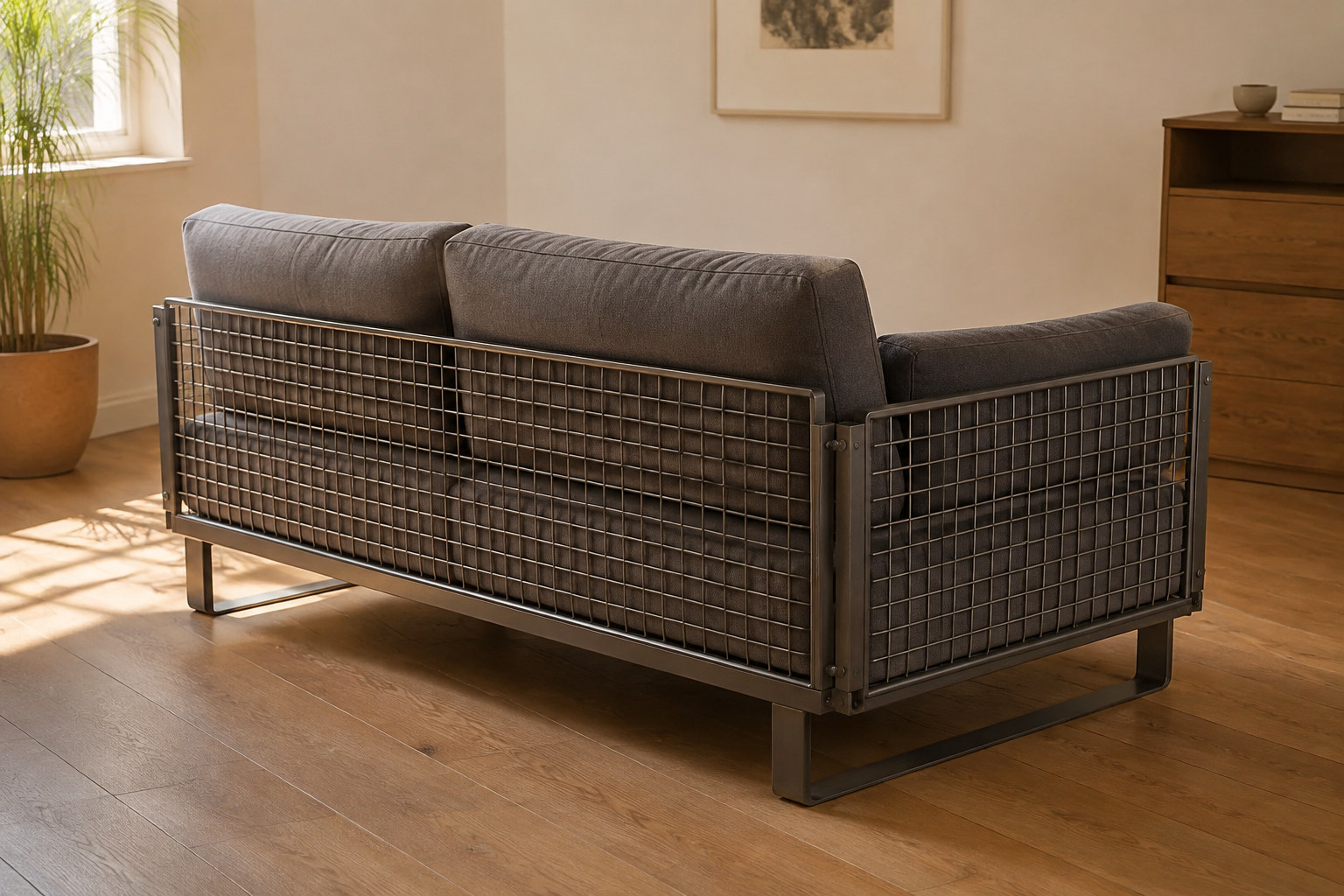
Reconstruction: A rear three-quarter view of a grey sofa with separate cushions inside an exposed steel wire-grid frame.
PatinaHall editorial reconstruction. It is not a documentary photograph. This MOMENT interpretation lets the steel grid remain visible behind the soft cushions. Frame details and upholstery are illustrative, not a record of one production example.
On this page
Key facts & takeaways

At a glance

Subject
IKEA MOMENT sofa
Entry
Design story
Last reviewed
7 September 2026

Three things to remember

  1. 1984 is the museum’s design year; 1985 is the catalogue chapter.
  2. The trolley-factory connection explains the visible steel grid.
  3. The frame and soft cushions were treated as separate components.

A factory with an unexpected answer

A sofa factory might start with timber frames and upholstery. MOMENT’s story takes another route. IKEA Museum describes Niels Gammelgaard and Lars Engman visiting a producer of shopping trolleys and seeing potential in its way of working with wire and flat steel.1

The useful connection was production capability. A company making one everyday object already knew how to form and join material for repeated loads and regular use. That knowledge suggested furniture beyond the trolley itself.

This is why MOMENT’s grid feels integral to the design. It is the visible consequence of asking a different factory a different question about a sofa.

The frame and the softness travel separately

The museum account describes four frame components and separate cushions for the seat, back and arms. It dates the design to 1984 and places the sofa on the 1985 catalogue cover.1

The division is easy to read. Steel establishes the support and outline; cushions supply the soft surfaces that meet a body. Packing and assembly become part of the design process because these elements do not have to travel as one large upholstered volume.

Our component drawing shows that separation conceptually. It is not an original assembly drawing and does not claim that loose cushions from different surviving sofas are interchangeable.
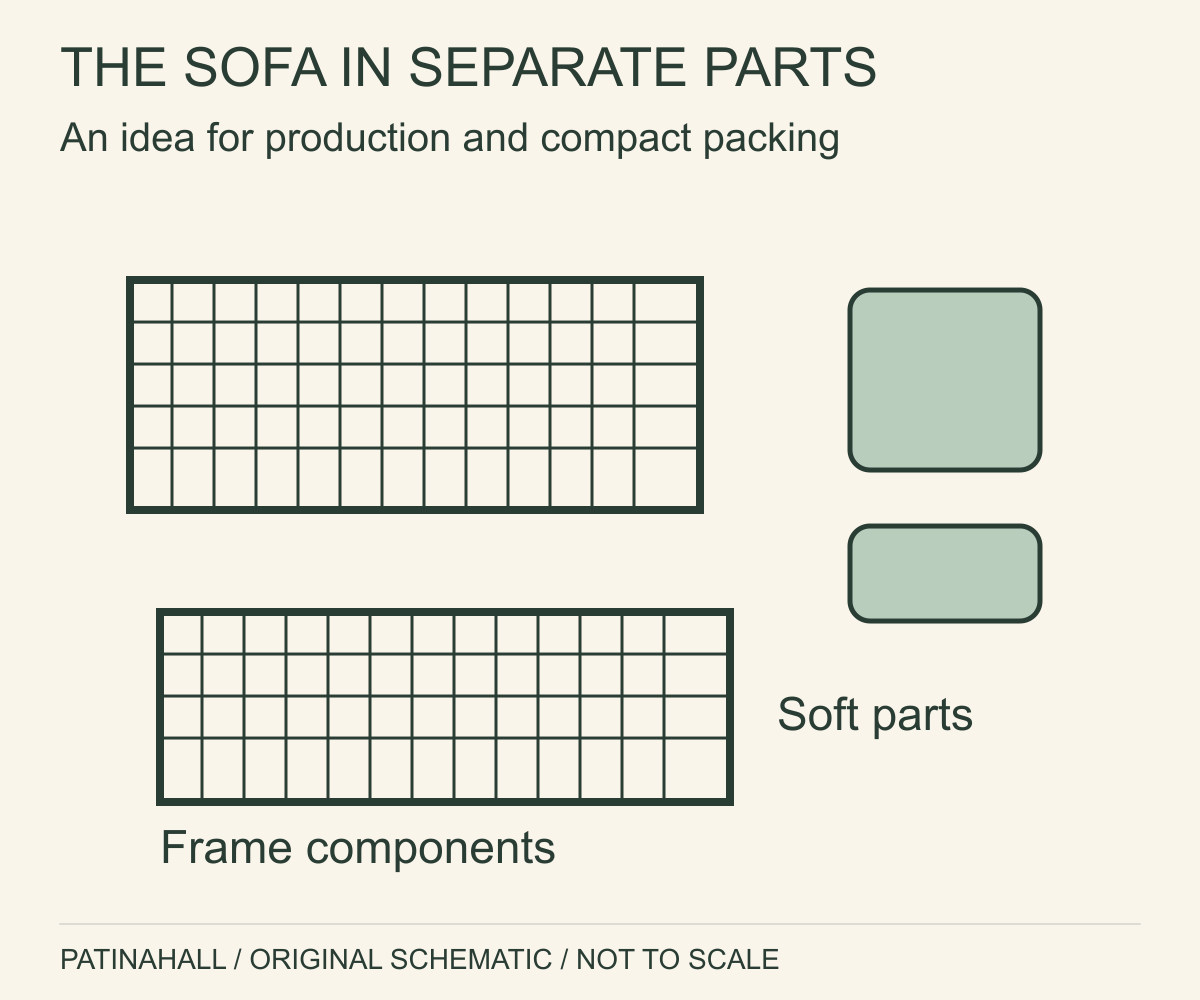
Separate rectangular steel grids and soft blocks illustrate a sofa divided into frame and upholstery components.
The museum records separate MOMENT frame parts and cushions. The diagram shows component separation only; it is not the original four-part assembly plan. Original PatinaHall schematic, not to scale.

A grid with space inside it

Look at MOMENT from behind and the grid becomes more than a frame hidden by fabric. Light can pass between the wires. The upholstery occupies only part of the visible structure, leaving a patterned boundary around it.

That makes the sofa feel different from a closed upholstered box. It does not take up less physical room simply because parts are open, but it lets more of the surrounding space remain visible. The repeated lines also create a clear contrast with the larger, softer cushion surfaces.

Gammelgaard’s GUIDE shelving, also documented by IKEA Museum in the 1984/85 period, offers a useful companion. Its open steel structure and separate shelves show a related interest in making components and their assembly readable.2

A familiar object from an unfamiliar route

The attraction of MOMENT’s history is that the source object is so ordinary. A shopping trolley is made to circulate through a supermarket, while a sofa is made to stay in a room. A production method can connect them even when their daily roles are far apart.

A used MOMENT does not need its original catalogue setting to make that connection interesting. The wire remains visible beneath and behind the cushions. It is the part of the sofa that tells you where the design began looking for an answer.

Research notesEvidence, connections and limits

IKEA Museum distinguishes the 1984 design from the 1985 catalogue. The production story is its retrospective account; no first-ever industrial claim, timeless cushion specification or authentication by grid alone is adopted.

Evidence map

Connected subjects and evidence

Reviewed connections

  • IKEA MOMENT sofadesigned byNiels Gammelgaarddocumented

    IKEA Museum distinguishes the 1984 design from the 1985 catalogue. The production story is its retrospective account; no first-ever industrial claim, timeless cushion specification or authentication by grid alone is adopted.

    Reviewed 7 September 2026 by PatinaHall editorial.
  • IKEA MOMENT sofamanufactured byIKEAdocumented

    IKEA Museum distinguishes the 1984 design from the 1985 catalogue. The production story is its retrospective account; no first-ever industrial claim, timeless cushion specification or authentication by grid alone is adopted.

    Reviewed 7 September 2026 by PatinaHall editorial.

Research trail

Sources and further reading

  1. MOMENT sofa: 1984 design and 1985 catalogueIKEA MuseumAccessed 7 September 2026
  2. GUIDE: 1984 bookshelf and 1985 catalogueIKEA MuseumAccessed 6 September 2026

Last reviewed 7 September 2026. Found an error or a stronger primary source? Contact PatinaHall.