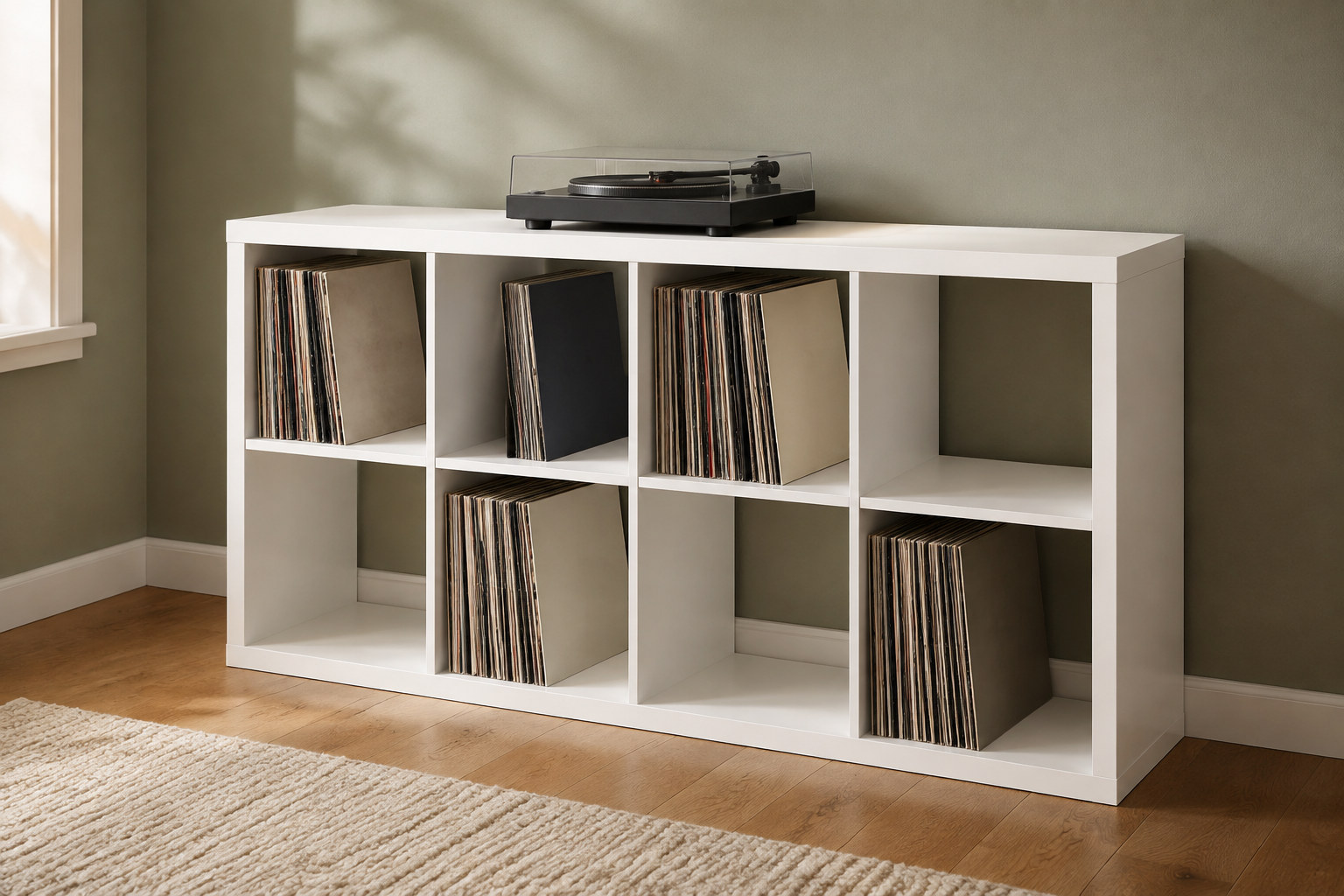
The records had already chosen a size
The distinctive unit of EXPEDIT was the open square. Books, boxes and records could each occupy a compartment while the repeated grid held the arrangement together. An early IKEA website preserved in the museum’s history shows EXPEDIT as part of the company’s developing online catalogue.2
A shelf like this accumulates more than possessions. Its owner learns what will fit. Once a row of records occupies a cube, the opening becomes a practical standard within that particular home. Changing it would affect a collection that already existed.
A change around the contents
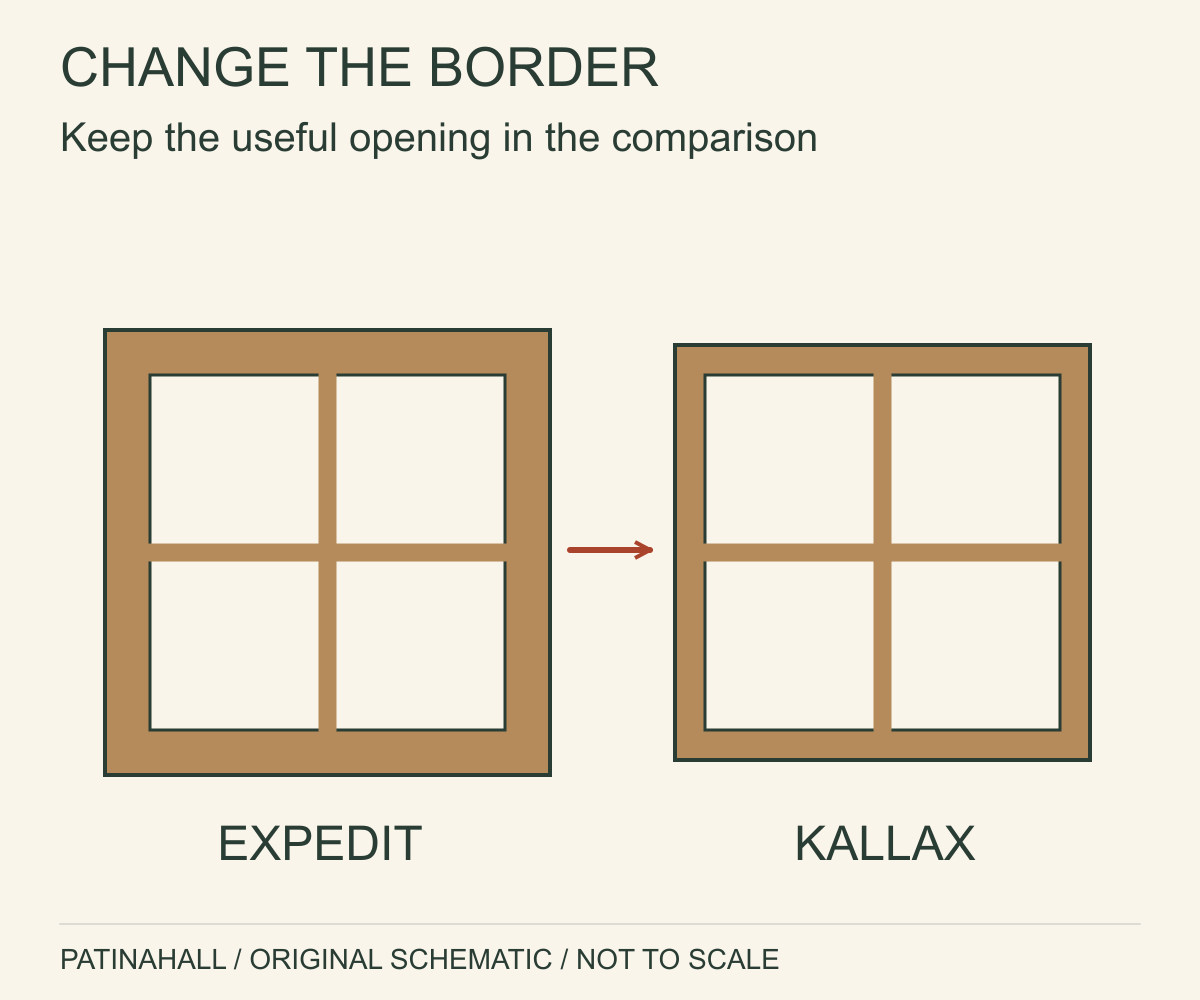
IKEA’s German announcement set out the transition to KALLAX from April 2014. The outer construction became slimmer, while the internal dimensions in its comparison remained unchanged. The company also described changes to edges, surfaces and packaging.1
This makes the redesign unusually easy to explain: the border changed while the useful opening stayed familiar. A unit can occupy slightly less space outside without making its individual compartments smaller inside.
Our comparison drawing separates those two measurements. It is a diagram of the decision, not a dimensional drawing for a particular unit. The heavy outside frame and the repeated internal divisions should be looked at as different parts of the design.
An open back becomes part of a room
The grid also works differently from a closed cabinet. Objects remain visible, and an open unit can be read from more than one direction. A few empty compartments can let a view continue through the furniture; filled compartments make a denser visual screen.
That is an observation about the form, not a claim that any size can stand safely anywhere. Orientation, anchoring and loading depend on the exact model and its instructions. The interesting design point is how a series of ordinary storage openings can begin to shape the space around it.
Why two names still matter
An EXPEDIT listing and a KALLAX listing may look almost identical in a small photograph. The names nevertheless refer to separate production chapters. IKEA’s 2014 comparison helps explain the relationship, but it is not a promise that every later accessory fits every older unit.1
The older shelf does not need a rare finish or a famous designer attribution to have a story. Its dimensions were already entangled with everyday possessions when its replacement arrived. KALLAX illustrates a quiet kind of continuity: redesigning a product while leaving room for the things people had put into it.