The grid is the first clue
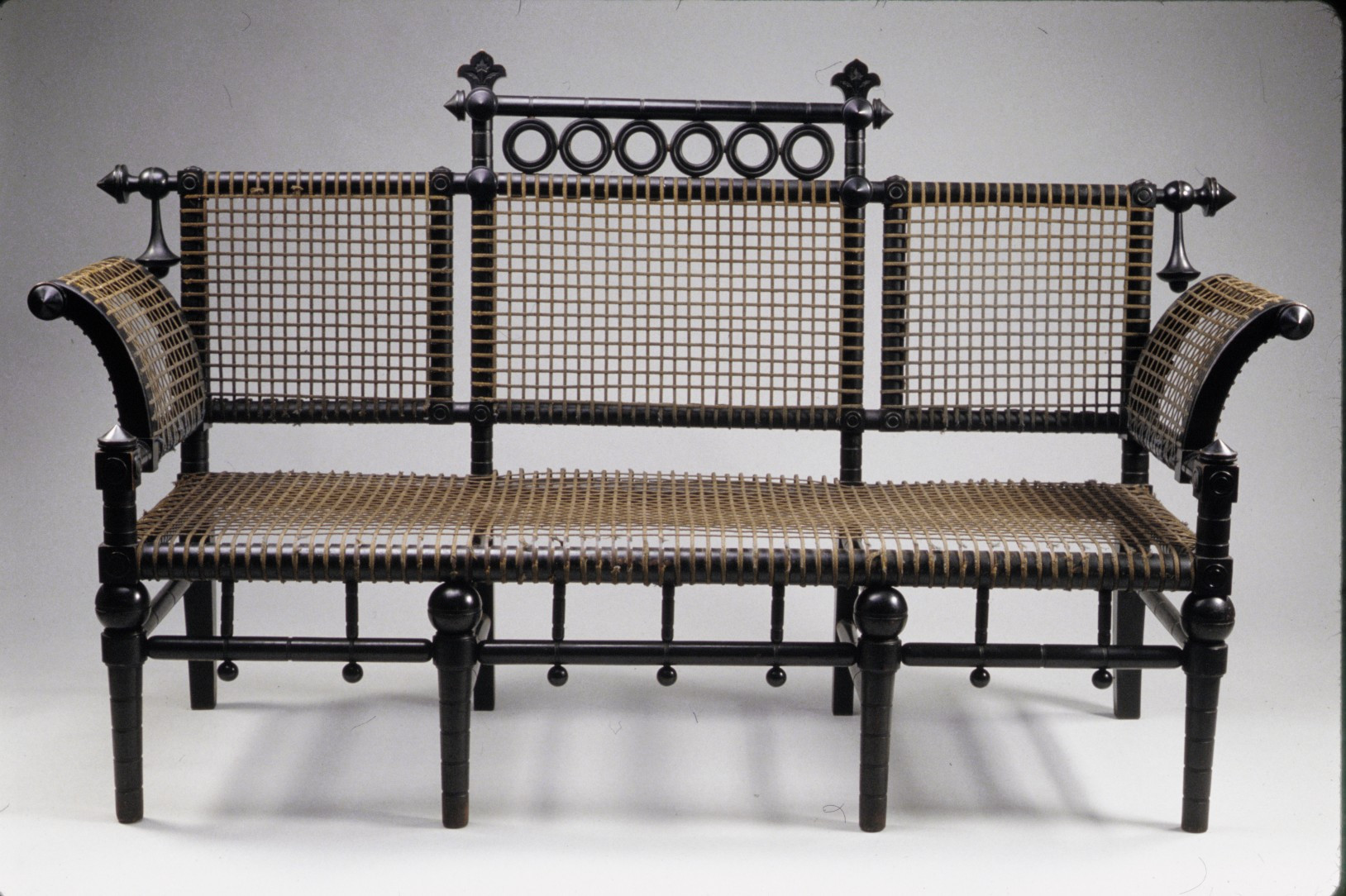
George Jakob Hunzinger’s settee looks almost diagrammatic. Dark turned members divide the back into three rectangles, while a pale square grid crosses the seat, every back panel and both outward-curving arms. The eye can follow frame and surface separately. Nothing resembling a thick upholstered pad conceals how the sitter is carried.
The Met dates this exact settee to about 1876–85 and records ebonized cherry with fabric-covered steel mesh. At just over 171 centimetres wide, it is large enough for the repeated construction to become unmistakable. Yet object 1992.269 is not the permanent identity of the system: it is one physical application made after the construction had been patented. 1
That distinction matters because the grid can easily be mistaken for cane in a photograph. Cane is plant material worked into a seat. Here the visible textile is a covering around metal. The surface looks woven because it is woven; its hidden core and its route around the frame make it a different proposition.
Metal wearing textile
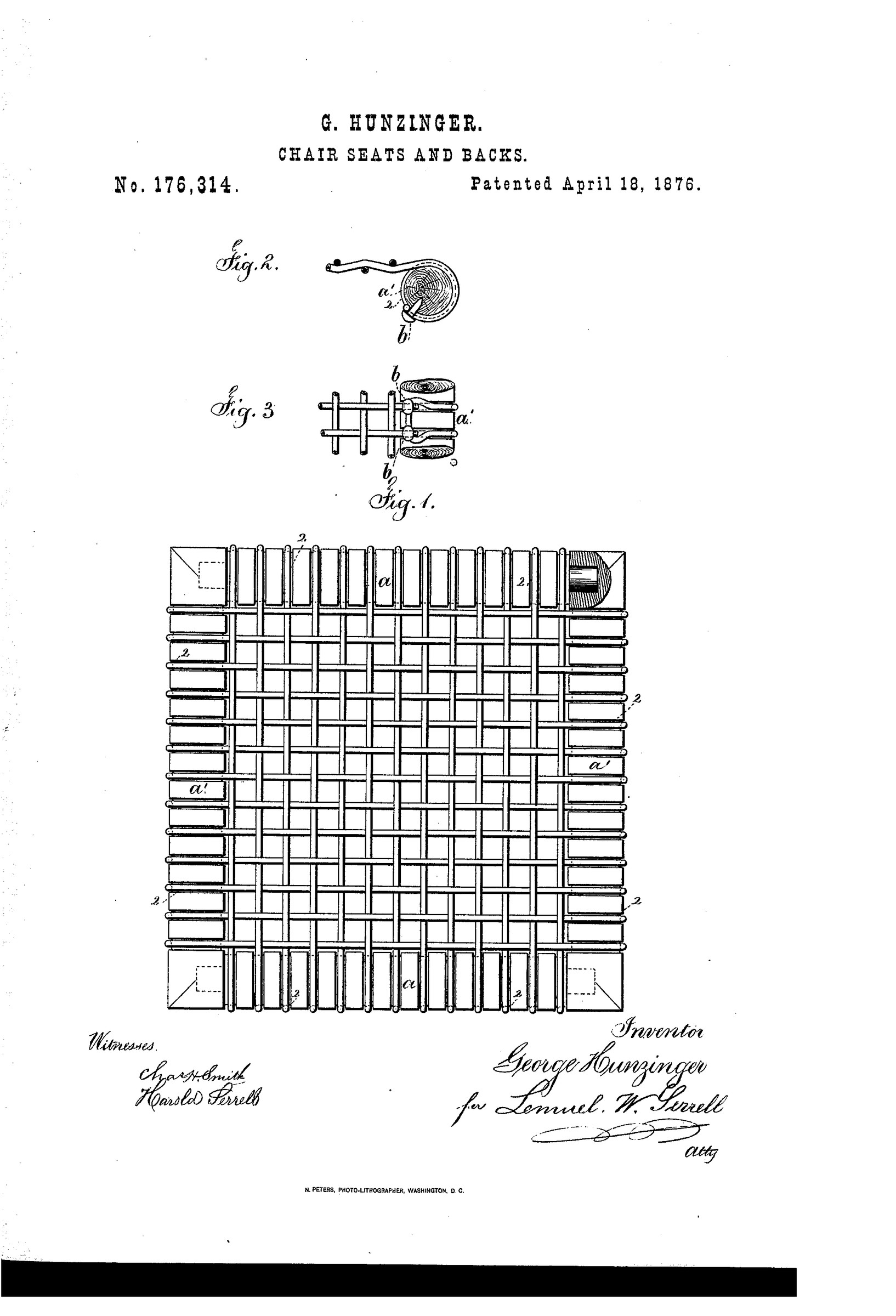
US Patent 176,314, granted to George Hunzinger on 18 April 1876, calls the invention an improvement in chair seats and backs. Its specification starts with metallic wire or strips and then changes what the sitter encounters: thread can be wound, braided or woven around that metal before it enters the chair.3
The wrapping does several jobs at once. It softens visual contact between dark wood and bright metal, gives the grid a textile surface and creates a material that can participate in a decorative colour scheme. The steel remains structural without needing to announce itself as bare industrial wire.
This was not simply a nineteenth-century maker replacing cane with a stronger lookalike. The patent joins metal, textile and wooden perimeter into one construction. Remove the covered strip and there is no supporting web. Remove the prepared frame edge and the strip has no ordered route.
One strip becomes a grid
The patent drawing makes that route readable. Small peripheral grooves divide the frame bars, and pins help retain the covered strip. One direction runs back and forth across the opening; the second crosses it and interlaces with the first like wire cloth. A section at the top of the sheet separates the flat metal core from its textile covering.3
The Met’s account of the settee sharpens the economy of that idea. Each seat, back and arm surface uses only two continuous wires, one travelling in each direction. What appears to be a collection of many short lengths is therefore a disciplined route made legible by every turn at the perimeter. 1
Those turns explain the stripes around the frame. They are not an applied trim imitating lashing. They record the covered wire leaving one span, wrapping the edge and returning across the field. The border is where a flat drawing becomes a tensioned surface.
Interchangeable parts organise the settee
Hunzinger’s construction did not stop at the webbing. The Met describes the settee as built from interchangeable parts, an industrial principle made visible by repeated turned rods, blocks, finials and circular ornaments. Distinct units meet at emphatic joints instead of being carved into one continuous wooden mass.1
Repetition creates both production logic and decoration. Three back fields share the same grid but not identical frames: the taller centre carries a row of rings and a crest, while the side fields align with the arms. Below, turned crossbars and hanging wooden balls make standardised-looking pieces into a rhythm.
The Met connects the settee to a larger suite with two armchairs, four side chairs and a table. That inventory shifts the subject away from a single eccentric sofa. A repeatable vocabulary of covered-wire panels and turned components could be recombined across several furniture types.
A system, not a single silhouette
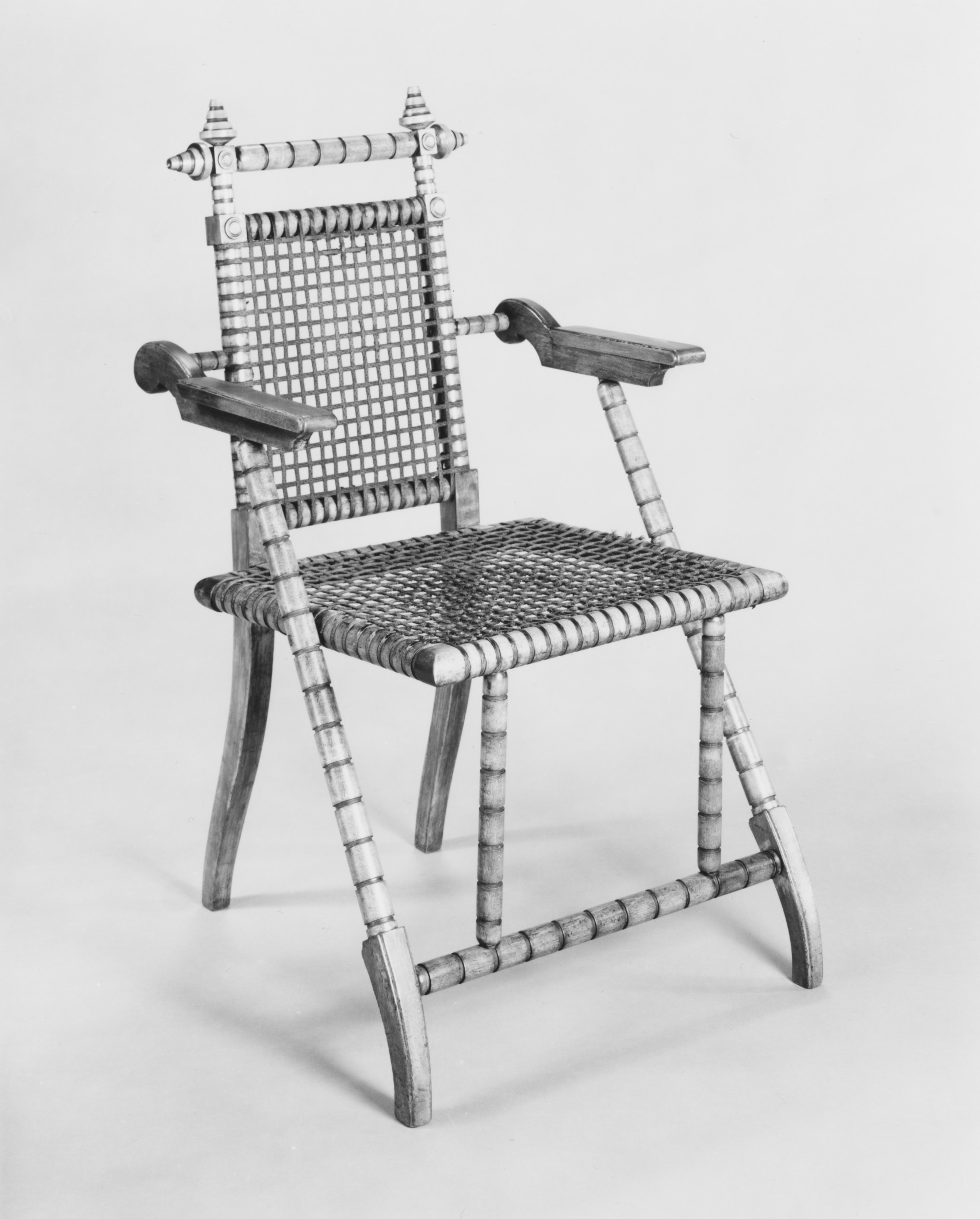
The folding armchair makes the point more forcefully because it does not look like a reduced settee. The Met dates that exact maple and steel-mesh object to after 1876. Its legs cross, the sides lean, the arms project and the frame advertises movement. The square grid still fills seat and back, but it now works inside a lighter structure intended to fold.2
Here the construction identity survives a change of wood, scale and geometry. The chair need not repeat the settee’s black finish, triple back or ornamental rings. What persists is the relationship between a prepared frame and textile-covered metal woven across it.
The comparison also prevents the patent date from drifting onto every object. The patent was granted in 1876; the settee is dated about 1876–85; the folding armchair is dated after 1876. Those statements can coexist because a design history and an object history answer different questions.
A patent records a claim, not every chair
Hunzinger was a prolific patentee: The Met credits him with at least twenty-one furniture patents. It also notes an important complication. This covered-wire construction, his sixth patent, modified a carriage-seat patent issued to Chester D. Flynt earlier in 1876.1
The useful claim is therefore bounded. Hunzinger patented this particular improvement and applied it to furniture with a distinctive prepared frame, covered metal and two-direction web. The evidence does not support a sweeping claim that he invented every wire seat or every textile-covered metal support.
Nor do a square grid and turned wood authenticate an unreviewed chair. The patent tells us how the proposed construction works; the Met records tell us what two exact objects are, when they are dated and what they contain. Between them, they reveal a design system unusually clearly. Beyond them, maker, production and date require their own evidence.