Design story

Hoosier cabinets: the kitchen gathers in one place

Before a kitchen wall routinely came lined with cupboards, a freestanding cabinet could gather much of the work into one place. The Hoosier idea put ingredients above, a preparation surface in the middle and storage below. Its appeal lay in the short journey between reaching for something and using it.

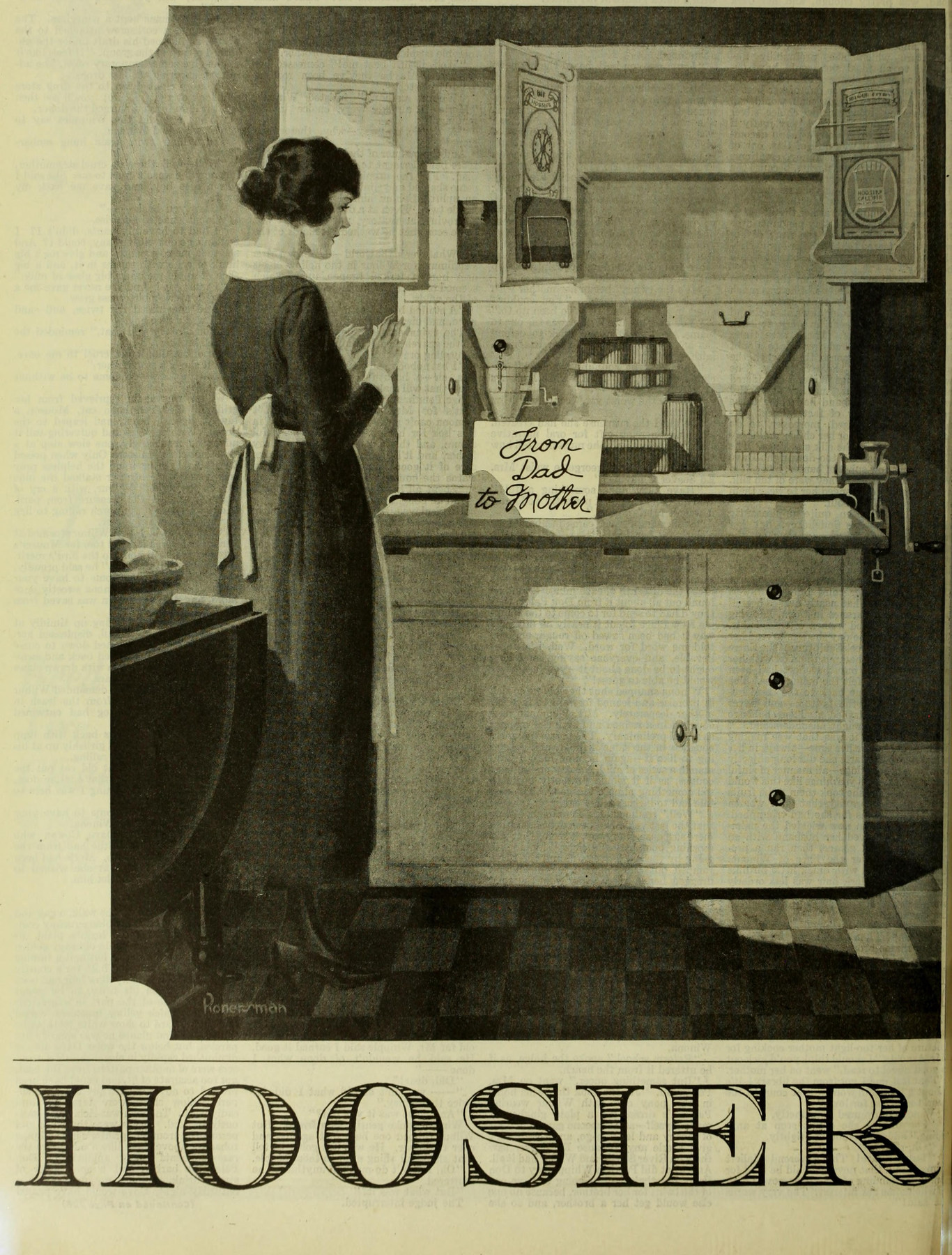
A period advertisement shows a woman beside a white kitchen cabinet with open upper doors and a wide work counter.
Illustration from a Hoosier Manufacturing Company advertisement in The Saturday Evening Post, 4 December 1920, p. 127. The cabinet presents storage and a work counter as a single domestic workplace. University of Illinois digitisation via Internet Archive Book Images and Wikimedia Commons; Public domain.
On this page
Key facts & takeaways

At a glance

Subject
Hoosier-type kitchen cabinets
Entry
Design story
Last reviewed
11 September 2026

Three things to remember

  1. The preparation surface is the centre of the cabinet’s arrangement.
  2. Hoosier Manufacturing Company was one maker within a wider cabinet type.
  3. Period claims about saved steps should be read as advertising claims.

Everything gathers around the counter

The counter divides the cabinet into things within reach above and things stored below. It is where ingredients become work: a bowl can be set down, a container opened and a small task kept within a concentrated area.

Historic New England’s 1920 example is made in oak with a white enamel counter. Its upper compartments include a flour sifter and sugar dispenser; drawers and a cupboard occupy the lower section. The institution identifies it as a product of the Hoosier Manufacturing Company of New Castle, Indiana.1

The arrangement is easier to understand if you imagine the cabinet occupied. The point is not simply that it holds many things. It places several things involved in the same task near a surface on which that task can happen.
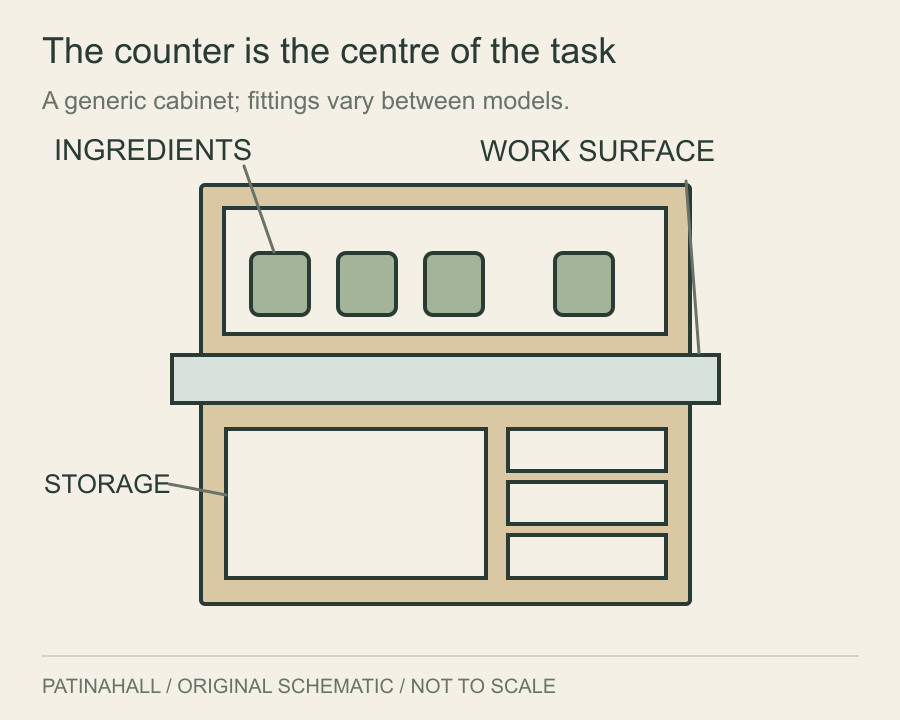
A broad counter sits between ingredient cupboards above and storage below.
Original PatinaHall schematic, not to scale: ingredients, a working surface and storage meet in one cabinet. The arrangement is generic; fittings and the allocation of space varied between makers and models.

A kitchen workplace could be bought as furniture

Indiana’s educational account places these cabinets in the period before fitted kitchen storage became commonplace. Their freestanding form let a household acquire a concentrated workplace as a piece of furniture. Variations included additional storage fittings and extending working surfaces.3

That relationship between object and room is distinctive. The cabinet organises a part of the kitchen without requiring every wall to be rebuilt around it. It arrives with an internal plan of its own.

The upper and lower sections also make different demands on the body. Some contents are reached for directly; others require opening a door or drawer. The cabinet turns a collection of repeated small movements into a design problem.

The name spread beyond one factory

Hoosier-type cabinets were made by several companies. The Coppes Commons museum’s account distinguishes its own production history from the wider category and explains why details must be read against a particular maker and period.2

A family resemblance does not mean that every cabinet has the same internal equipment. Nor does the generic name establish a Hoosier Manufacturing Company origin. The useful comparison begins with the broad arrangement, then moves towards the fittings and marks of the individual object.

That variety is part of the story. Manufacturers could compete over how successfully they organised the same everyday work.

The advertisement sells the steps between things

The Indiana Historical Society’s material on kitchen organisation preserves the period interest in reducing unnecessary movement. Advertising made saved time and effort central to the cabinet’s appeal.4

Such promises are evidence of what sellers wanted households to value. They are not, by themselves, proof that every kitchen or user achieved the advertised result.

Look again at the cabinet’s middle: the clear working surface with ingredients and equipment arranged around it. The most durable idea is visible there. Furniture can be designed around the short distances travelled by a pair of hands.

Research notesEvidence, connections and limits

The Historic New England cabinet is an exact object; the wider type varies by maker and date. The period image records a sales presentation, and the schematic does not reproduce a particular model or verify its claimed labour savings.

Evidence map

Connected subjects and evidence

Reviewed connections

  • Hoosier-type kitchen cabinetsassociated with placeIndianadocumented

    A centre of manufacture, not a statement that every later cabinet of this type was made in Indiana.

    Reviewed 11 September 2026 by PatinaHall editorial.
  • Hoosier-type kitchen cabinetsmanufactured byHoosier Manufacturing Companydocumented

    One documented producer within this wider furniture family. The exact HNE cabinet is by this maker; the relation does not attribute every Hoosier-type cabinet to it.

    Reviewed 11 September 2026 by PatinaHall editorial.

Research trail

Sources and further reading

  1. Hoosier cabinetHistoric New EnglandAccessed 11 September 2026
  2. How to date your Hoosier cabinetCoppes Commons / Hoosier Cabinet MuseumAccessed 11 September 2026
  3. CampIN: Hoosier cabinetsIndiana Department of AdministrationAccessed 11 September 2026
  4. Organisation is keyIndiana Historical SocietyAccessed 11 September 2026
  5. Hoosier Period Ad — image recordHoosier Manufacturing Company / Wikimedia CommonsAccessed 11 September 2026

Last reviewed 11 September 2026. Found an error or a stronger primary source? Contact PatinaHall.