Start with the seat height
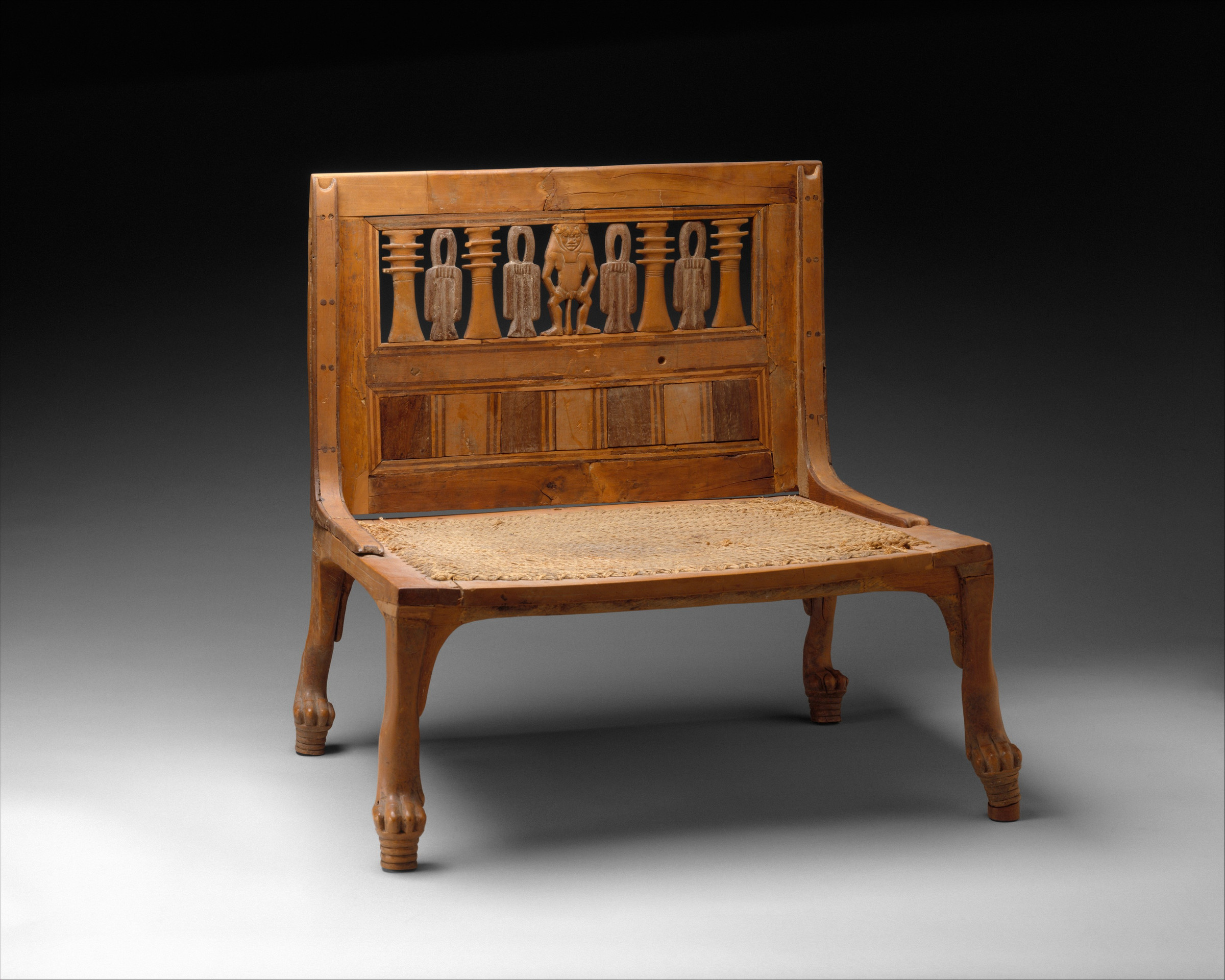
Hatnefer's Chair is easy to enlarge in the mind because the museum photograph isolates it against an empty background. The measurements correct that first impression. The chair is 53 centimetres high, 50 wide and 42 deep. Its seat is only 24.5 centimetres above the floor.1
Low does not mean slight. Four legs broaden into carved animal paws, the front rail carries a taut woven surface and the back rises as a framed panel. The object concentrates several kinds of work inside a compact volume: structural woodworking, cord weaving, carving and protective imagery.
The Met dates the exact chair to c. 1491–1473 BCE, in the early Eighteenth Dynasty. That range belongs to object 36.3.152. It is not a label for every chair with feline legs, a woven seat or an open back.
Pegs make the construction readable
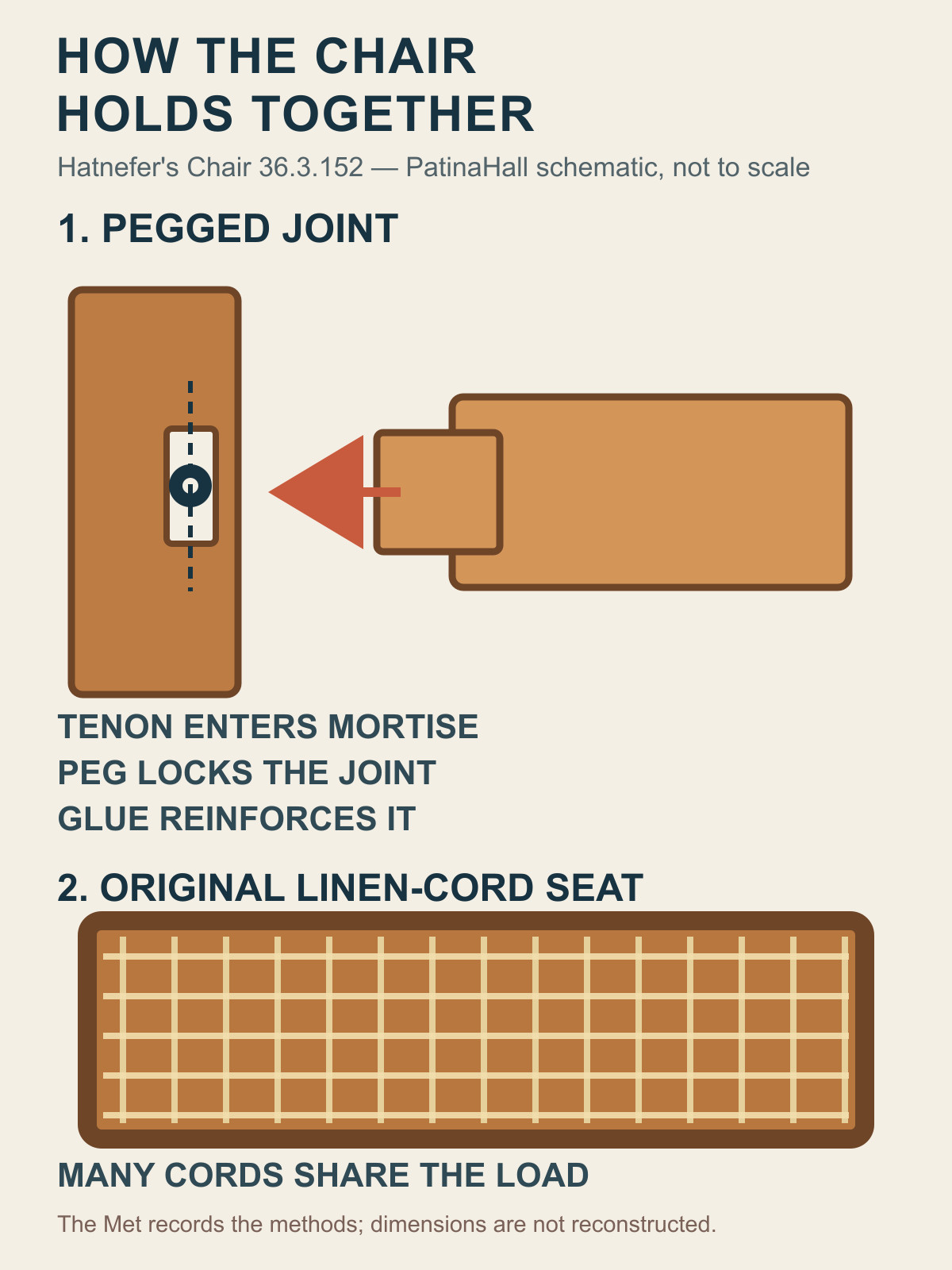
The Met describes mortise-and-tenon assembly. A projecting tenon on one member enters a mortise cut into another; pegs hold the tenons in place. Further pegs fasten the braces to the back and seat, and resinous glue reinforces the joints.1
This is construction with several lines of defence. The shaped joint locates one member inside the next. The peg resists withdrawal. Glue adds another bond, while braces control the angle between the horizontal seat and upright back. No single device has to explain the whole frame.
Some pegs remain visible in the photographs as small dark circles. They are not flaws to be visually erased. They are evidence of assembly, showing where separate pieces were made to act together.
The original cord is part of the evidence
The Met's most consequential material statement may be the shortest: the linen-cord seat is original.1 The woven surface is therefore not a modern guess placed over an ancient frame. It belongs to the chair's surviving physical record.
Cord changes what a seat can be. Instead of asking one solid board to span the frame, many narrow lengths share the load. Their crossing pattern makes a surface that can yield locally while remaining anchored around the rails. The seat reads as dense and continuous from a distance, then resolves into repeated lines at close range.
The object record lists boxwood, cypress and ebony alongside linen cord. It does not publicly map every visible rail, peg or carved element to one species, so colour alone cannot complete that inventory. The useful fact is the documented combination, not an unsupported visual assignment.
The back protects as well as supports
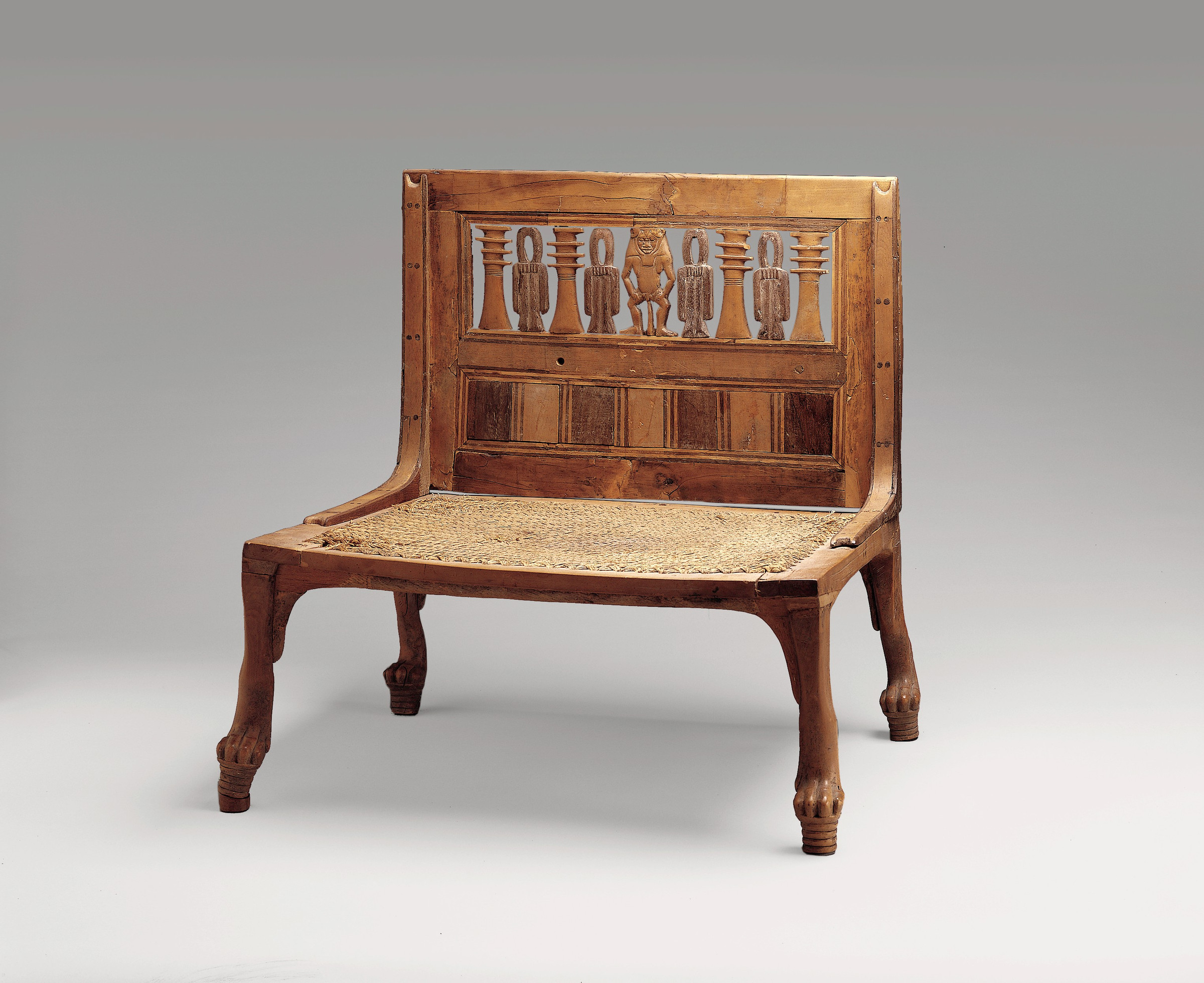
The back panel is both a brace and an image field. At its centre stands Bes, whom the Met identifies as a protector of the home. On either side are tit amulets associated with Isis and djed pillars signifying stability and endurance.1
The arrangement makes support readable twice. Timber rails and side braces hold the sitter physically. Repeated protective signs frame the sitter symbolically. Bes occupies the centre rather than hiding in a marginal detail; the alternating signs establish order across the full width of the back.
The straighter museum view also shows how open the panel remains. Figures and pillars do not fill a solid board. Air passes around them, allowing protection, decoration and reduced material to occupy the same framed structure.
The findspot keeps the chair exact
The chair was not separated from all context before entering the record. The Met's Egyptian Expedition found it in 1936 in front of the entrance to the undisturbed tomb of Hatnefer and Ramose, on the hillside below Senenmut's tomb chapel TT 71. The Egyptian government assigned it to the Museum in the division of finds.1
That location matters because it binds the materials and joinery to one recoverable archaeological event. The object was outside the entrance, not described as resting beneath Hatnefer's body or positioned inside a recreated domestic room. The exact wording prevents a vivid but unsupported scene from replacing the documented find.
It also explains why the accession number matters editorially. Without 36.3.152, a low woven chair could drift into a generic illustration. With it, date, dimensions, original cord and excavation context continue to refer to the same physical thing.
One comparison is enough
The Met compares Hatnefer's chair with another low New Kingdom example, object 12.182.28. That chair has a straight back, legs carved as lion legs and a mesh seat; the Museum says such low chairs appear with women in banquet scenes. Its frame is held with pegs and dowels, but its central back slat and minor repairs are modern, and its mesh seat has been restored from surviving evidence.2
The comparison helps precisely because the objects are not collapsed. Both make low seating, animal legs, open backs and woven surfaces legible. Only Hatnefer's object record, however, supports the claim that its linen-cord seat is original. Only its record supplies the tomb-entrance findspot and the Bes, tit and djed arrangement described here.
One exact chair cannot stand for every New Kingdom seat, every woman in a wall painting or every piece of Egyptian joinery. It can do something more useful: preserve a compact chain from material to joint, from joint to body, and from body to documented place.