A stop worth remembering
Ware lay on a route between London and Cambridge. Travellers needed places to stop, and an inn needed a reason to be remembered. The V&A considers it likely that the enormous bed was made as an attraction for one of the town’s inns around 1590–1600.1
Its proportions explain the appeal without requiring any of the later stories about how many people supposedly slept in it. A familiar object had been pushed beyond its expected scale. A visitor could understand the joke immediately: it was a bed, but the room had to negotiate with it.
That is a different kind of distinction from expensive ornament alone. A richly carved small bed might impress its owner. This bed could become a story that travelled on with the guest.
A room inside a room
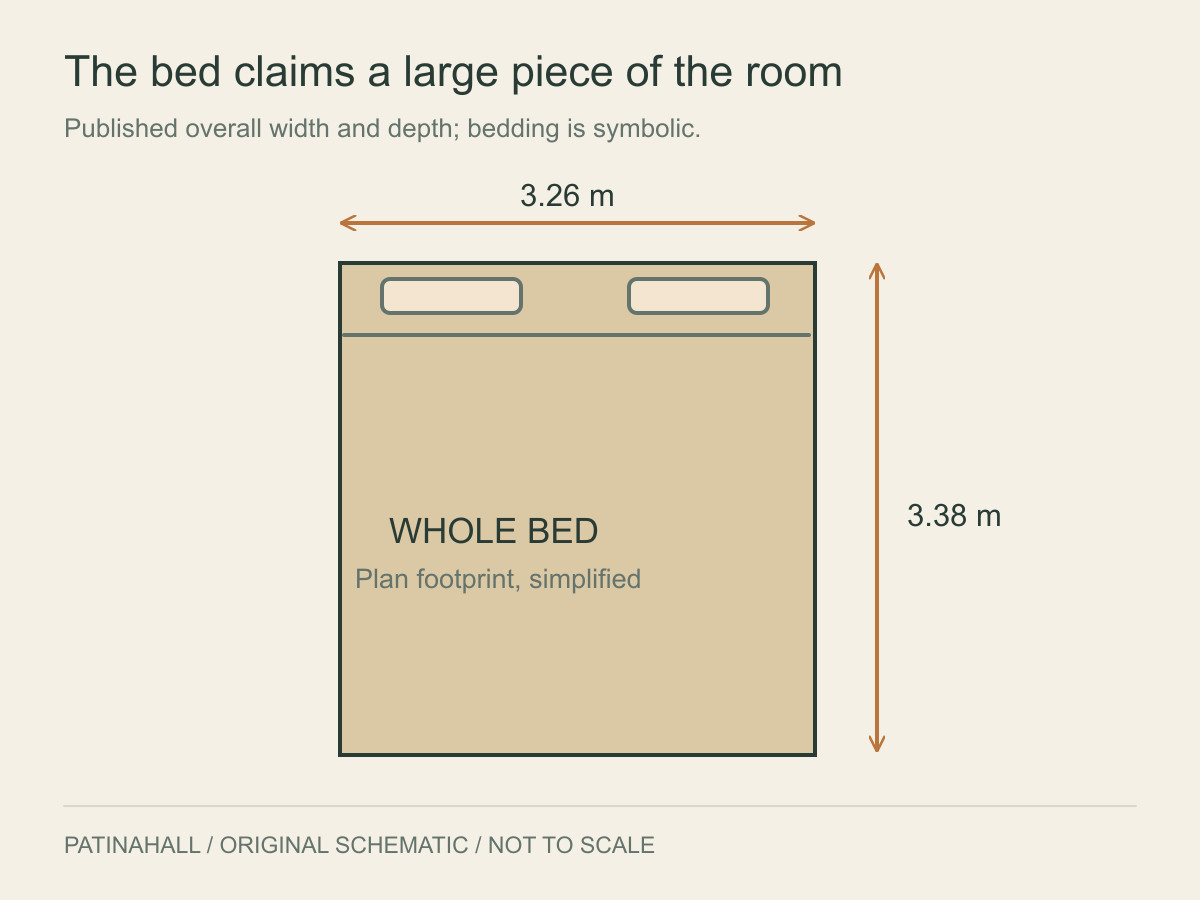
The bed measures approximately 3.26 metres wide and 3.38 metres deep. Its canopy rises above the sleeping surface, supported by substantial posts, with carving characteristic of the late Elizabethan period. Those dimensions make it useful to think about as a small enclosure rather than just an unusually broad mattress.1
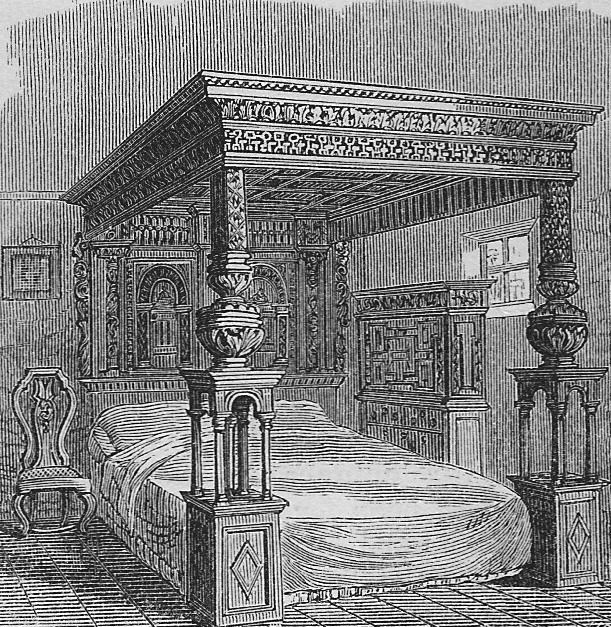
The 1877 engraving makes the architectural effect particularly clear. A deep cornice defines the upper edge. The posts act like columns. Behind them, the headboard forms an elaborate wall of its own. A chair at the side helps the reader see how much space the bed occupies.2
The image is also a reminder that presentation changes over time. An engraver chooses a viewpoint and translates surfaces into lines. The illustration is evidence of how the bed was pictured in the nineteenth century, not a transparent window back to its first night in an inn.
Guests who wrote themselves onto the furniture
The V&A records initials cut into the wood and red wax seals left by visitors. Shakespeare mentioned the bed in Twelfth Night, and Ben Jonson referred to it too. Its reputation had escaped the room while the object was still relatively young.1
A mark on furniture usually appears in a condition report as damage. Here it also helps explain why the object mattered. People wanted their encounter with it to leave a trace. The surface became a record of attention as well as a surface to be admired.
We need not romanticise every scratch to find that moving. The visitor is gone; a small action remains. Furniture can preserve social history in places that were never intended as an archive.
What the old picture cannot tell us
The wood retains traces of paint, while the hangings and bedding now used to interpret the bed are modern reproductions. A dark wooden object in a museum should not automatically be imagined as equally dark and undressed throughout its life.1
In the engraving, the bed almost fills the frame. That remains the most direct explanation of its success. It made an ordinary overnight stop large enough to remember.
