Grand, but mostly empty
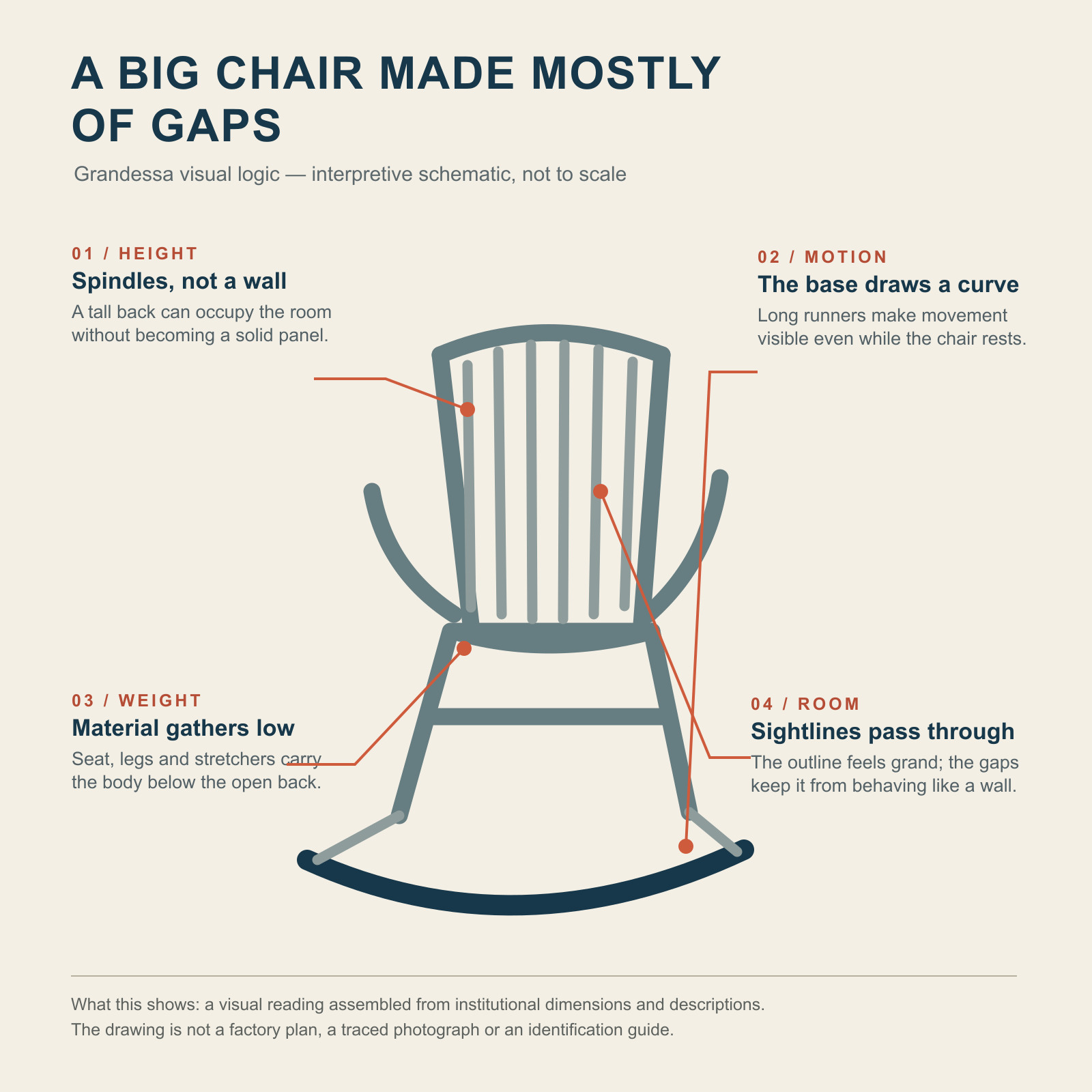
Grandessa is not shy furniture. Möbeldesignmuseum records a width of 57 centimetres, a depth of 97 and a height of 110. The width is fairly contained; the other two numbers describe a chair that rises and reaches. It claims air above the sitter and floor beyond the seat.1
Yet the chair does not turn that claim into a wall. Its high back is opened into a row of slender verticals. The outline is emphatic, but the room remains visible between the members. Grandessa can therefore look large from across a room without behaving like a solid upholstered mass once it is there.
That is the first useful contradiction in the design. The name sounds grand, and the height earns it, but much of the chair is literally absence. Larsson uses wood to mark the limits of a generous sitting place, then leaves the space inside those limits open. Its grandeur is drawn rather than filled in.
The chair is drawn in two directions
The upper chair reads vertically. Back posts and spindles lift the eye, while the arms curve away from that upright rhythm to locate the body lower down. Below them, the runners reverse the argument. They stretch horizontally and finish the chair with one long, shallow arc.
Those directions make motion legible even when nobody is rocking. A normal leg ends at the floor; a runner continues along it. Grandessa's base is thus both support and a visible route, showing where the chair may travel before it moves. The curve gives stillness a before and an after.
The visual weight also gathers low. Seat, side structure and stretchers make the densest zone around the sitter, while the back becomes progressively more permeable above. The 110-centimetre height feels less like bulk than reach. This is not a claim about universal comfort or safe operating clearance; those depend on the exact chair, sitter and room. It is a reading of how Grandessa's documented wooden structure organises what the eye sees.1
A rocker for the all-purpose room
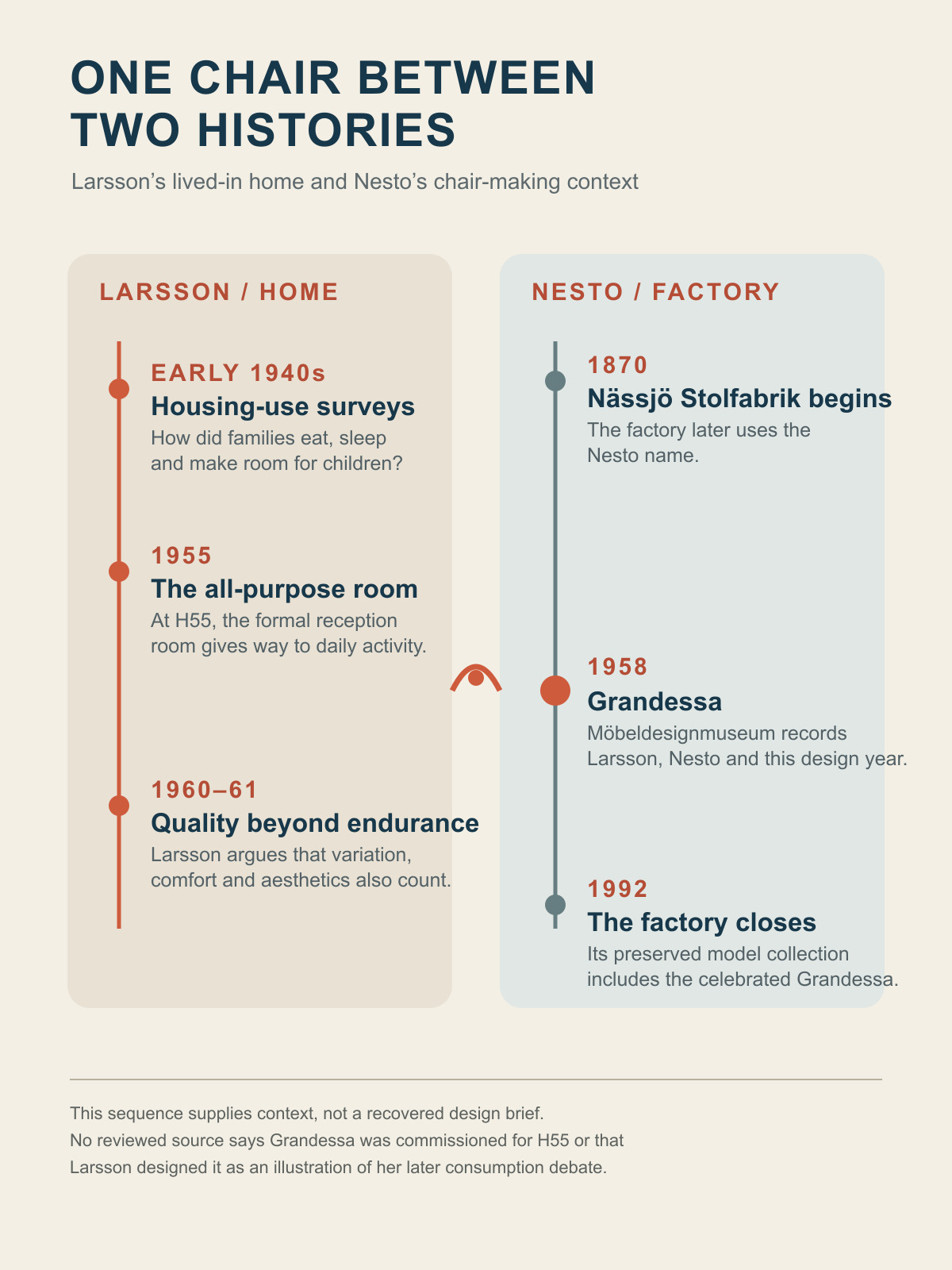
Larsson had been asking what rooms were actually for long before Grandessa. The Swedish Biographical Dictionary of Women describes her early-1940s housing studies of how families ate and slept and whether children had room. The surveys exposed a familiar absurdity: a formal reception room could sit unused while daily family life was squeezed elsewhere.3
At the H55 exhibition in 1955, her Skal och kärna interior replaced that protected reception room with an open, child-friendly all-purpose space for sitting, eating, play and leisure. Grandessa followed in 1958. No reviewed source says the chair was commissioned for H55, carried over from that room or was intended to illustrate its argument. The sequence supplies context, not a missing brief.
Even with that boundary, the pairing is illuminating. A rocking chair asks a room to tolerate changing positions rather than preserve one perfect arrangement. Grandessa's open back lets sightlines continue through a tall object, while its runners make movement part of the silhouette. It belongs comfortably in the history of a home treated as a place of activity, not a display awaiting callers.
Nesto gave the idea a factory
Grandessa was not only Larsson's drawing. Möbeldesignmuseum names Nesto — Nässjö Stolfabrik as producer, and Rian's Female Traces catalogue records the same designer, maker and 1958 year.1 2
The factory gave that individual design a much longer industrial backdrop. Sveriges Radio dates Nässjö Stolfabrik from 1870 to 1992, notes its later Nesto name and describes it as one of the Nordic region's largest chair factories. A preserved collection of more than 200 chairs keeps the range of that history visible; Grandessa is among the named, sought-after models. 4
That context matters because a spindle-backed rocker can look timeless or anonymous at first glance. The institutional records make it specific: Larsson, Nesto, Sweden, wood, 1958. What they do not provide is an exhaustive production chronology. They do not tell us that every finish, joint detail or dimension encountered on the market belongs to one unchanged specification. A famous model name is not a shortcut around examining the object in front of you.
1958 is not the age of every chair
Why, then, is Grandessa so often introduced as a 1960s rocking chair? The likely explanation is simple, but it must remain conditional: 1958 describes the design in the reviewed museum records, while a seller may be assigning a later production decade to a particular example. Both statements could be true. They are not interchangeable.
For an individual chair, a decade should rest on object-level evidence: labels or marks, construction and finish, documented ownership, repairs and comparison with securely dated examples. None of that can be supplied by the design name alone. Nor should a fresh surface or replaced component silently inherit the date of the underlying design.
The precise wording is modest but useful: Grandessa was designed in 1958; a particular chair may be described as a 1960s example only when its own evidence supports that description. This article establishes the first statement, not the second.1 2
A survivor of the wrong slogan
Larsson's best-known phrase arrived after Grandessa. In 1960 she opened a debate usually remembered as Köp, slit och släng — buy, wear out and throw away. Detached from its argument, the phrase can make her sound like an advocate for badly made disposable things. Her biographical record gives a more interesting position: endurance was not the whole of quality; variation, comfort and aesthetics also mattered in a changing household. 3
It would be neat to cast a surviving wooden Grandessa as Larsson's rebuttal to her own slogan. The dates refuse that neatness: the chair precedes the debate, and no reviewed source connects the two. What they share is a larger question. Should furniture be judged only by how long its material persists, or also by how well it allows a home to change around actual life?
Grandessa never answers in words. It answers in the peculiar calm of a chair whose base anticipates movement. Its tall outline announces itself, the gaps give the room back, and the runners keep a quiet curve in reserve. The chair does not stand still, even when it is standing still.