Design story

The G Plan “Astro” table: a view through the glass

A glass-topped G Plan coffee table lets you see the furniture underneath the furniture. The curved base supplies much of its character, while the familiar “Astro” name hides a surprisingly untidy model history.

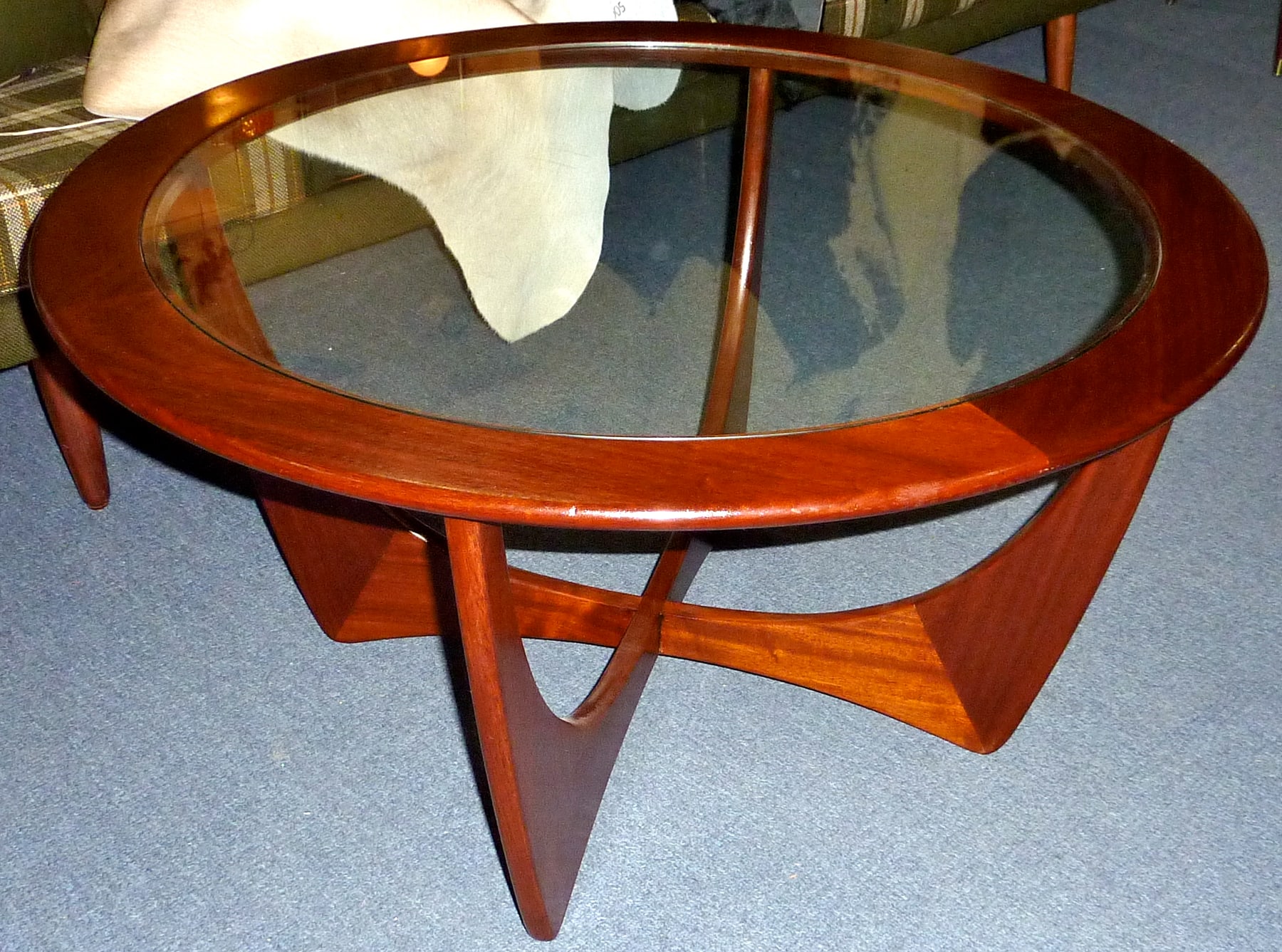
A round G Plan Astro coffee table with a wooden ring around a clear glass centre and curved wooden supports joined beneath it.
A round Astro-family G Plan table. The glass centre lets the curved structure below read as part of the tabletop’s composition. Tangerineduel, CC BY-SA 4.0. Resized; metadata removed. Source: Afrormosia 'Astro' Coffee Table by G Plan.
On this page
Key facts & takeaways

At a glance

Subject
G Plan 8040 and 8050 coffee tables
Entry
Design story
Last reviewed
6 September 2026

Three things to remember

  1. The 8040 has a round top; the 8050 has an oval one.
  2. The company distinguishes both from the five-leg 1970 Astro.
  3. A transparent top turns the supporting base into a visible feature.

The coffee table with a view inside

Most coffee tables show you their top. A glass-topped G Plan 8040 also shows you the support beneath it. From a seat, the curved wooden members become part of the view through the table, alongside the floor and anything placed on the glass.

The model is often advertised as an Astro. G Plan’s own retrospective distinguishes the circular 8040 from the later oval 8050 and from a separate five-legged Astro introduced in 1970. It attributes all three designs to V. B. Wilkins.1

For the familiar round and oval tables, the useful starting point is therefore the shape and model number. The nickname alone covers too much territory.
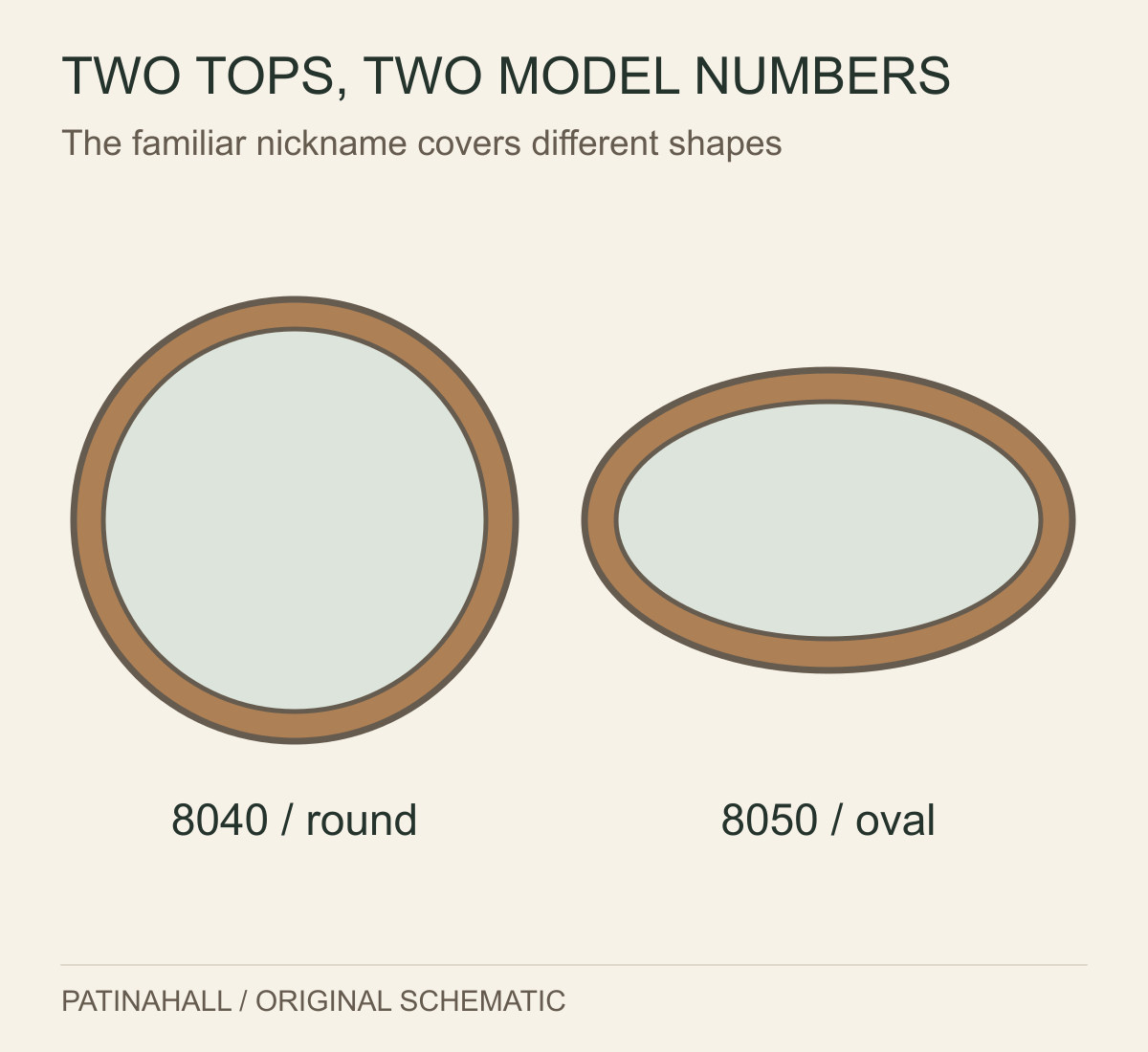
Top-view diagrams contrast the round glass-centred 8040 table with the longer oval glass-centred 8050.
The circular 8040 and oval 8050 have different outlines despite often sharing the Astro nickname. Original PatinaHall schematic, not to scale.

The base becomes the view

On the 8040, a wooden border outlines the circular glass, above a curved, crossing support. The 8050 stretches the top into an oval. That change gives the table a direction: a long edge can run alongside a sofa, whereas the circle presents a similar approach from around the room.1

The transparent centre makes the relationship between top and base unusually legible. The border describes the usable surface; the wood below gives that surface a footing. An opaque top would conceal much of the second element from someone sitting nearby.

This is furniture that rewards an ordinary seated viewpoint. Its construction becomes something to look at without requiring the whole table to be tipped over.
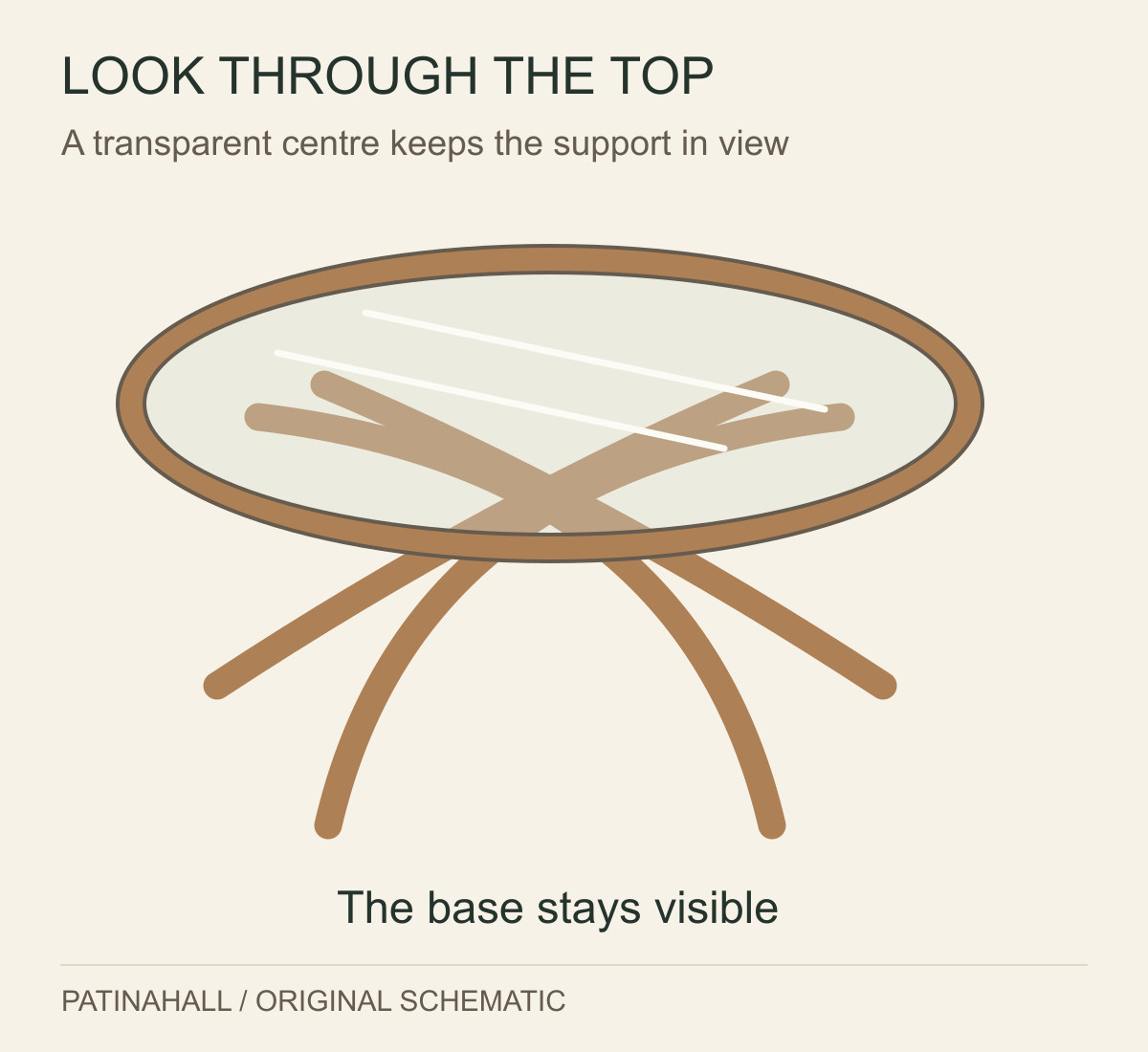
A schematic glass-centred coffee table reveals curved wooden supports beneath its elliptical perspective outline.
The glass centre keeps the curved wooden support visible from above. The members are simplified to explain that view. Original PatinaHall schematic, not to scale.

A table in a bigger room set

The High Wycombe Furniture Archive records an 8040 in a photographed G Plan living-room arrangement. Its description names Wilkins and refers to the 1965 GF11 material; it also records versions in teak or tola. The seating in that scene has its own designer and chronology.3

The room-set context matters. G Plan built a domestic furnishing programme, with showrooms demonstrating how furniture could sit together. Its company history connects the 1960s to Scandinavian influence and the later Fresco range.2

A small table could participate in that wider room without becoming a miniature sideboard. Glass introduced a different surface and let the surrounding furnishings remain visible through the centre.

What the nickname leaves out

A popular name is convenient in conversation and less precise in a listing. “Astro” can lead to a round top, an oval one or the separate five-legged design. The distinction is useful before getting into dates, finishes or the story attached to an individual example.

Once the forms are separated, the common tables become easier to enjoy on their own terms. The circle gathers a seating arrangement around a centre; the oval follows its length. Both offer the same small pleasure: a supporting structure that remains in the picture even after the table has taken its place beside the sofa.

Research notesEvidence, connections and limits

G Plan supplies the three-model distinction; archive GF13_05 separately names the 8040 and records teak or tola versions. The room-set date and sofa designer are not transferred to the table. No seller’s object, replacement glass or exact production year is authenticated.

Evidence map

Connected subjects and evidence

Reviewed connections

  • G Plan 8040 and 8050 coffee tablesdesigned byVictor Bramwell Wilkinsdocumented

    G Plan’s retrospective distinguishes round 8040, oval 8050 and the five-leg 1970 Astro. Keep the primary subject the common 8040/8050 family; the rare five-leg design is a brief comparison only. Archive GF13_05 names 8040 in teak or tola and cites GF11, 1965; its top-level Dandy credit belongs to the seating, while Wilkins is named for the table in the description.

    Reviewed 6 September 2026 by PatinaHall editorial.
    • Source 1Occasional Table 8040
    • Source 3Description: Occasional Table (8040); Manufacturer
  • G Plan 8040 and 8050 coffee tablesmanufactured byE. Gomme Ltddocumented

    G Plan’s retrospective distinguishes round 8040, oval 8050 and the five-leg 1970 Astro. Keep the primary subject the common 8040/8050 family; the rare five-leg design is a brief comparison only. Archive GF13_05 names 8040 in teak or tola and cites GF11, 1965; its top-level Dandy credit belongs to the seating, while Wilkins is named for the table in the description.

    Reviewed 6 September 2026 by PatinaHall editorial.

Research trail

Sources and further reading

  1. Iconic G Plan designs: occasional tables 8040, 8050 and AstroG PlanAccessed 6 September 2026
  2. 70 years of G PlanG PlanAccessed 6 September 2026
  3. G-Plan living room setting, GF13_05, archive record 1143High Wycombe Furniture ArchiveAccessed 6 September 2026
  4. Afrormosia 'Astro' Coffee Table by G Plan.jpgWikimedia CommonsAccessed 6 September 2026

Last reviewed 6 September 2026. Found an error or a stronger primary source? Contact PatinaHall.