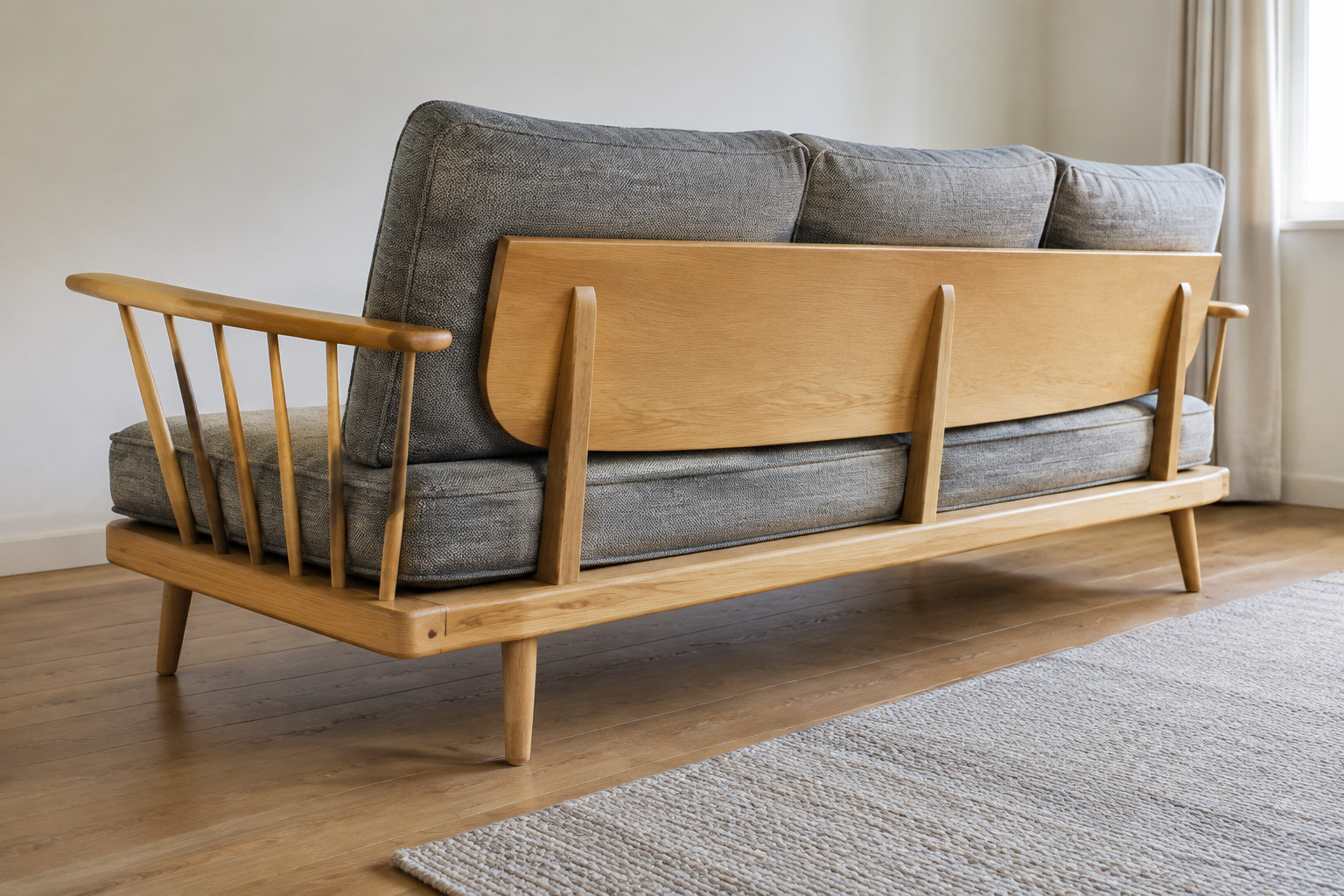
A sofa that reveals its layers
Many sofas present one continuous upholstered body. The Studio Couch lets the eye separate a long wooden frame, a supporting layer beneath the seat and loose cushions above it. The outer structure remains part of the room even when fabric covers much of the sitting area.
That separation is the key to its character. A cushion can look soft because the wood around it looks firm. The visible arms and back give the sofa a clear outline without asking upholstery to build the whole silhouette.
What the 1956 catalogue promised
Ercol’s original catalogue introduces model 355 as a settee whose back can be removed for use as a single bed. It describes a solid elm backboard carried on shaped beech supports, a foam-filled seat cushion and fabric-reinforced rubber suspension. The cushion cases were zip-fastened and detachable.1
Those details place the couch between several domestic roles. The same long surface could support sitting during the day and a different use later. The removable back was an active part of that flexibility, rather than a decorative board added after the seating had been designed.
The catalogue also makes the materials legible. Elm and beech belong to particular wooden parts, while the soft cushion and the suspension beneath it do different work. Calling the whole couch simply “wood and upholstery” loses the most interesting relationships.
The cushion is not the support beneath it
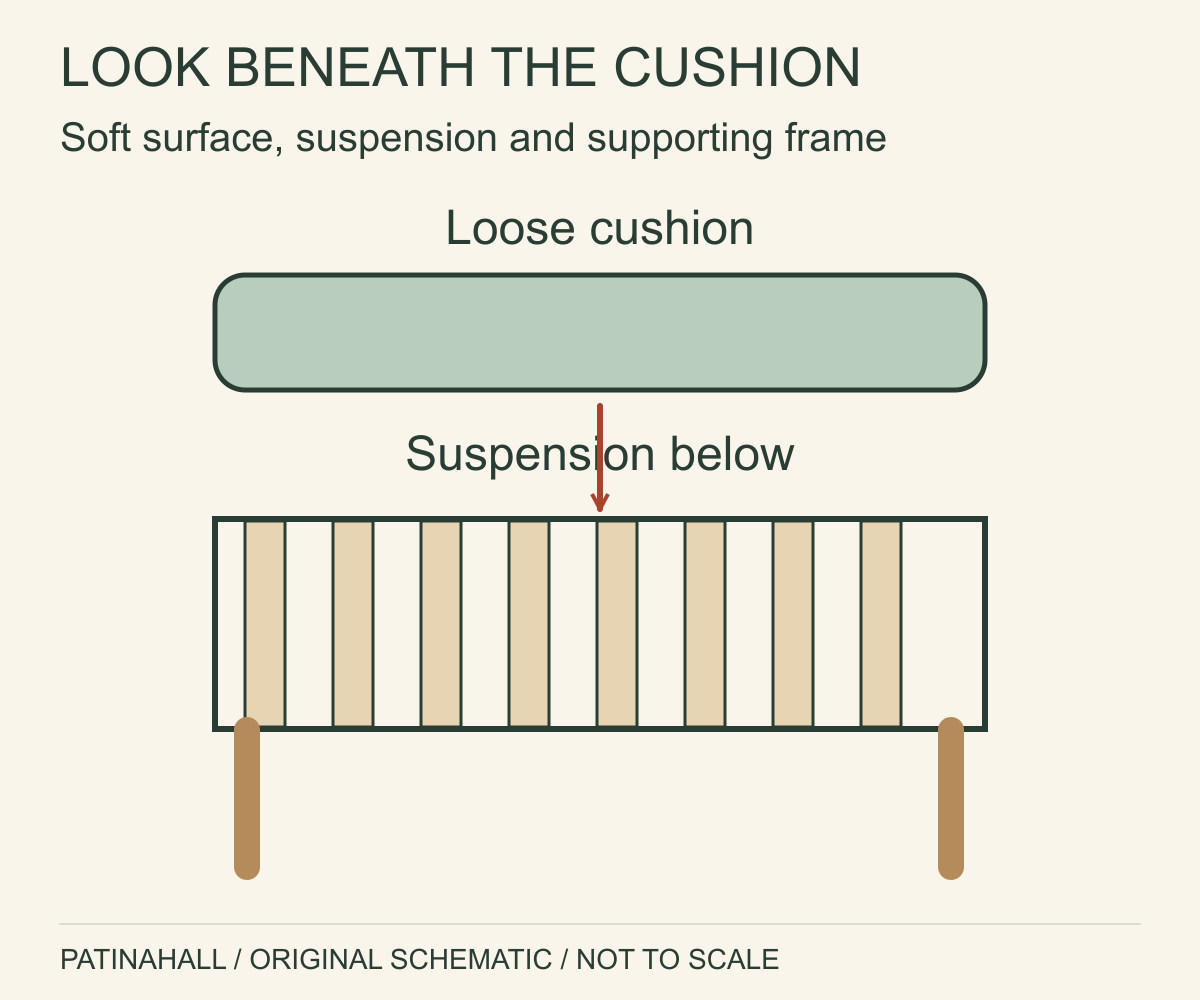
A loose cushion provides a shaped, soft surface. The layer under it carries that surface across the frame. On the original Studio Couch, the catalogue’s suspension description shows why those two things should not be confused.1
The distinction is easy to miss in a fully dressed sofa. It becomes clear when imagining the cushions lifted away: the furniture still needs something between the sitter and the open wooden frame. Our diagram separates the layers to explain that arrangement, without providing a rewebbing pattern or restoration specification.
The visible timber similarly has more than one role. Some parts define the outer frame; the broad backboard gives the couch a recognisable face when viewed from behind. This makes placement within a room more interesting than pushing an anonymous upholstered back against a wall.
The Studio Couch today
Ercol’s present Studio Couch carries model number 7355 and is described with an ash frame. Its current details belong to that version; the 1956 catalogue cannot stand in for a modern instruction sheet.2
The two chapters nevertheless share an appealing design idea. A sofa can have a long-lived visual structure while its soft layers remain distinct. An ordinary used Studio Couch becomes more interesting when you see those layers separately—and when the wooden back turns out to have had a job beyond completing the outline.