A small seat with a very clear idea
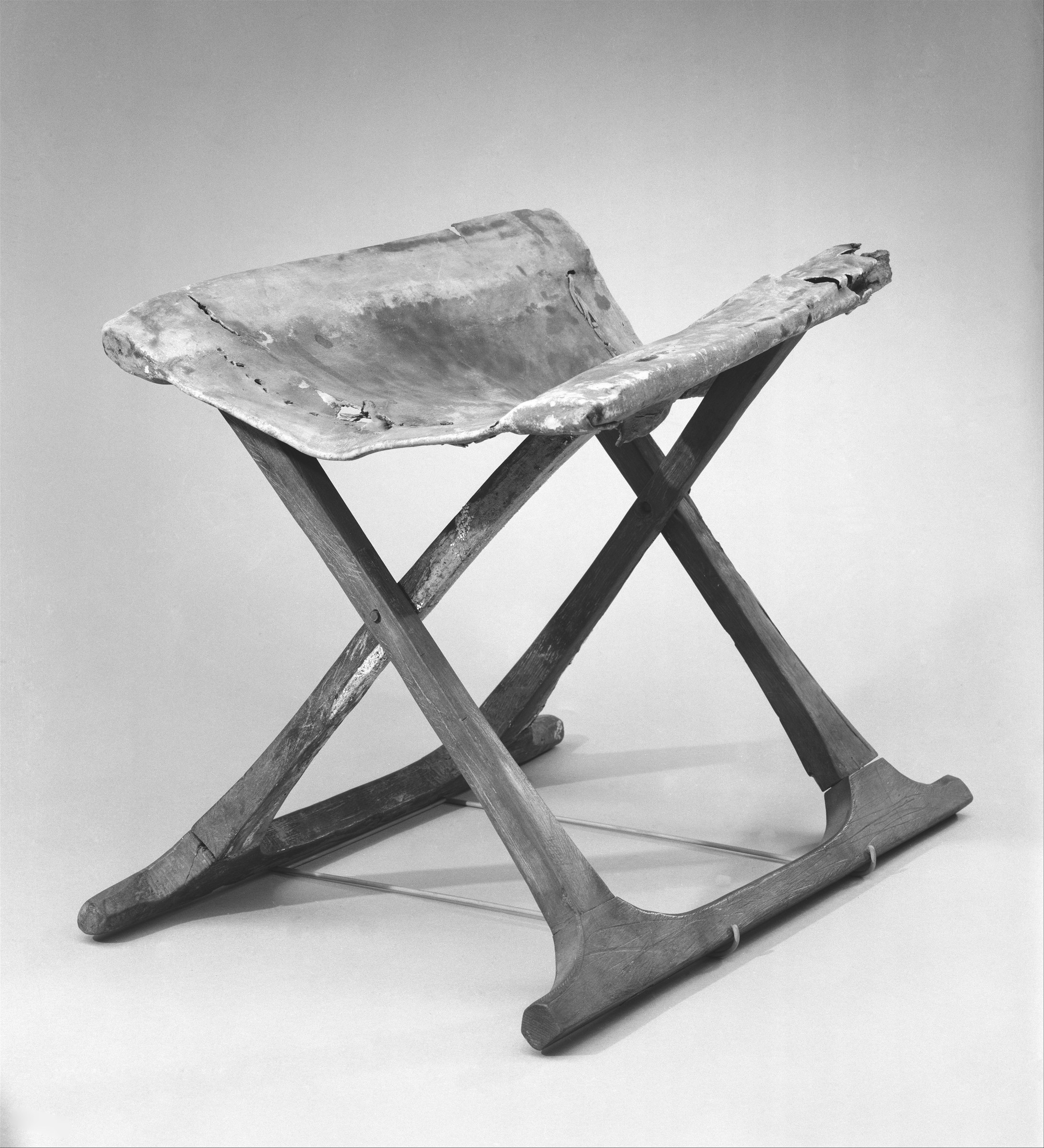
The first photograph gives almost everything away. Two wooden frames cross at their centres. Long feet spread the load on the floor. A hide seat bridges the upper rails, cupping rather than pretending to be a rigid board. The object is only 35.7 centimetres high, yet its structure can be understood from across a room.
The Metropolitan Museum of Art currently dates this exact stool to the Middle Kingdom, across Dynasties 11–13, about 2030–1640 BCE. It records the object as coming from Meir in Middle Egypt through the Khashaba excavations of 1910–11. Its materials are listed with deliberate breadth: wood, leather, and bronze or copper alloy.1
That clarity raises the interesting question. How did a construction suited to movement also become a form associated with dignity and office? The answer begins in the X itself. It is at once a mechanism and a sign: useful because it changes shape, memorable because it remains unmistakable when open.
The X is not decoration
At each end of the stool, two members cross and meet at a pivot. The paired end frames are tied together by rails running the length of the seat. Open, the diagonals brace one another and spread into stable feet. Brought toward alignment, they reduce the frame's depth. The Met's title identifies the object as a folding stool, while its oblique image makes the crossed logic visible.1
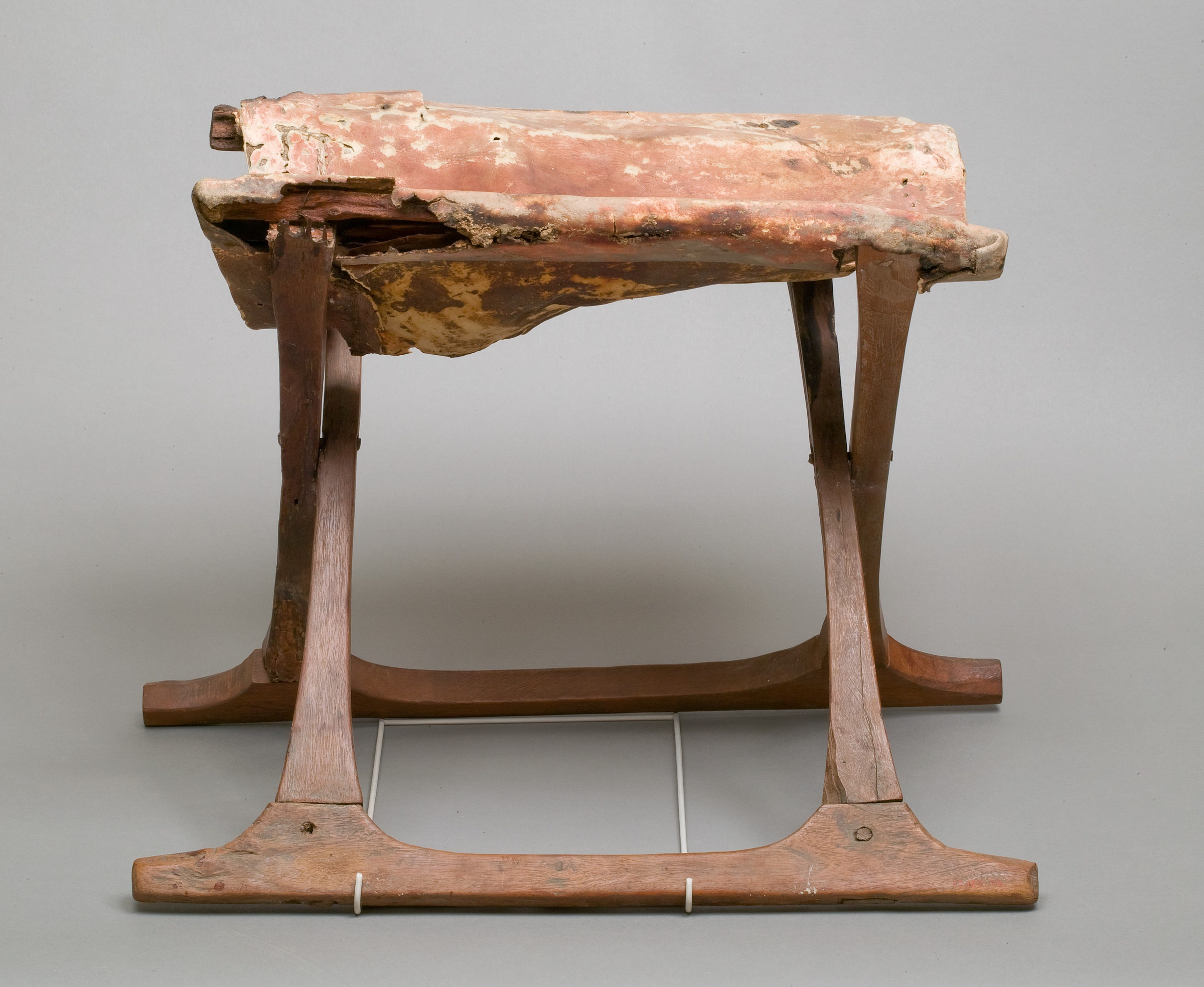
The second view offers a useful visual trick. Seen along its long side, the diagonals nearly line up in projection. The emphatic X seems to disappear, leaving upright-looking legs, long rails and the leather edge. Nothing in the object has changed; only the reader has moved. It is a neat warning against trying to understand furniture from one photograph.
Met scholarship places this stool within a much wider history of crossed seating, but it also preserves an essential distinction: an X-shaped base is not proof that every seat actually folded. Here the object record, visible pivots and paired views support the folding identification. The X is working geometry, not a motif pasted onto a fixed frame.2
Leather turns motion into a seat
The frame alone would make a compact support, not a comfortable place to sit. Leather completes the system by spanning the upper rails as a flexible surface. It can receive a body without requiring a broad rigid panel, and its edges remain tied to the same members that move with the frame.
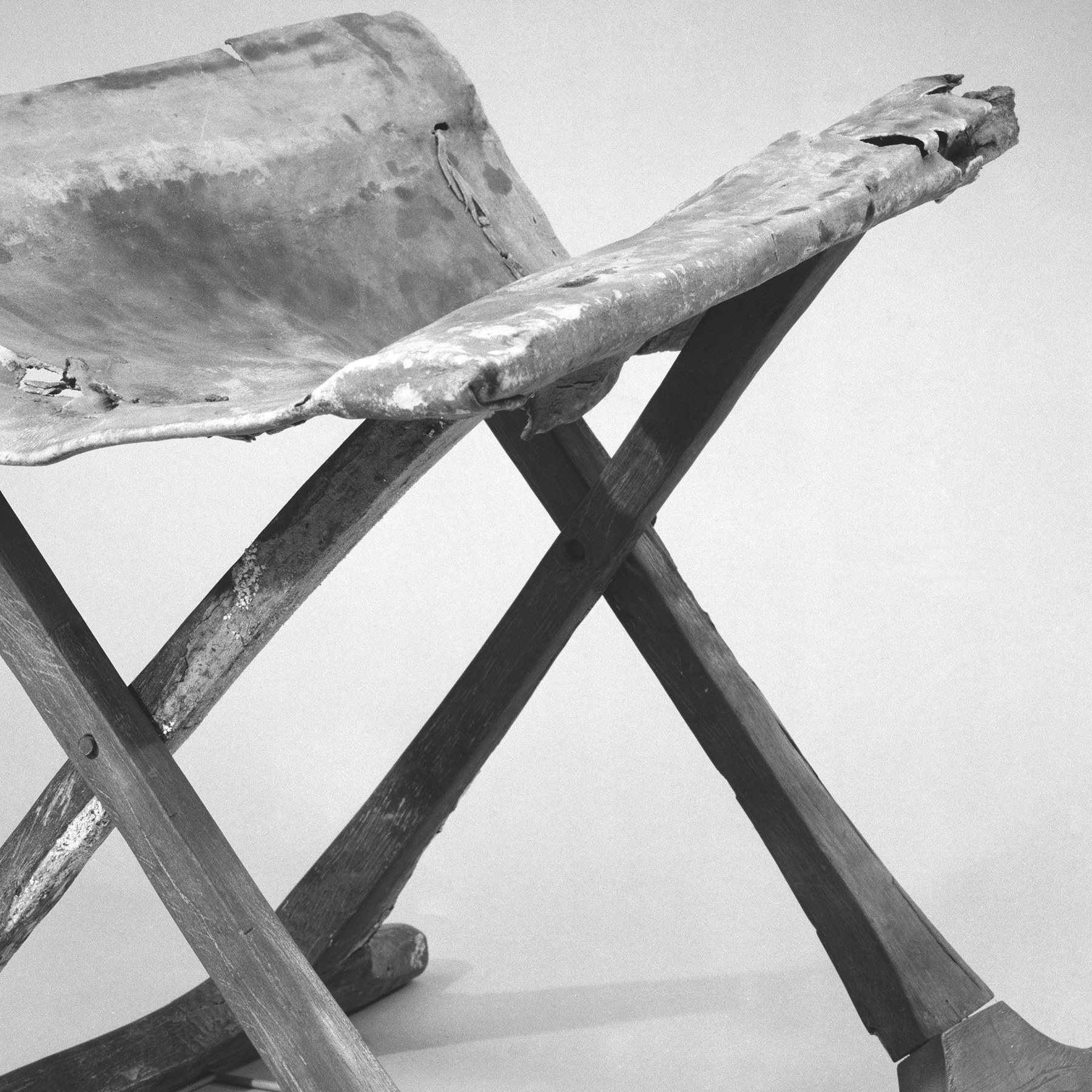
Age makes that relationship unusually legible. The hide is worn, cracked and uneven; in the side view it sags beneath the upper rail. The close photograph brings the leather edge, one rail and the crossed members into the same field. Soft and hard parts are not separate decorative layers. They cooperate to turn a pair of moving Xs into a seat.1
It is important not to repair the object in prose. A 2003 Met study describes the leather as original, while the current online record simply says leather and supplies no condition history. We can see the surviving material and cite the older description; we cannot use a photograph to settle every episode in its conservation.2
Portability can become ceremony
Folding is often treated as a synonym for informal: the spare chair, the camp stool, the thing put away when company leaves. Ancient Egyptian evidence makes that reflex unreliable. The Met's wider study says X-frame seats came to serve official and ceremonial roles and were associated with persons of status, including priests, scribes and architects.2
Portability and rank are not opposites. A recognisable seat that can accompany an office holder can make authority visible in more than one place. The X is especially suited to that work because it does not vanish into ordinary legs when opened; it announces its crossed structure from a distance.
That is a history of the form, not a biography of object 12.182.58. The Met does not name its maker, owner or sitter. We should not assign this particular stool to a priest or architect simply because comparable crossed seats could carry status. For a backless seat with very little visual fuss, it already carries quite enough institutional baggage.
One stool, three museum dates
The most revealing complication is not hidden in a joint. It sits in the catalogue history. The current Met record places the stool in the Middle Kingdom, Dynasties 11–13, about 2030–1640 BCE, and at Meir. A 1965 Met Bulletin listed the same object number as Dynasty XII, 1991–1786 BCE, in acacia with a leather seat.1 3
The 2003 Met article moved it much later, to about 1550–1500 BCE, called the wood cypress or acacia and said the object was probably from Rifa. Its figure caption and discussion unmistakably identify 12.182.58.2
Those are not three different stools, and choosing the neatest date would not make the evidence neater. Museum catalogues change as attributions and chronologies are reconsidered. For this article, the current object record governs the identity; the older Met publications remain valuable evidence of how that identity has been revised. Uncertainty here is not a hole in the story. It is part of the object's documented modern life.
The X does two jobs
Return to the open view and the central answer becomes visible. The crossed members let a small frame change its spread; the leather makes that changing frame habitable. At the same time, the X gives the seat a forceful outline, one capable of carrying social recognition as well as physical load.
We do not need to claim that this exact stool belonged to a named official, that every fitting is untouched or that it should still be operated. Nor do we need to draw a straight family tree from Egypt to every later curule or folding chair. The object is more interesting when those shortcuts are left closed.
What survives is enough: a seat in which portability never became anonymity. Move around it and the X alternately declares itself and slips from view. Once seen, that double act is difficult to unsee. The simplest-looking geometry in the room is doing both the mechanical work and the social speaking.