Design story

Eames shell chairs: one seat, several ways to stand

An Eames shell chair changes character below the seat. The moulded body supplies a recognisable sitting surface, while different bases turn that surface into several related kinds of chair.

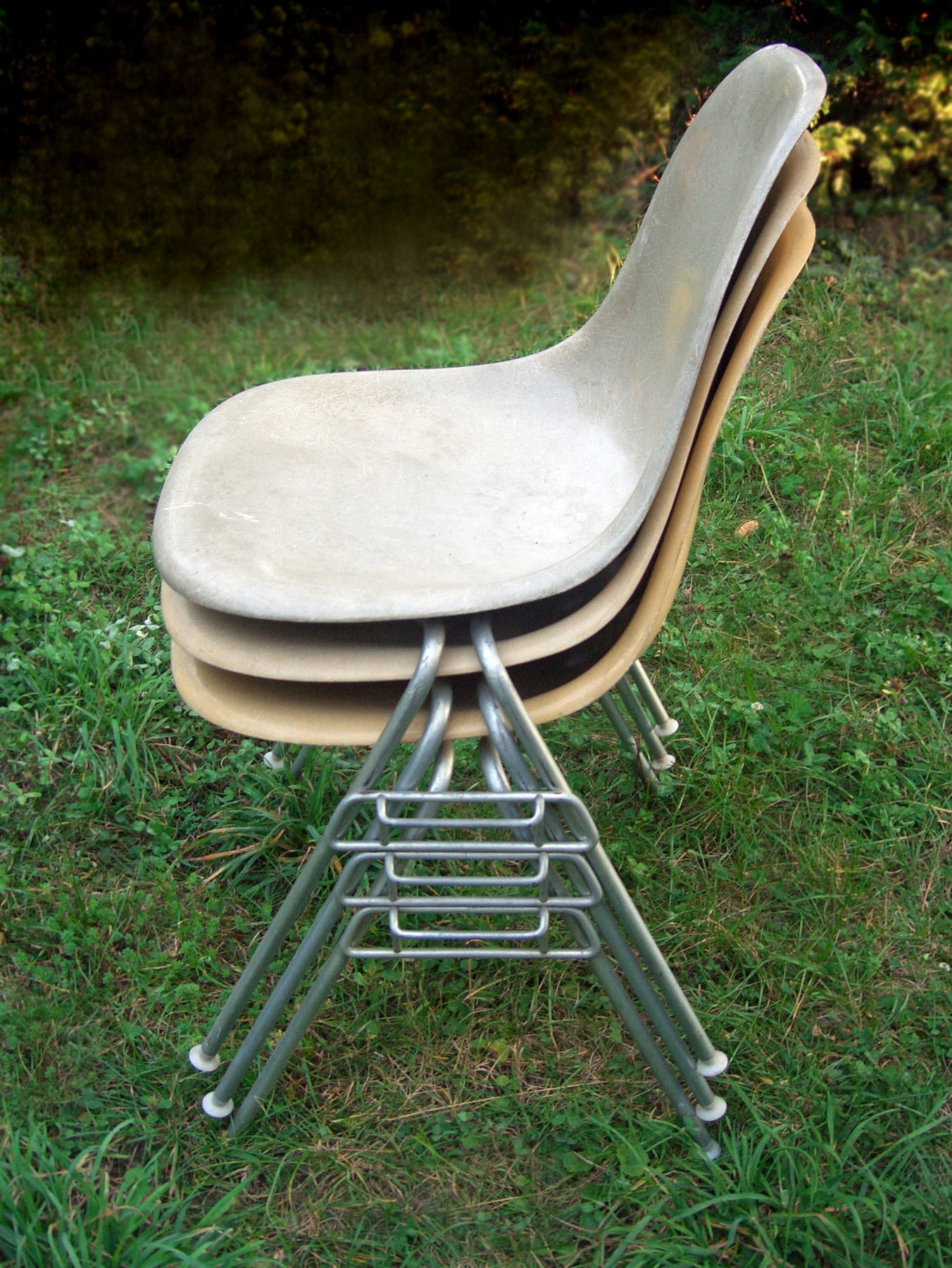
Three pale Eames shell side chairs stacked on wire bases, seen from the side on a lawn.
Stacked Eames shell side chairs show how one curved seat meets a separate metal base. Christos Vittoratos, CC BY-SA 3.0. Resized; metadata removed. Source: Eames-stapelstuhl.
On this page
Key facts & takeaways

At a glance

Subject
Eames moulded shell chairs
Entry
Design story
Last reviewed
6 September 2026

Three things to remember

  1. The shared shell and separate base are the organising idea of the family.
  2. The 1950 armchair introduction should not be used as a date for every side chair.
  3. Historic fibreglass and later plastics belong to different production specifications.

Start above the legs

Two Eames shell chairs can look surprisingly different at floor level. One base may emphasise a network of slender lines, another a more substantial set of supports. Move the eye upwards and the relationship becomes clear: the shaped sitting surface belongs to a shared design idea.

Eames Office describes the plastic side chair as part of a system in which shells could be paired with different bases. The body-contact surface and the way it stands on the floor became separable design problems. That division allowed one recognisable form to serve several settings.1
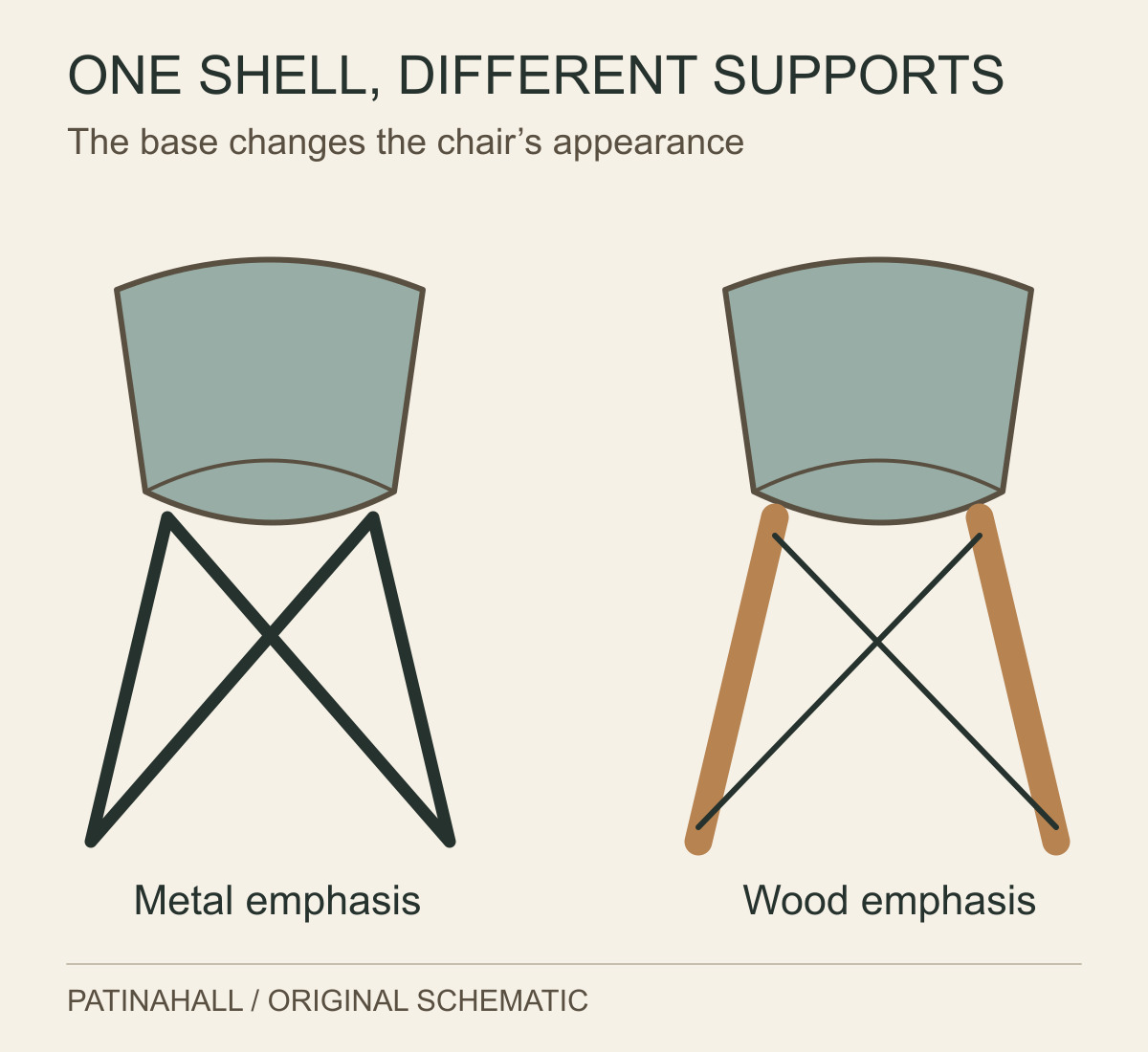
Two matching shell outlines are drawn above contrasting metal and wood-emphasised bases, showing a shared upper form with different support structures.
The repeated shell explains the Eames family’s component idea. Base layouts and attachment positions are conceptual, not an assertion that loose parts are interchangeable. Original PatinaHall schematic, not to scale.

The shell ends; the base begins

The moulded shell combines seat and back into a continuous surface. Instead of reading several upholstered pads and a surrounding wooden framework, the eye follows a curve from the seat into the back. The form makes the sitter’s space visible as one piece.

Below it, the base has another job: hold that surface at a usable height and transfer its support to the floor. Herman Miller’s brochure presents the family through a range of base and shell options. The shared upper shape becomes a way of giving different chairs a common identity.3

Changing that lower component can shift the whole chair’s character. A thin metal structure draws lines across the space below the seat; visible wooden members add another colour and texture. The shell provides continuity while the support helps place the chair in a different visual setting.
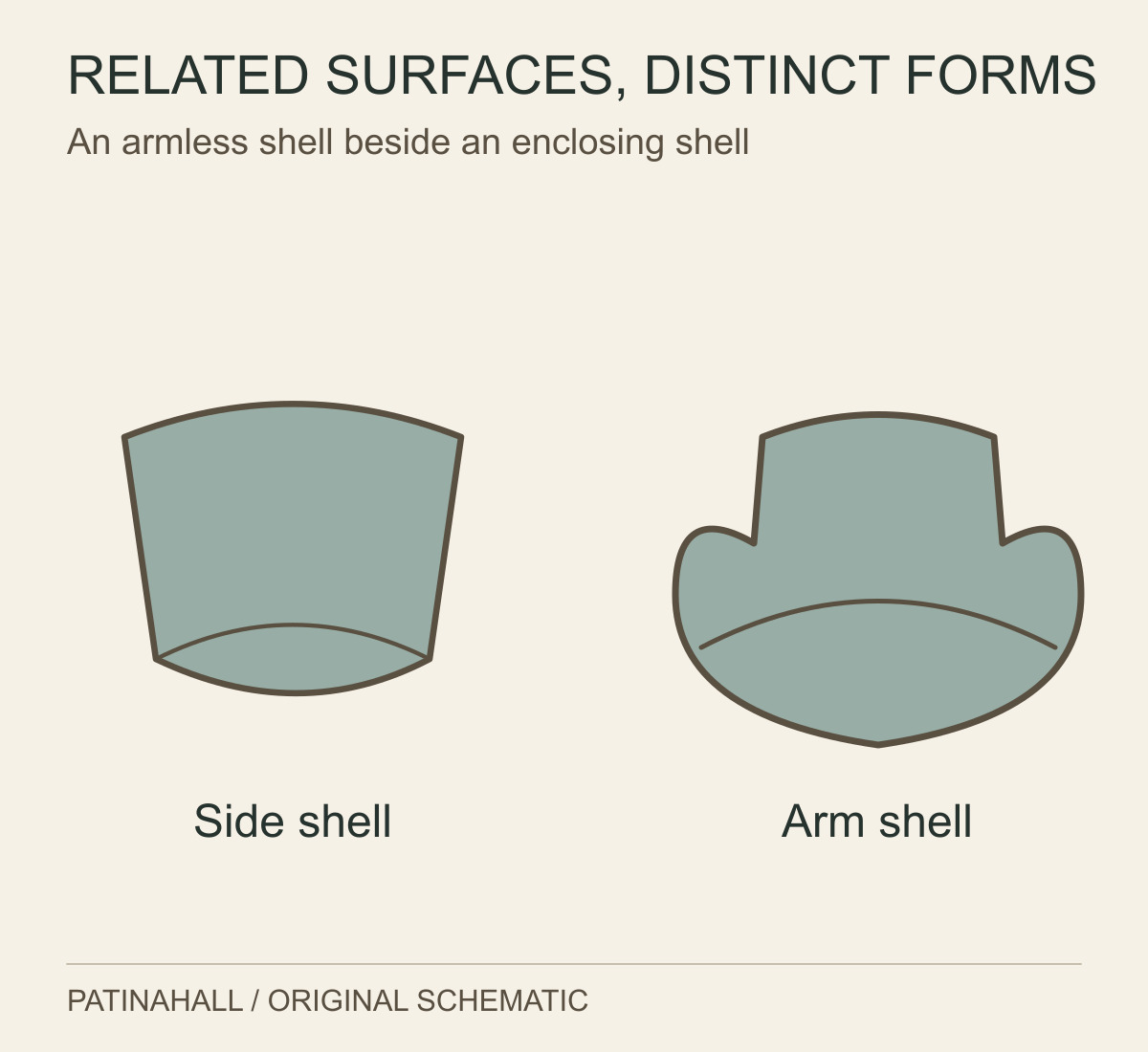
An armless moulded shell is compared with a wider shell whose sides rise to form arm areas, isolating two related sitting-surface forms.
The side and arm shells are distinct forms within the family. These abstract outlines do not date a shell or reproduce a particular mould, trim profile or material finish. Original PatinaHall schematic, not to scale.

Fibreglass came before the familiar later plastics

The Eames Institute describes late-1940s development involving Charles and Ray Eames, Herman Miller and Zenith. Its account places the fibreglass armchair’s introduction in 1950 and the side shell afterwards. Producing a seat with arms and producing the related armless shape were stages in the family’s development.2

That sequence is worth preserving. The curved shell is an idea with a manufacturing history, not a shape that arrived in every material and version at once. The early fibreglass surface and later moulded plastics can look related while belonging to different ways of making the chair.1

Material also contributes to what the eye notices. A surface can foreground its texture, its colour or simply the sweep of the moulded shape. The outline is only part of the experience; the particular material gives the outline its visible character.

A family at the table

The system makes sense in an ordinary dining room. Several chairs can repeat the same body shape and create a settled rhythm around the table. Different bases or colours can introduce variation while the common shell holds the group together.

That is a more useful way to appreciate the design than beginning with a list of famous owners or awards. Follow the chair from the top down: one continuous place to sit, a clear meeting with a separate support, and several possible ways to reach the floor. The family is contained in that change of component.

Research notesEvidence, connections and limits

The Institute supplies the early development sequence; Eames Office and Herman Miller describe the shell-and-base family. This account does not date a loose shell, authenticate a mixed assembly or treat every plastic formulation, attachment and base as historically interchangeable.

Evidence map

Connected subjects and evidence

Reviewed connections

  • Eames moulded shell chairsdesigned byCharles Eamesdocumented

    Eames Office documents Charles Eames in the designed by role for Eames moulded shell chairs. This relation describes the design family, not the origin of an individual secondhand object.

    Reviewed 6 September 2026 by PatinaHall editorial.
    • Source 1Design, material or production account; scope described in the evidence note
  • Eames moulded shell chairsdesigned byRay Eamesdocumented

    Eames Office documents Ray Eames in the designed by role for Eames moulded shell chairs. This relation describes the design family, not the origin of an individual secondhand object.

    Reviewed 6 September 2026 by PatinaHall editorial.
    • Source 1Design, material or production account; scope described in the evidence note
  • Eames moulded shell chairsmanufactured byHerman Millerdocumented

    Eames Institute documents Herman Miller in the manufactured by role for Eames moulded shell chairs. This relation describes the design family, not the origin of an individual secondhand object.

    Reviewed 6 September 2026 by PatinaHall editorial.
    • Source 2Design, material or production account; scope described in the evidence note

Research trail

Sources and further reading

  1. Eames Plastic Side ChairEames OfficeAccessed 6 September 2026
  2. Fiberglass Side Shell: Ray’s Hand, object 14Eames InstituteAccessed 6 September 2026
  3. Eames Moulded Plastic Chairs: product brochureHerman MillerAccessed 6 September 2026
  4. Eames-stapelstuhl.jpegWikimedia CommonsAccessed 6 September 2026

Last reviewed 6 September 2026. Found an error or a stronger primary source? Contact PatinaHall.