Artefact story

Darwin’s writing chair: the work is in the alterations

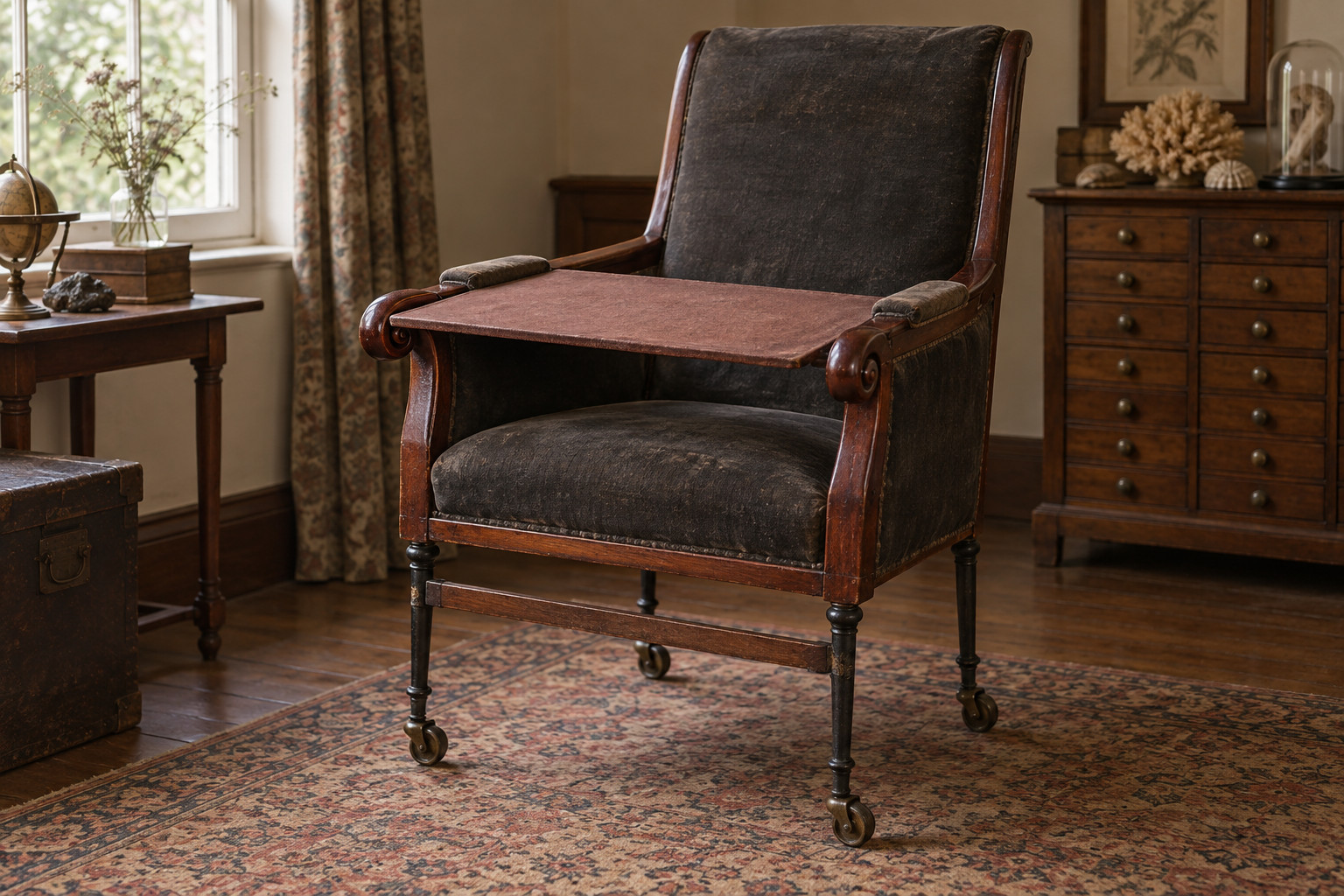
Darwin’s writing chair borrowed parts from a bedframe. Iron extensions, wheels and a board across the arms turned a mahogany armchair into a working arrangement shaped around one person.

A reconstructed mahogany armchair has a writing board across its arms, dark upholstery, added iron legs and castors.
PatinaHall editorial reconstruction. It is not a documentary photograph. The board, raised seat and wheels explain the working arrangement; actual wear and fittings are not reproduced.
On this page
Key facts & takeaways

At a glance

Subject
Charles Darwin’s writing chair at Down House
Entry
Artefact story
Last reviewed
10 September 2026

Three things to remember

  1. Cast-iron bedframe supports raised the chair, and castors let it move.
  2. The removable writing board wore the armrests where it touched them.
  3. Francis Darwin remembered his father’s preference for unusually high chairs.

Furniture parts from somewhere else

English Heritage dates the mahogany armchair to about 1835. Its unusual height comes from cast-iron supports taken from a bedframe. Castors add movement, and a rough wooden strut runs across the front.1

The additions are easy to overlook if you concentrate on the upholstered back. Down at floor level, the chair stops looking like a matching set of parts. Another piece of furniture has contributed to its structure.

The result answers several needs at once. Raising the seat changes the sitter’s position; wheels allow movement without standing up. This is a chair that acquired a second design through use.

A writing board leaves its mark

A cloth-covered board rested across the arms to give Darwin a writing surface. The chair carried the desk. Where the board repeatedly touched the armrests, it wore through the upholstery; English Heritage’s curator points out the surviving patches.1

Those small repairs connect the object with a repeated action. The armrests supported both a person and the edge of a working surface. Their wear records a habit that a pristine chair would conceal.

It also explains why the board belongs in the story even though it was removable. Take it away and this looks like seating. Put it across the arms and the whole arrangement becomes a place to write.
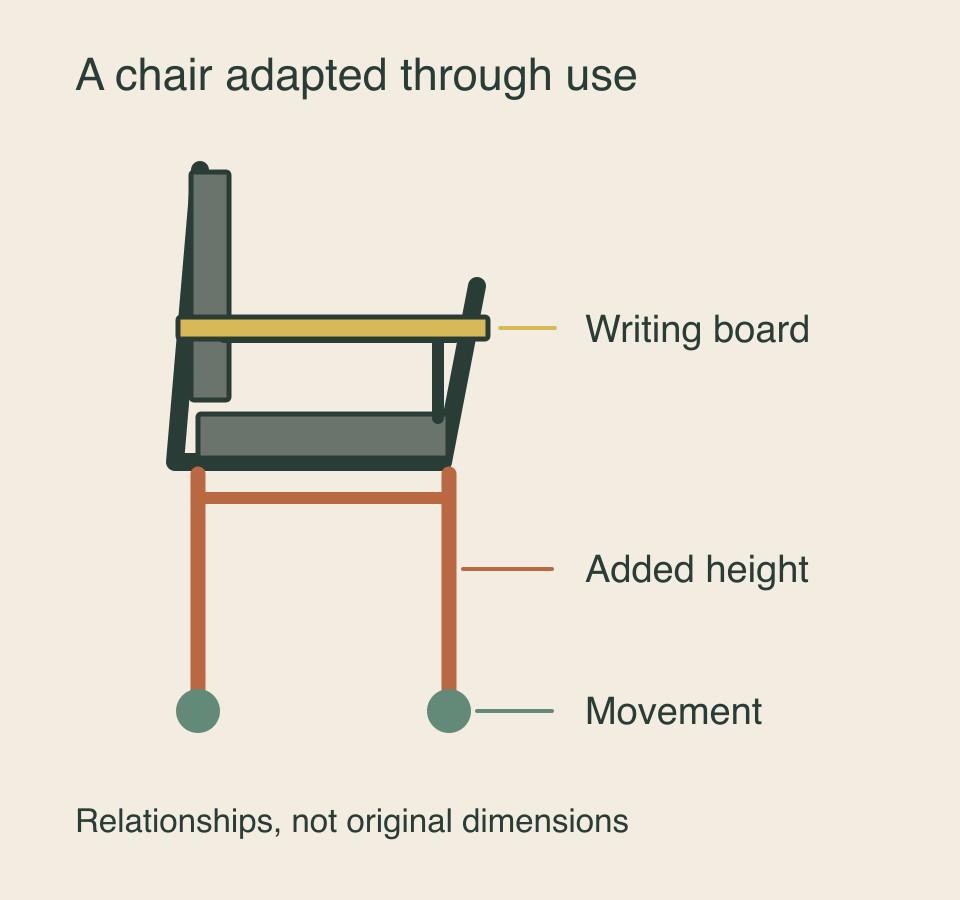
A simplified chair diagram distinguishes the writing board at its arms, extra support height and wheels below.
Added height, castors and a writing board change how the chair works. Original PatinaHall schematic, not to scale; exact joints and fittings are omitted.

A height the family remembered

Francis Darwin recalled his father’s unusually high chairs in the study and drawing room. Ordinary low chairs caused him discomfort. The household also joked about his elaborate combinations of chairs and foot supports.2

The family memory gives the iron extensions a human reason. Height mattered enough to alter the furniture and to become something other people noticed.

When English Heritage examined the chair in 1997, directional stresses in its structure provided further evidence of movement around the study. That investigation helped inform the researched presentation of the room now seen at Down House.3

The extensions, wheels and patched arms tell the same small story from different angles. A person’s working habits kept asking things of a chair, and the chair kept being changed to suit them. The most revealing parts are the ones that were added or worn away.

Research notesEvidence, connections and limits

English Heritage documents the chair and its alterations, but does not date every change or identify every person who made it. This is not evidence for a first office chair. The reconstruction cannot demonstrate the exact surviving wear.

Evidence map

Connected subjects and evidence

Reviewed connections

  • Charles Darwin’s writing chair at Down Houseassociated with placeDown Housedocumented

    English Heritage identifies the chair in Darwin’s Old Study at Down House.

    Reviewed 10 September 2026 by PatinaHall editorial.
    • Source 1Object description and historical account
  • Charles Darwin’s writing chair at Down Houseuses techniqueWriting board supported on chair armsdocumented

    The curator describes Darwin resting a cloth-covered writing board across the chair arms.

    Reviewed 10 September 2026 by PatinaHall editorial.
    • Source 1Object description and historical account

Research trail

Sources and further reading

  1. Curators’ Collections: Darwin’s writing chair at Down HouseEnglish HeritageAccessed 10 September 2026
  2. Francis Darwin: recollections of his father, CUL-DAR140.3.1–159Darwin Online / Cambridge University LibraryAccessed 10 September 2026
  3. 20 years at Down House: then and nowEnglish HeritageAccessed 10 September 2026

Last reviewed 10 September 2026. Found an error or a stronger primary source? Contact PatinaHall.