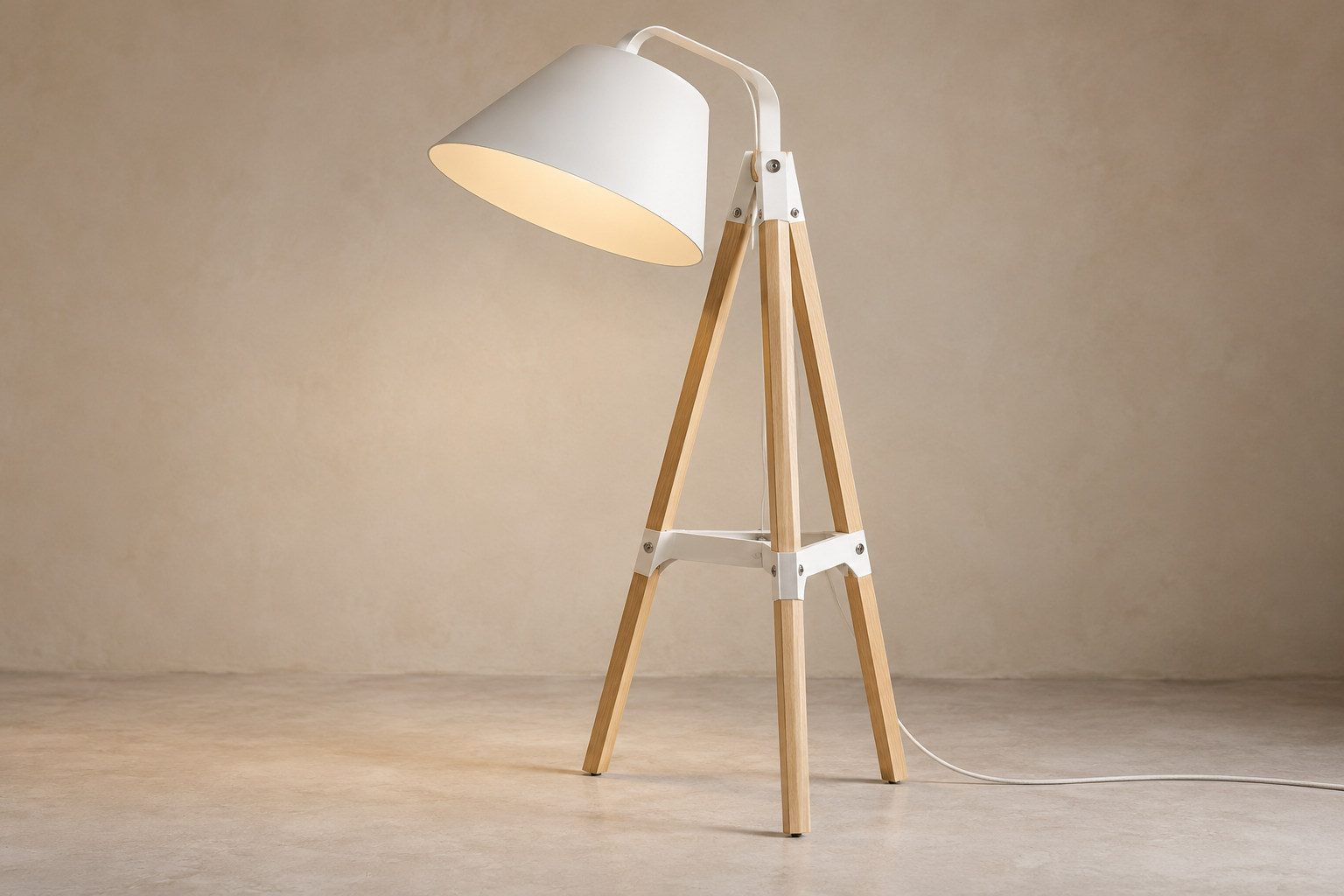
A small structure beneath a shade
Construction Lamp gives the support beneath a light a story of its own. Its assembled base, joints and visible screws make the act of connecting parts part of the appearance. Joost van Bleiswijk explicitly names the visible screws when discussing the design.3
A floor lamp has a straightforward spatial task: raise a light into the room and keep its support on the floor. Here the support becomes something the eye can explore on the way up to the shade.
The result recalls a small piece of infrastructure. Moooi's account uses the language of construction toys and scaffolding, helping explain why the base feels assembled rather than concealed inside a smooth casing.2
Different materials meet in view
Moooi dates the design to 2012. For the white medium floor version selected here, it specifies diecast powder-coated aluminium, wooden slats and a bent-steel shade. It also describes the lamp as hand assembled.1
Those material changes help divide the object into readable parts. Wood, coated metal and the shade retain different visual roles, while the connections bring them into one lamp.
The producer compares details to Victorian cast iron. That comparison offers a way to read the shapes of joints; the documented materials describe a contemporary object. The interest lies in translating a structural vocabulary to the scale of a room.1
Enjoying the connection
Van Bleiswijk's wider work returns repeatedly to how materials meet. In this lamp, a screw can become an accent: a small, recognisable sign of assembly placed where the viewer can notice it.3
That gives looking a useful route. Start with a joint, follow the piece it connects, and continue towards the shade. A necessary connection becomes the next point in a visual sequence.
Construction Lamp brings the workshop's question into the room: how will these parts hold together as an object? Its answer remains visible each time the eye travels up the support to the light.