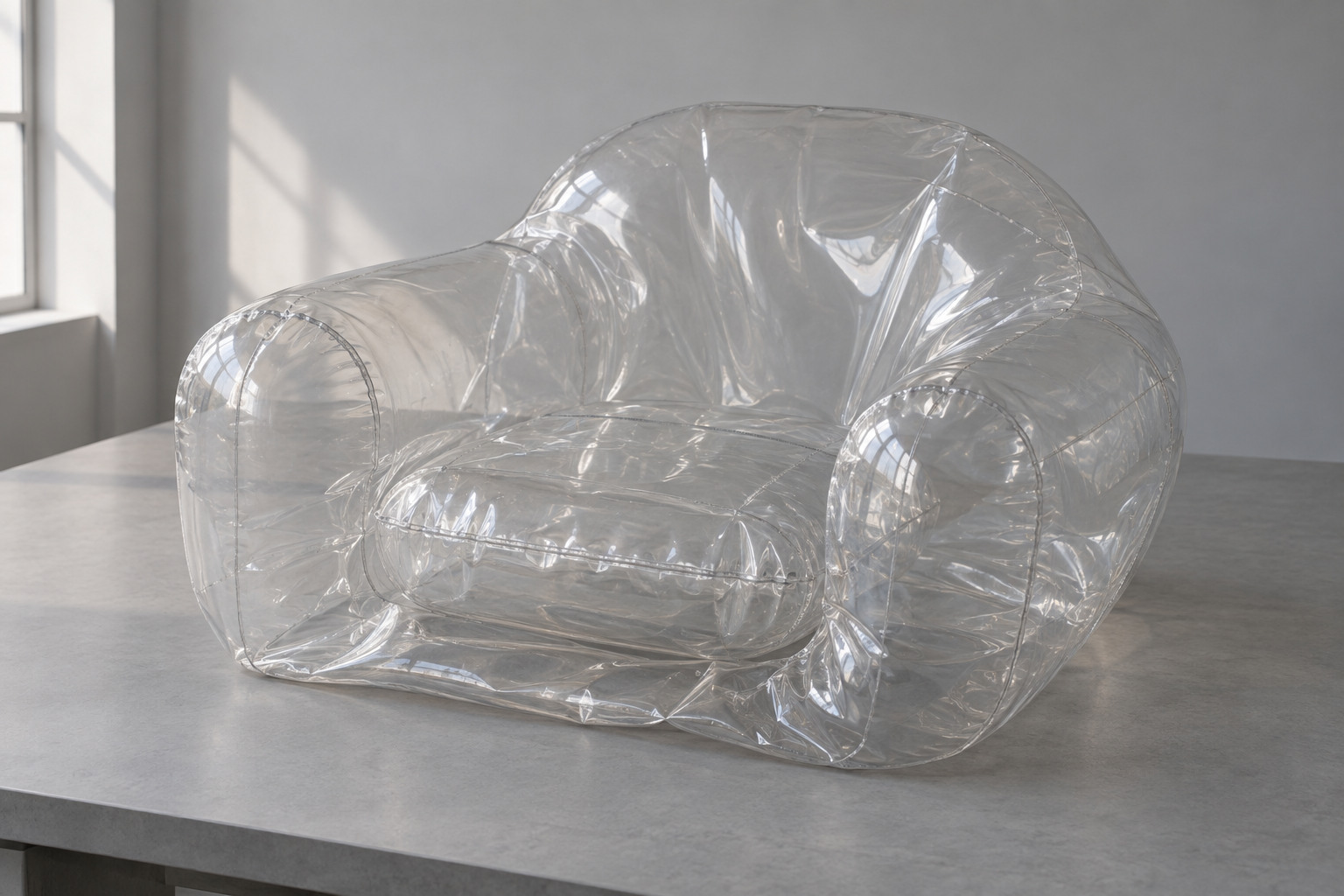
The surface can hold the whole chair together
In an upholstered timber chair, worn cloth may reveal a frame that still holds its shape. Other furniture depends much more directly on the integrity of its outer layer.
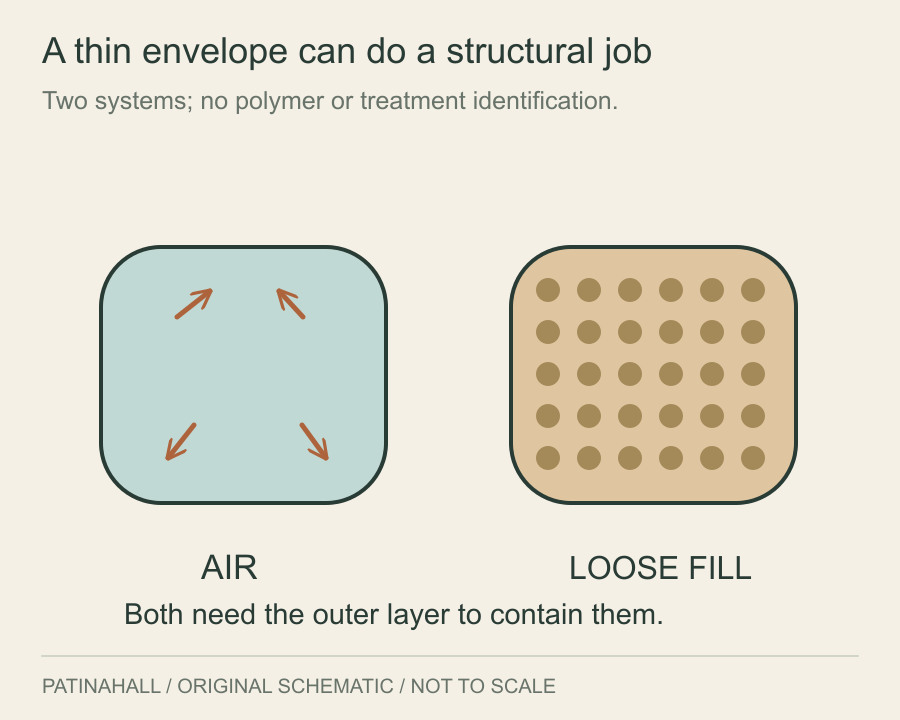
Air gives an inflatable seat its volume only while the envelope contains it. Loose beads make a beanbag adaptable only while the cover gathers them into one object. A small opening can therefore have consequences far beyond a visible mark on the surface.
This is a useful distinction when looking at experimental furniture. Softness, transparency and freedom of shape can depend on a surprisingly demanding job performed by a thin layer.
Two chairs in a 1996 report
V&A conservator Roger Griffith described two examples in “Two Pooped-Out Pop Chairs.” The museum’s Sacco, circ.73-1970, had a deteriorating polyurethane-coated covering that was allowing filling to escape. Its Blow chair, circ.100-1970, showed yellowing, brittleness and creases in the PVC.1
These were observations of specific objects. They do not establish that every Sacco cover or every inflatable chair will age in the same way.
They do reveal why a photograph of the original design can be an incomplete guide to its later life. The image preserves an outline; the object must continue negotiating the behaviour of its materials.
One familiar word, many materials
We often group these objects together as plastic furniture. The Canadian Conservation Institute explains why that category is too broad to determine how an individual object will change. Different polymers, additives, manufacturing choices and environments can produce different forms of deterioration.2
A material may become brittle, sticky, discoloured or distorted. Those visible symptoms matter, but appearance alone cannot supply a complete material history. A transparent surface is not automatically the same formulation as another transparent surface.
Identifying an object’s composition can itself be difficult. The Institute’s guidance on rubber and plastics connects that uncertainty with the need for informed care decisions.3
For the visitor, the practical insight is simple: the original maker’s choice of material remains active in the museum. It has not stopped being part of the design just because the object has entered a collection.
What should remain?
Imagine replacing every weakened surface until an old chair looks exactly like its early publicity photograph. The outline might become clearer, but evidence of the original material and construction could disappear.
Leave everything untouched, and continuing deterioration might make the object harder to understand—or threaten its survival. These competing possibilities help explain why conservation involves judgement rather than a universal instruction to repair or refrain.
Documentation adds another form of continuity. Records of materials, condition, previous interventions and intended use allow later readers to understand decisions that the restored outline alone cannot explain.
An ageing plastic chair can therefore tell two connected stories: how designers made an unfamiliar way of sitting possible, and how a museum learns to care for the material experiment they left behind.