The mechanism arrives in full flower
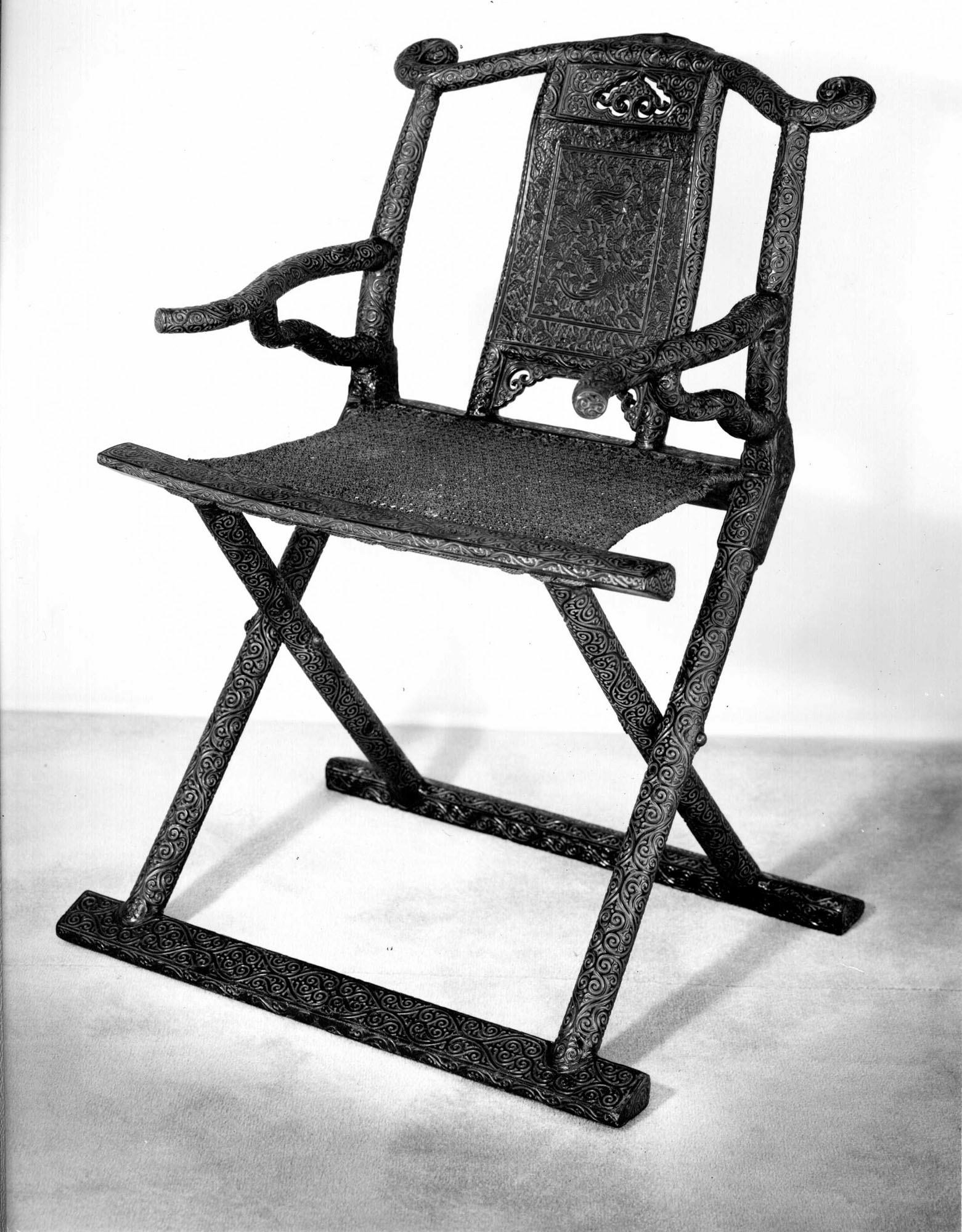
Begin at the top and this chair can seem almost determined to prevent the eye from reaching the floor. A long-tailed bird turns among flowers in the back panel. Scrolls run along the curved crest and down the arms. Smaller patterns occupy the borders between them. Then the gaze finally reaches the seat and discovers that all this abundance stands on a folding X-frame.
The Metropolitan Museum of Art dates exact object 69.217 to the 13th–14th century and places it within a Yuan-to-early-Ming range. It is 96.5 centimetres high, with a rattan seat and carved lacquer. The museum calls it a very rare example and praises the balance among its folding legs, armrests and curved back.1
How can a chair engineered to fold carry such a densely worked world? Because mobility and magnificence are not competing programs here. The mechanism gives the chair a commanding, repeatable silhouette; the lacquer makes that entire silhouette, moving members included, carry ornament and meaning.
Begin below the seat
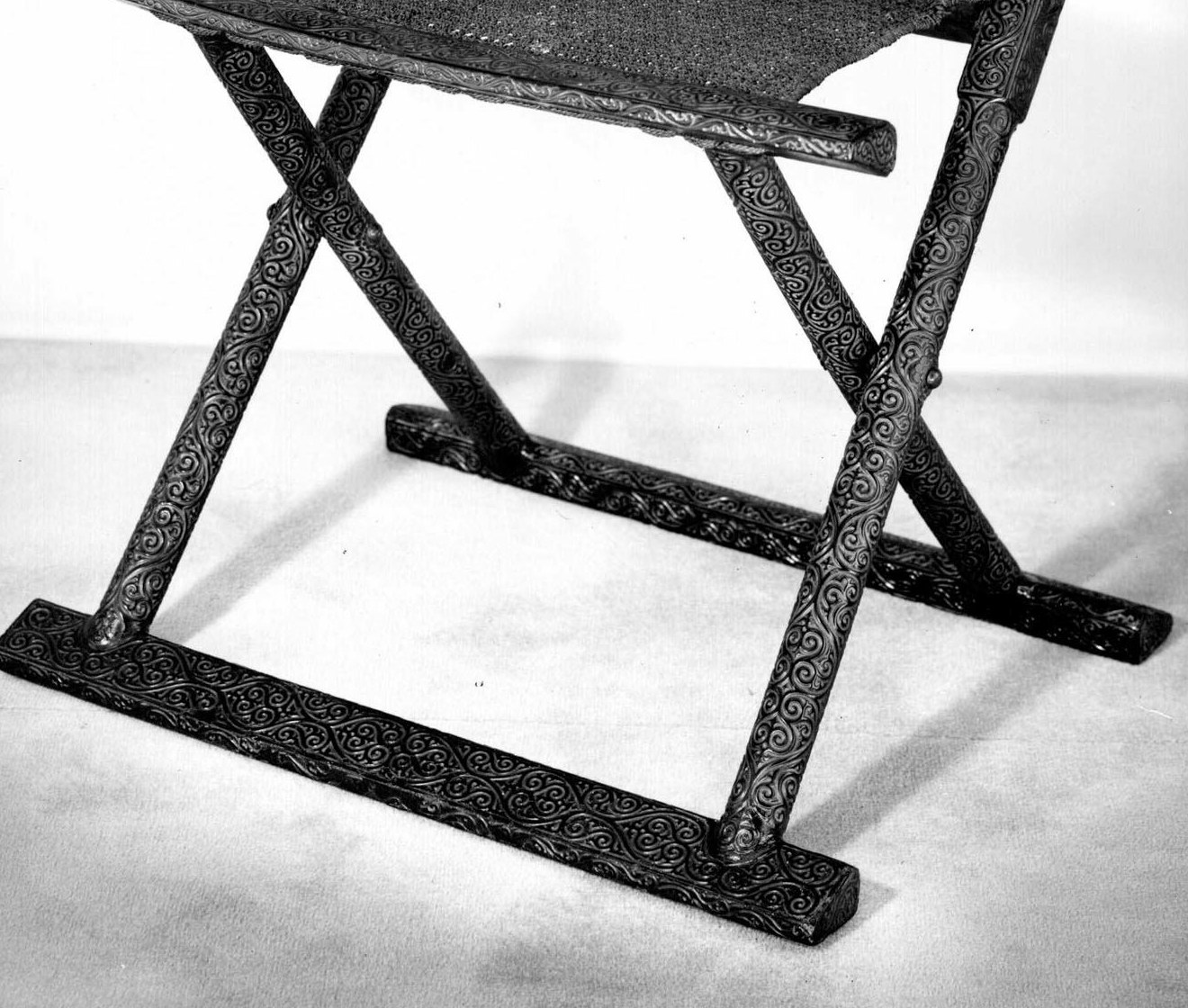
The lower photograph is the quickest cure for seeing the frame as background. Two pairs of legs cross beneath the rattan seat and descend into long feet. The Xs control how the upper and lower members relate; the extended feet spread the chair's contact with the floor. The Met describes the folding legs as well balanced with the arms and back, creating a stable structure when presented open.1
Nothing below the seat is visually anonymous. Tight scrolling patterns travel down the diagonals, continue across their joints and occupy the feet. The parts responsible for movement receive the same attention as the parts nearest the sitter. This is not a lavish chair placed on a utilitarian folding stand. The stand has joined the lavishness.
The image documents the open structure, not a modern demonstration. It cannot tell us whether the chair should be folded now, how much of a joint has been renewed or how the mechanism feels under load. Restraint is useful here: a surviving pivot is evidence of design, not an invitation to test it.
A surface built before it could be carved
Carved lacquer reverses the ordinary intuition that decoration is a thin skin. East Asian lacquer begins as tree sap refined and applied in coats. Each thin layer hardens in warmth and humidity before another can follow. Once enough material has accumulated, the built surface can be cut into relief. 3
That sequence matters on a three-dimensional chair. The craftsperson was not simply drawing curls over completed legs. The lacquer had to become a workable depth across rails, arms, borders and narrow crossed members before the pattern could be carved. Ornament is therefore an added material body as well as an image.
The Met's broader lacquer exhibition notes that carved works can contain as many as two hundred layers. Its East Asian lacquer essay says high-quality objects may require thirty or more coats.2 3
Neither number is a measurement of chair 69.217. No cross-section or coat count is supplied for this object. The honest conclusion is still remarkable: carved lacquer depends on repeated application and waiting before the first deep cut can make a flower. The chair folds; the production schedule most emphatically did not.
Two birds make a sentence
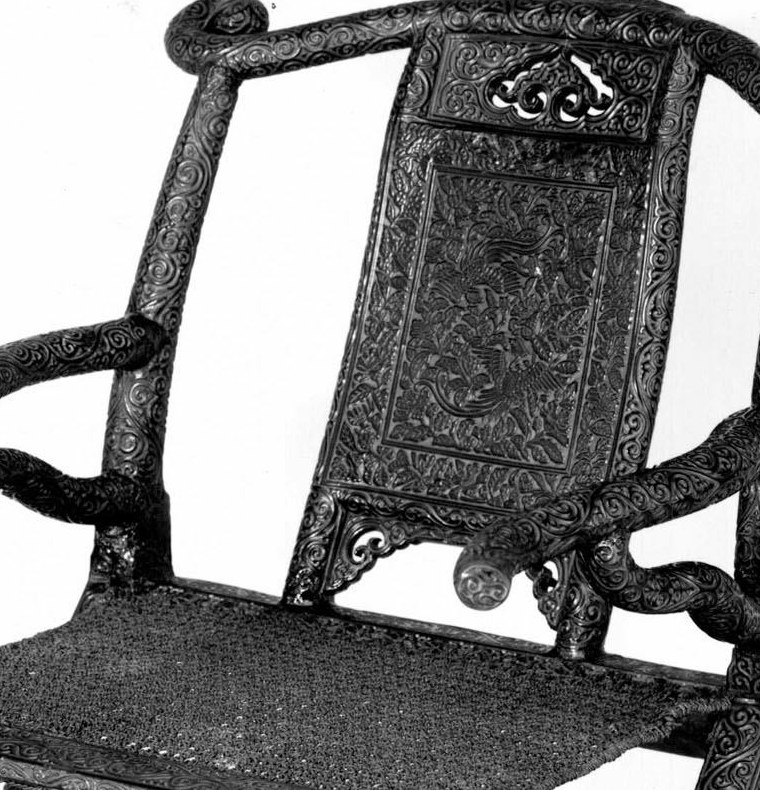
The back panel rewards the closer view. Two paradise flycatchers occupy a thicket of flowers and leaves, their long tails curling through the relief. They are framed by one ornamental field after another, so the panel reads less like a picture hung on a chair than a concentrated passage within the chair's larger surface.1
The birds also carry language. The object record connects the long-tailed bird, known as shoudai, with fortune and longevity. The Met's exhibition essay gives the wordplay more precision: shoudainiao can act as a rebus for enduring generations because shou sounds like the word for longevity and dai like the word for generations.2
This does not reduce the birds to a code that can be translated once and put away. Their feathers, movement among flowers and place behind the sitter still matter visually. The rebus adds another register. Surface, sound and good wish occupy the same small panel.
Folding did not mean informal
A later comparison helps loosen another modern assumption. The British Museum holds a green-glazed funerary model of a Chinese folding armchair made about 1550–1600. Its research notes connect folding chairs in Ming evidence with scholars at desks, dining, important sitters and travel. They were familiar enough to appear as the chair in an illustrated primer of daily objects. 4
That model is centuries later than the Met chair's stated 13th–14th-century date. It does not prove who used 69.217 or where it travelled. It does show why folding should not be translated automatically as temporary or second-rate. A movable chair could participate in work, ceremony, rank and journeys.
Seen in that light, the carved legs are not a contradiction needing an excuse. They let the chair retain its visual authority through the very structure that makes movement possible. Compactness could be a feature of important seating, not a retreat from it.
Keep the date range open
The Met record contains a small chronological seam worth leaving visible. Its structured fields say Yuan to early Ming and 13th–14th century; the overview calls the chair a very rare example from the early Ming dynasty. Those phrases overlap at the edge, but they are not identical.1
This article therefore keeps the museum's full range instead of selecting a single dynasty or an invented midpoint. The broad wording may reflect the difficulty of dating a rare survivor, revisions in cataloguing or distinctions between a period label and a concise introduction. The source does not tell us which explanation to choose.
The same discipline applies to material. The record gives carved lacquer and rattan seat, but it does not name the substrate beneath the lacquer. A familiar construction may be tempting to supply from comparison; the exact object has not granted that permission.
Mechanism and ornament keep the same promise
Look once more from the birds to the floor. The back panel concentrates flowers and auspicious language. The arms carry the pattern outward. The crossed legs turn that surface into a mobile geometry, and the long feet bring it decisively to ground. No plain chassis appears at the last moment to spoil the spell.
That continuity answers the opening question. The chair can fold and carry a carved world because both systems organise transformation. The frame changes the object's spread in space. Lacquer changes accumulated coats into relief, then turns birds and flowers into a field of good wishes.
The maker, owner, exact layer count and present operation remain unknown. What the documented chair gives us is already generous: a mechanism that never asks to be excused for looking magnificent, and ornament that understands it has structural company all the way down.