A bench belongs to its garden
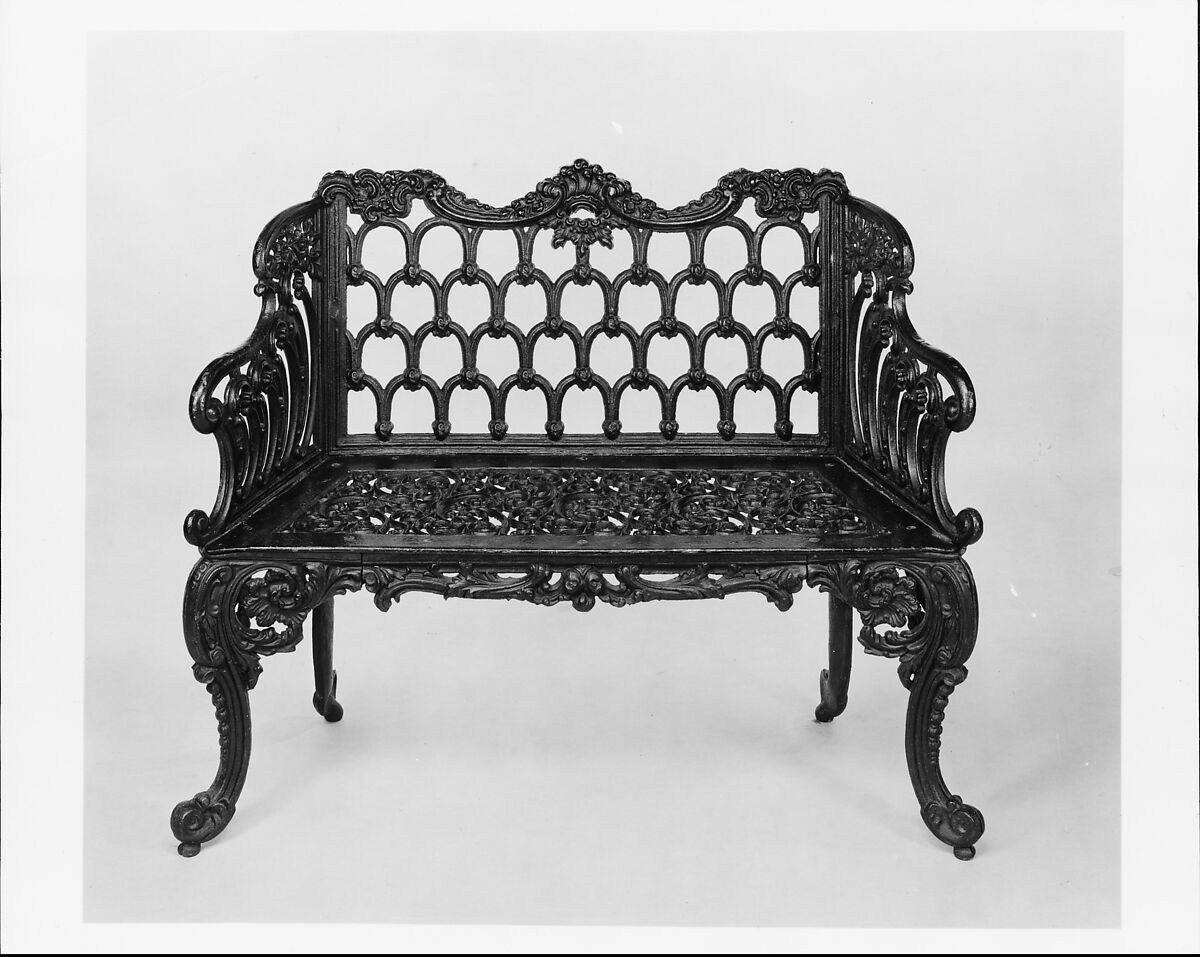
The Met’s bench, made in America around 1850, offers a useful place to begin. Its back is an open composition rather than a solid board. Light and the landscape behind it can pass through the ornament.1
That openness helps a substantial metal object sit among plants without becoming a blank wall. From one angle, the eye follows the dark iron. From another, the gaps become the stronger pattern.
The seat has to support a person, but the back also has a visual task: it places the furniture within the setting. Botanical forms connect the manufactured object with the garden, even though their regular arrangement belongs to a different kind of order.
The work happens before the iron arrives
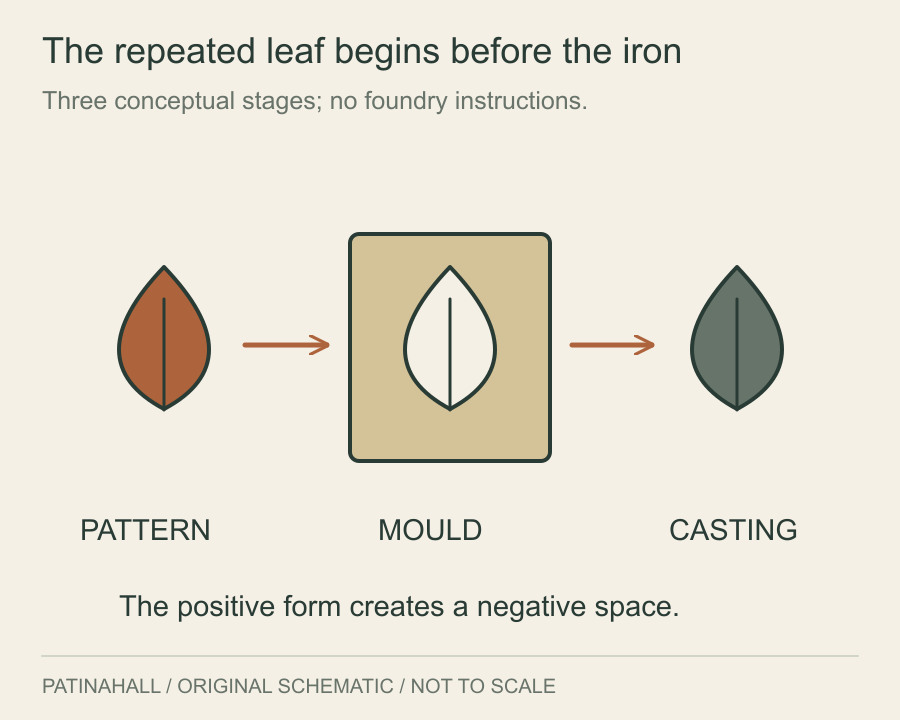
A casting begins with a pattern: a positive model of the form to be reproduced. In traditional sand casting, that model creates a negative impression in a mould. Molten iron fills the resulting space; after cooling, the casting is removed and finished.
Conservation specialist David Mitchell’s account explains why the pattern maker mattered so much. The skill embodied in the initial model could reappear in successive castings. Repetition did not mean that the ornament had designed itself.3
This changes the way to look at a curled leaf or a branching line. Its detail points back to work done before the metal entered the mould. The finished bench gathers pattern making, mould preparation, casting and finishing into one apparently continuous object.
The simplified drawing shows that relationship. It deliberately leaves out the practical equipment and technical decisions of running a foundry.
Oak and ivy, arranged for sitting
A documented comparison makes the botanical intention particularly clear. Art Fund records a Coalbrookdale garden seat and two chairs in the Oak and Ivy design, dated 1875 and acquired for the Coalbrookdale Museum of Iron with support in 1981.2
The name invites us to identify plants. The furniture also asks those plants to perform a compositional job: divide the back, join its edges and create a repeatable arrangement around the sitter.
Leaves in a garden overlap because they have grown. Leaves on a casting overlap because someone organised them into a pattern. The pleasure comes partly from recognising both kinds of order at once.
Similar ornament is not the same history
Coalbrookdale is an important name in cast-iron furniture, but elaborate foliage is not a maker’s signature by itself. The American bench and the documented English group have different records. Their visual relationship helps explain a furniture type; it does not make their origins interchangeable.
Try looking at such a bench twice. First follow the plants. Then follow the repetitions, joins and empty spaces that let those plants become furniture.
The second view brings the foundry into the garden without making the first any less enjoyable.