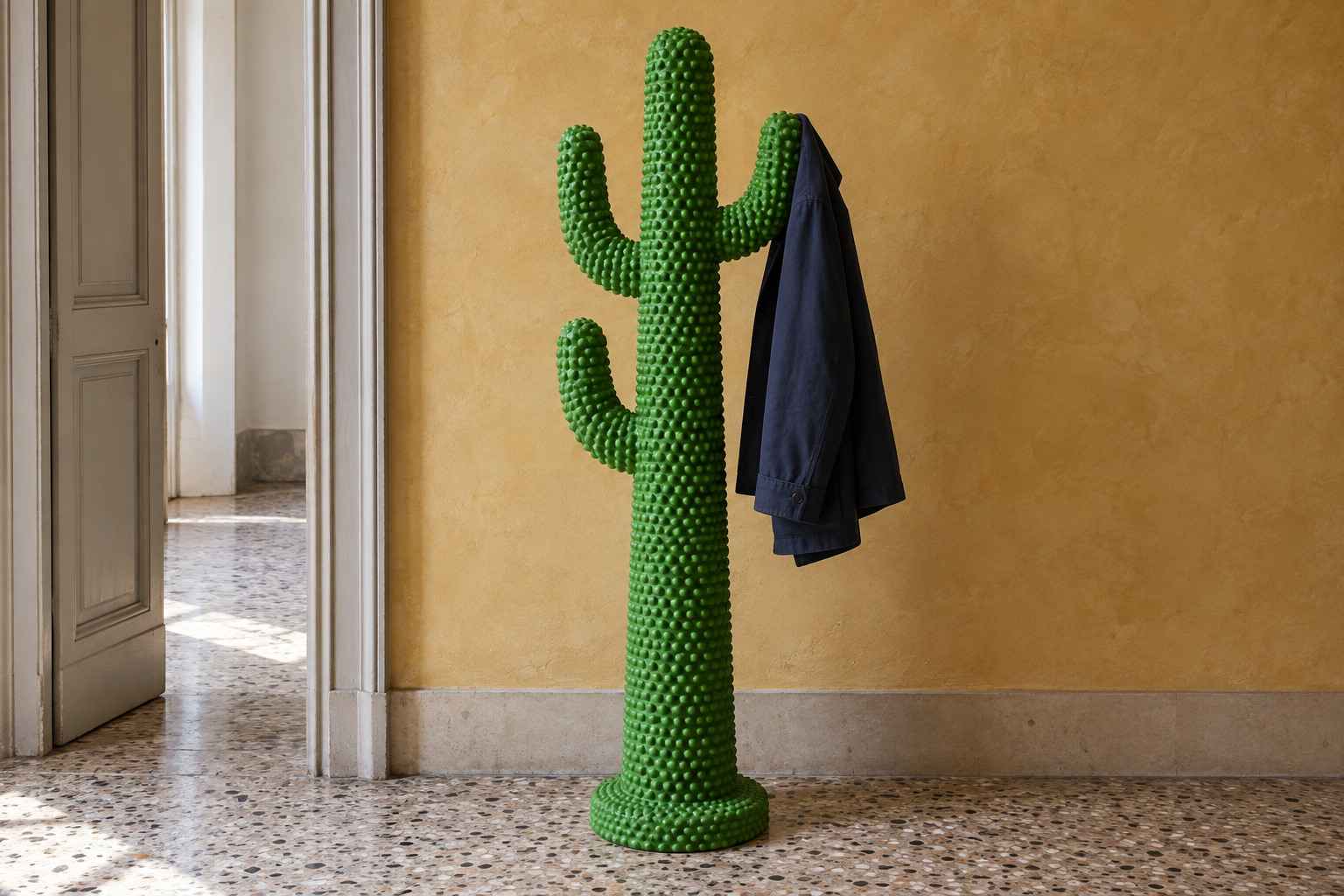
The branch becomes a hook
A conventional coat stand reduces its task to a vertical support and a few projecting arms. Cactus gives that practical arrangement a familiar natural outline.
The trunk stands upright; the branches turn upwards; a coat can occupy a place normally associated with a plant’s growth. The scale is crucial. A small cactus would be a tabletop joke. A human-sized one becomes something with which the body and its clothes can have an ordinary domestic relationship.
Gufram dates Drocco and Mello’s design to 1972. Its account makes the clash between recognisable plant and useful household object central to the piece.1
A hard-looking plant with a yielding body
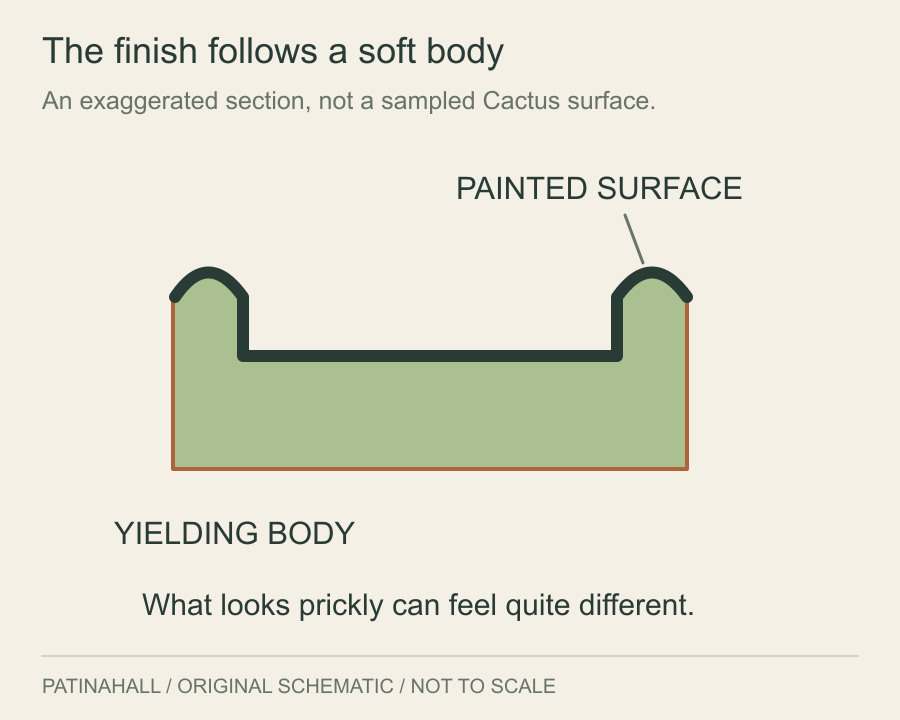
The surprise continues at the surface. Closely repeated bumps give the silhouette its prickly character, but the body is polyurethane rather than a rigid carved or cast plant.
Gufram’s description of its making process explains the role of the painted coating known as Guflac. The finish works with the yielding material beneath it, allowing colour and texture to belong to a soft object.2
This makes looking and touching disagree in an enjoyable way. From a distance, we recognise the cactus immediately. Close up, the material asks us to reconsider the assumptions that recognition brought with it.
A furniture object can therefore produce surprise without changing what it does. The coat still needs somewhere to hang. The altered surface changes the experience of encountering its support.
A plant that does not try to be botanical
Cactus does not reproduce a particular specimen with scientific accuracy. Its broad silhouette is selective: a trunk, rounded branching arms and a strongly textured skin. Those features are enough to make the reference legible.
The technical sheet presents the object at roughly human height, with a footprint much smaller than its overall reach. The proportions make the projecting arms useful while keeping the figure upright and recognisable.3
Colour editions can change its mood considerably, but the central arrangement remains the point of recognition. A new finish belongs to the history of a version; it need not rewrite the design’s original date.
The coat supplies the last detail
An empty Cactus can be read as sculpture. Put a jacket on an arm and the ordinary task becomes explicit. The cloth also makes the scale easier to judge: this strange green object belongs in the same world as sleeves, pockets and a hallway.
That small act completes the joke without exhausting the design. The cactus remains recognisable beneath the coat, and the coat remains a perfectly ordinary coat.
The pleasure is in seeing a familiar job given to an apparently unsuitable character—and discovering that the material has been chosen to make the mismatch work.