Three and a half metres of suspense
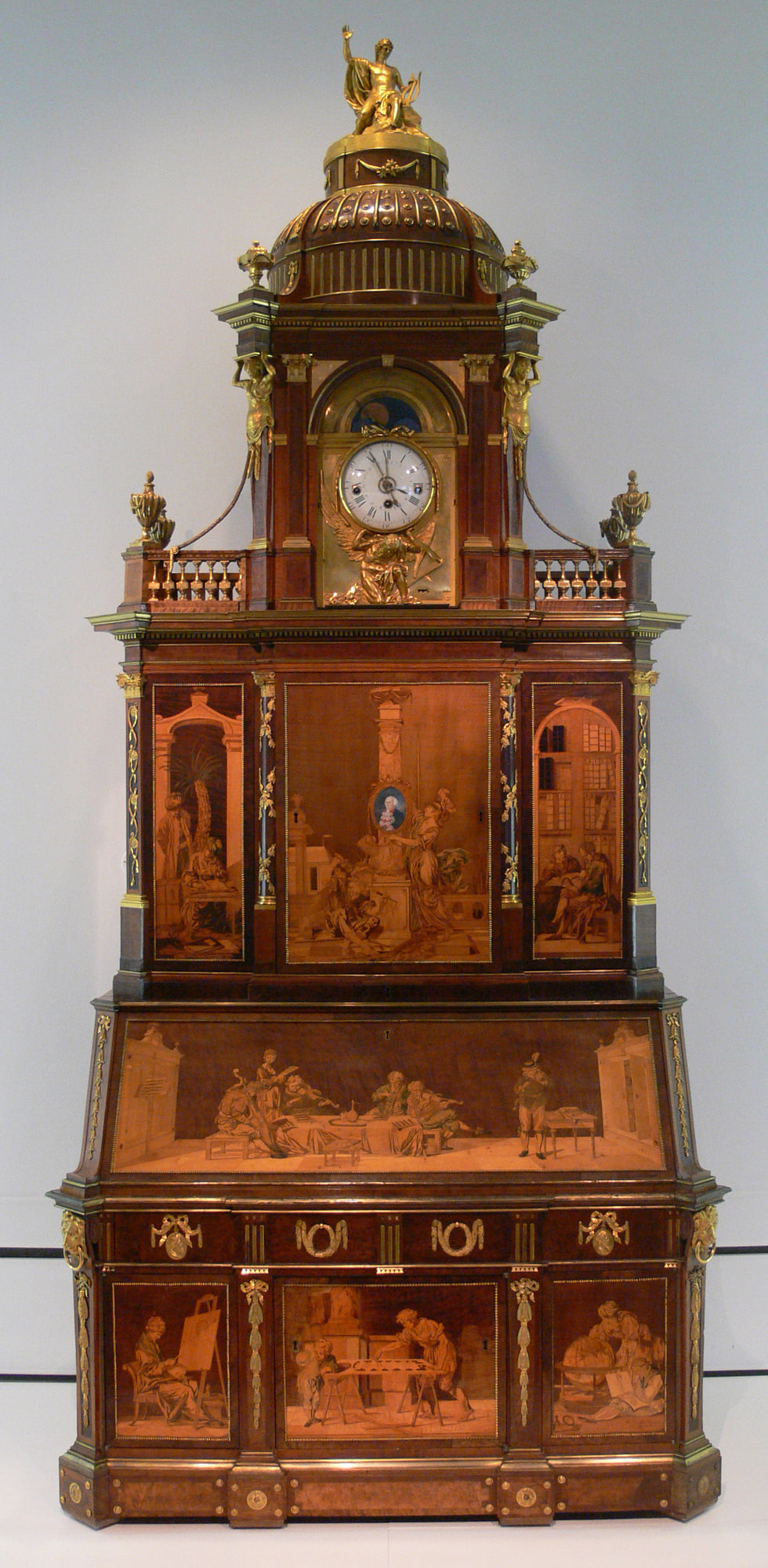
Why would a writing cabinet need to behave like theatre? Because this one was made for a court where furniture could demonstrate command before anyone wrote a word. Closed, it resembles a small building: base, doors, columns, pediment and clock rise to 3.59 metres. Opened in sequence, it produces work surfaces, tools, compartments, movement and sound. The owner does not merely use the cabinet. He cues it.
The Kunstgewerbemuseum dates its physical object O-1962,24 to 1777–79 and records Neuwied as its place of manufacture. Its materials list reads less like one cabinet than a well-stocked continent: mahogany and maple, rosewood, apple, mulberry, oak, pine, cherry and cedar, joined by gilt bronze, brass, steel, enamel and clockwork.1
Scale is the first mechanism. A person approaching the closed front must look up towards the clock and down across ranks of pictorial doors before reaching the writing body. The cabinet delays access by giving the eye an entire architecture to cross before any working surface appears.
Turn the key and the room changes
The spectacle is not simply that compartments are hidden. It is that useful furniture appears where a flat façade suggested there was none.
The Met's catalogue describes a standing writing desk that emerges when the mechanism is released. Its front opens and tilts to become a writing surface; a lectern rises; small compartments present ink, sand and other tools. Behind the upper relief are further doors, swivel drawers and concealed spaces. The same account describes weights, springs and a mechanism case weighing nearly 66 pounds.3
The Berlin museum adds music to the sequence: buttons release doors, drawers, writing desks and secret caskets while flutes and bells sound. Movement turns storage into an event. A conventional secretary asks its user to lower a flap and find a pen. This one appears to expect applause. 1
That timing changes the social meaning of the desk. Writing is usually a private activity, associated with papers kept away from other eyes. Here the equipment for writing can be revealed before witnesses. Concealment protects; revelation performs control. The same hand that possesses the key appears to command an entire wooden architecture.
A workshop hidden behind one name
David Roentgen's name leads the object record, but the cabinet is an argument against the lone-genius version of making. The Roentgen firm coordinated cabinetmakers, marquetry specialists, metalworkers, sculptors, clockmakers and mechanical designers. The Met describes a distributed production system in which specialist work was brought together and marketed through one unusually ambitious manufactory.2
For this cabinet, the Met catalogue names Johann Christian Krause in connection with much of the mechanical design. A clock surface bears the name Kintzing of Neuwied, connecting the object with the clockmaking family usually rendered as Kinzing in the catalogue. Other named contributors supplied pictorial marquetry and gilt-bronze work.3
That division of labour does not diminish Roentgen's role. It clarifies it. His achievement included organising incompatible crafts so that timber, veneer, springs, locks, music and moving furniture behaved as one product in front of a client.
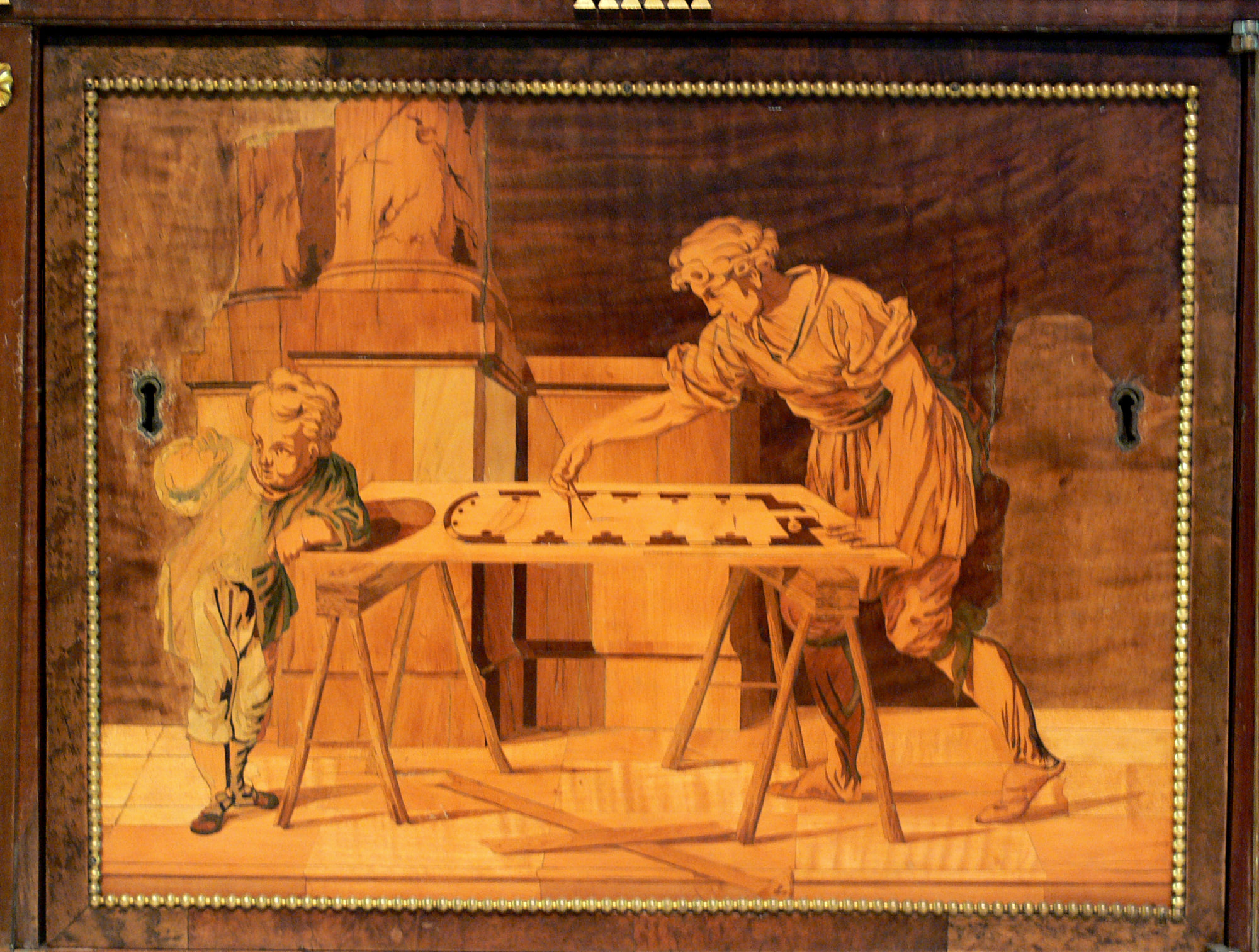
The marquetry scene beside this chapter is almost a signature in pictures. It shows craftsmen gathered around a bench, but it is not a photograph of the Roentgen workshop. It is an image made from fitted veneers on the cabinet's own surface: labour represented through more labour.
Pictures that also conceal machinery
The cabinet's pictorial doors are not a decorative layer added after the useful work was complete. They help disguise openings, divide the façade and direct attention. Figures, rooms, instruments and tools occupy surfaces that may also be doors. A viewer reads an image while standing inches from a mechanism.
Different woods provide the colour. Grain becomes shadow, architecture, clothing or polished equipment; narrow outlines keep figures legible against the darker ground. Gilt-bronze borders and mounts then return the eye to the cabinet's larger symmetry. The result alternates scale: a monumental front contains intimate workshop scenes, and an intimate picture can cover a route into the interior.
The museum calls the cabinet a principal work of Roentgen's 1770s production, combining fine coloured marquetry with refined mechanisms. The Met's broader study explains why this pairing became the firm's competitive language: keys and controls promised not just locked storage but a succession of discoveries. 12
Flattery, delivered in 1786
The cabinet reached Berlin in 1779, when the future Frederick William II was still crown prince. The Met records that he acquired it with only part of the price paid, leaving a debt that followed Roentgen for years. Mechanical marvels could apparently solve many things, but not court accounting. 2
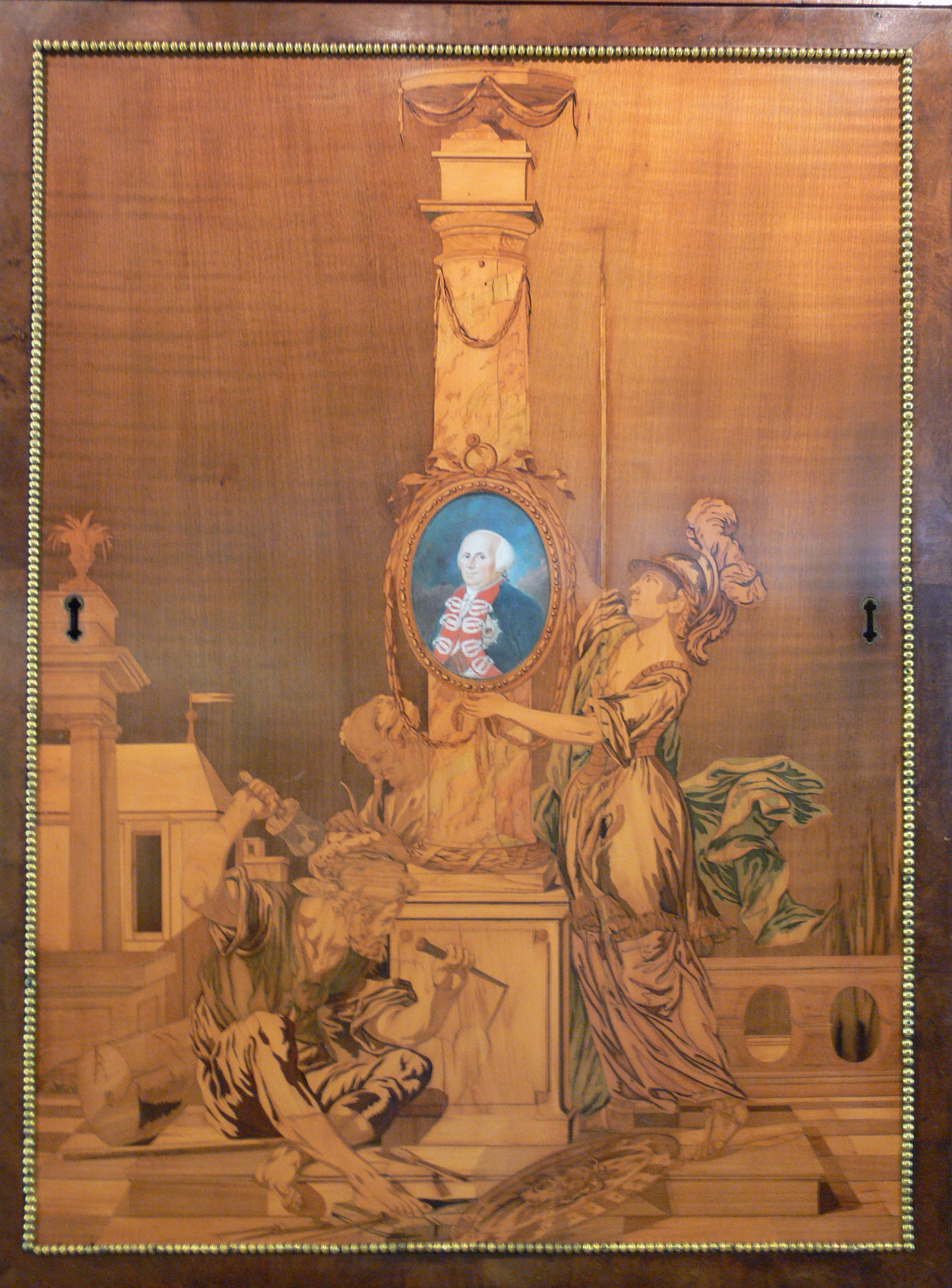
When Frederick William became king in 1786, the object changed with his rank. The Met catalogue links that year to a replacement central door presenting an apotheosis of the new monarch. The portrait medallion does not sit quietly in one corner. Allegorical figures arrange the cabinet's centre around it, turning royal promotion into a material update.3
That revision reveals how adaptable court furniture could be. The mechanism remained a demonstration of technical authority, while the visible programme was adjusted to address a newly crowned owner. The cabinet did not merely enter history in 1779 and stop. It acquired a second public moment.
One cabinet, several dates
The dates therefore need to remain attached to events. The Berlin museum gives 1777–79 for manufacture. The Met catalogue gives 1778–79 and 1786, separating the main cabinet from its later central-door alteration. Delivery in 1779 is neither the beginning of every component nor the end of the object's physical history.1 3
The evidence reviewed here belongs to Kunstgewerbemuseum object O-1962,24. It documents David Roentgen's workshop authorship, named specialist contributions, materials and described mechanisms. Photographs of the closed cabinet cannot demonstrate every concealed movement, and resemblance cannot transfer this record to another secretary.
That specificity is what makes the object more interesting, not less. This is not a generic tale about luxurious eighteenth-century desks. It is the history of one cabinet that arrived for a crown prince, changed for a king and still holds the work of many makers behind one composed front.


