Artefact story

Two half-tables, one dinner: Baltimore’s folding dining table

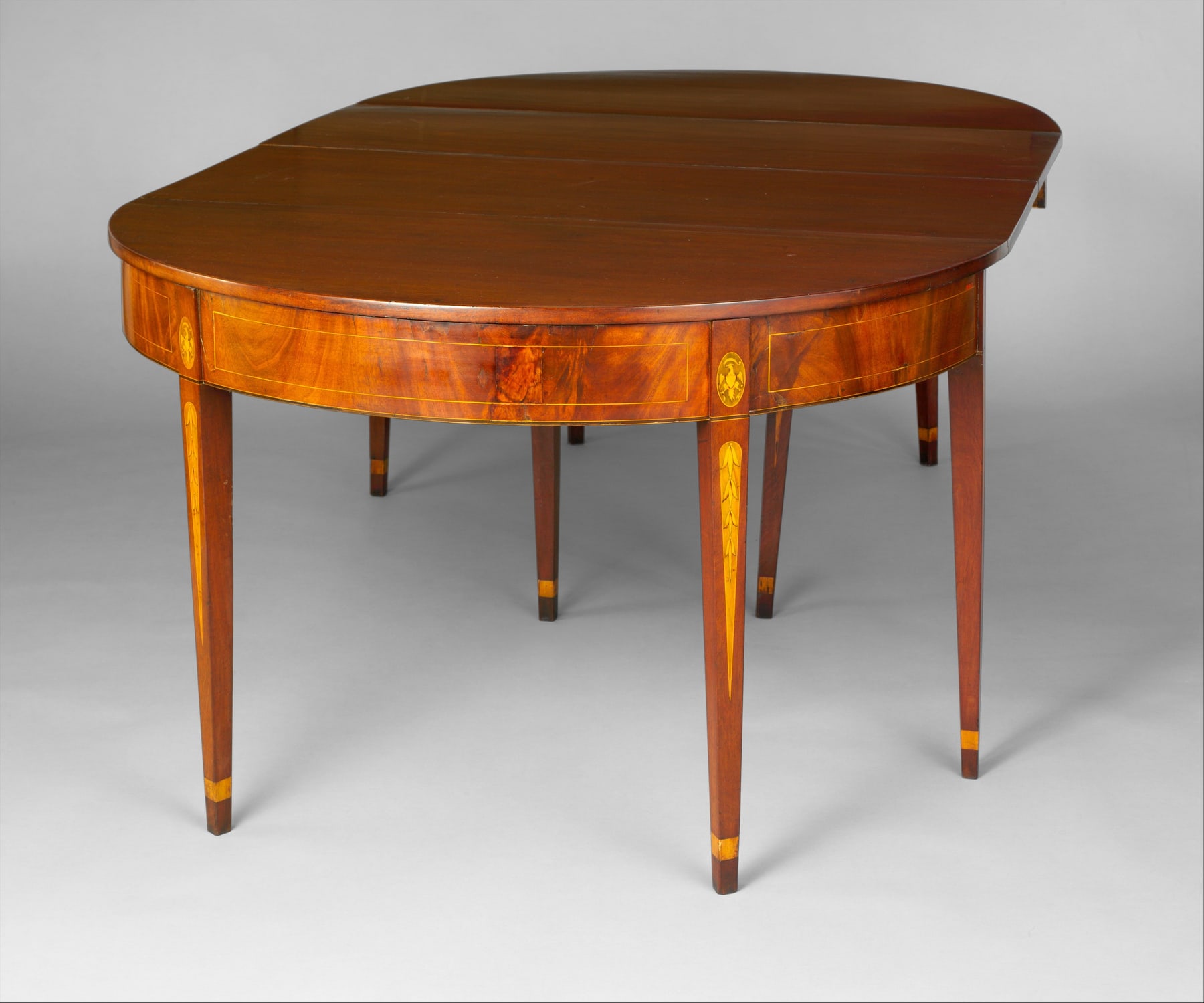
This Baltimore dining table is made from two half-tables. Each curved end has a rectangular drop leaf and a hinged supporting leg. Brought together, the sections provide a long dining surface; separated and folded, they become much smaller pieces. The room does not have to belong to dinner all day.

Baltimore dining table assembled from two curved end sections with their rectangular leaves extended.
Baltimore dining table assembled from two curved end sections with their rectangular leaves extended. Accession 19.13.2. The Metropolitan Museum of Art. Public domain (CC0).
On this page
Key facts & takeaways

At a glance

Subject
Drop-leaf Dining Table 19.13.2
Entry
Artefact story
Last reviewed
6 September 2026

Three things to remember

  1. The dining surface is assembled from two distinct sections.
  2. Each section has its own drop leaf and hinged support leg.
  3. The folded half-table is a useful form in its own right, not merely dismantled furniture.

Find the join in the long top

At first glance, the extended table reads as one continuous piece. The rounded ends soften a long central dining surface. Its construction becomes clearer when you recognise that each end belongs to a separate demilune, or half-moon, table.

The Met identifies Baltimore as the place of manufacture and dates the table to 1795–1810. Each section carries a rectangular drop leaf, supported when raised by a hinged leg.1

A half-table is a complete idea

The photograph of one section is the decisive view. Its curved front remains finished and coherent when the table is separated. The broad leaf no longer occupies the horizontal space it needs during dining.

This is why the design is more interesting than a table that merely becomes shorter. The two sections can have independent presences in a room. Their curved ends and fine legs still provide a complete silhouette, with no need to disguise them as temporary leftovers from a larger object.
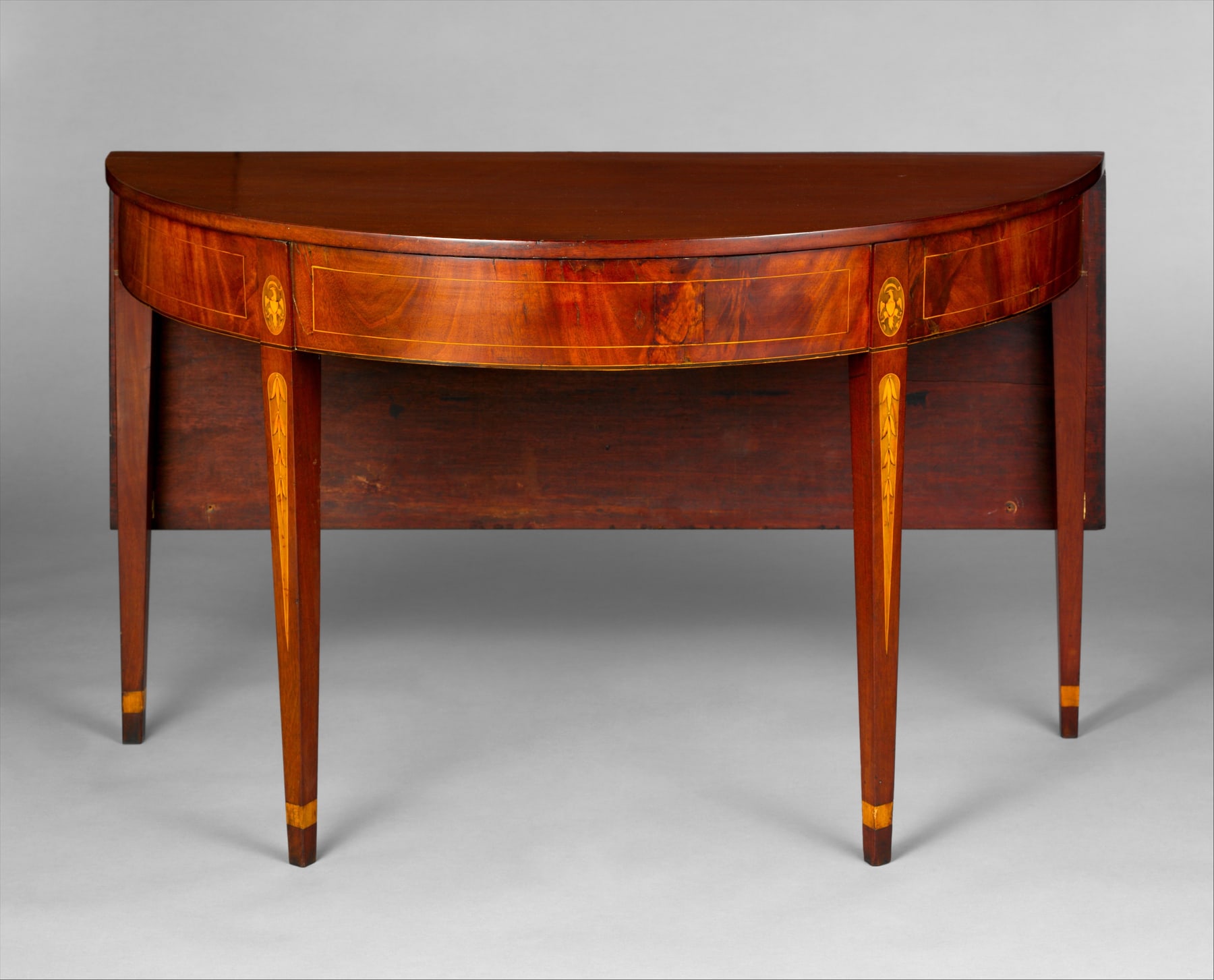
One demilune section of the Baltimore table, with its leaf lowered and its curved front still forming a complete small table.
One demilune section of the Baltimore table, with its leaf lowered and its curved front still forming a complete small table. Accession 19.13.2. The Metropolitan Museum of Art. Public domain (CC0).

The legs participate in the change

A folding top must be supported when it is open. Here a hinged leg answers that problem. The action changes the relationship between the legs as well as the outline of the top: the table’s working footprint expands along with its surface.1

The visible slender legs are also part of its visual restraint. Their light vertical lines prevent the broad open top from reading as a heavy block. The photographs establish the two table states, although they do not provide a diagram of the hidden fittings.

Folding was already a furniture tradition

An earlier British gateleg table in the Met, dated about 1670–90, provides a useful comparison. It belongs to an established tradition of bringing support into position under an extended surface. Its date does not prove a direct design lineage to this Baltimore table; it makes clear that adaptability had a long furniture history.2

The Baltimore example combines that general possibility of movement with two separate curved end sections. Its intelligence is spatial. A long surface can appear for a meal and then give way to smaller arrangements, allowing the same room to support different activities. Look from the extended view to the single section: both are deliberately resolved forms.

Research notesEvidence, connections and limits

The museum documents the folding arrangement, but the selected photographs do not expose the underside hardware. Its eight-chair description is historical context, not a capacity guarantee for every modern chair.

Evidence map

Connected subjects and evidence

Reviewed connections

  • Drop-leaf Dining Table 19.13.2uses materialMahogany, tulip poplar, white pine and sycamoredocumented

    The primary record lists these materials for this subject. The full material list and object dating remain in the cited accession record; listed replacement or uncertain materials retain their qualifiers.

    Reviewed 6 September 2026 by PatinaHall editorial.
  • Drop-leaf Dining Table 19.13.2associated with placeBaltimore, Marylanddocumented

    The Met records this geographic association for the exact artefact.

    Reviewed 6 September 2026 by PatinaHall editorial.

Research trail

Sources and further reading

  1. Drop-leaf Dining Table — 19.13.2The Metropolitan Museum of ArtAccessed 6 September 2026
  2. Gateleg table, British, ca. 1670–90The Metropolitan Museum of ArtAccessed 6 September 2026

Last reviewed 6 September 2026. Found an error or a stronger primary source? Contact PatinaHall.