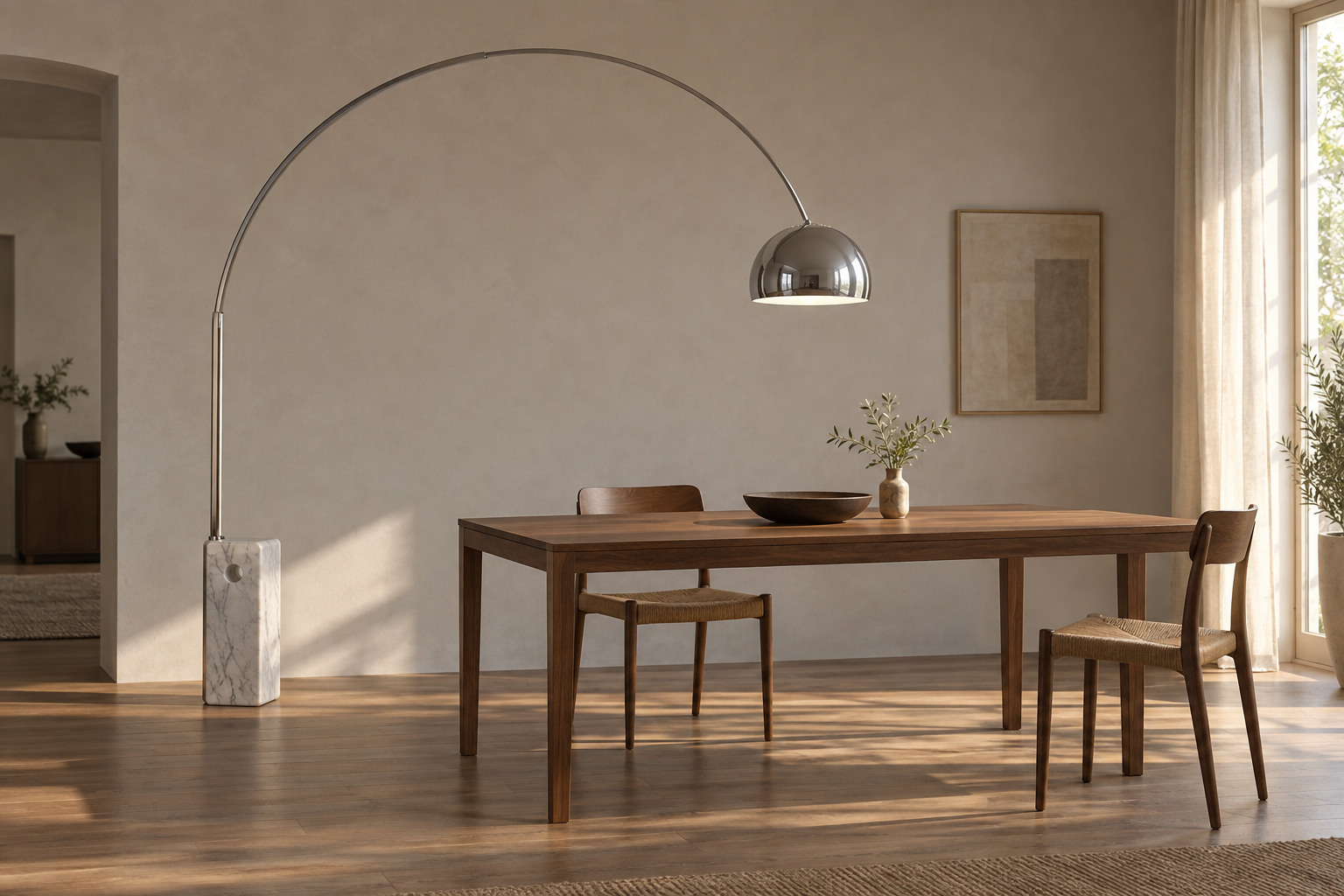
A street-light idea comes indoors
A street lamp does not usually stand in the middle of the patch it illuminates. Its support can remain at the edge while an arm carries the light outwards. MoMA identifies that arrangement as a starting point for Arco.1
Inside a room, the same separation is useful. A suspended light gives the table clear space around it, but asks the ceiling to carry the fitting. A floor lamp is easier to position independently, but an ordinary upright standard may stand close to the people it serves.
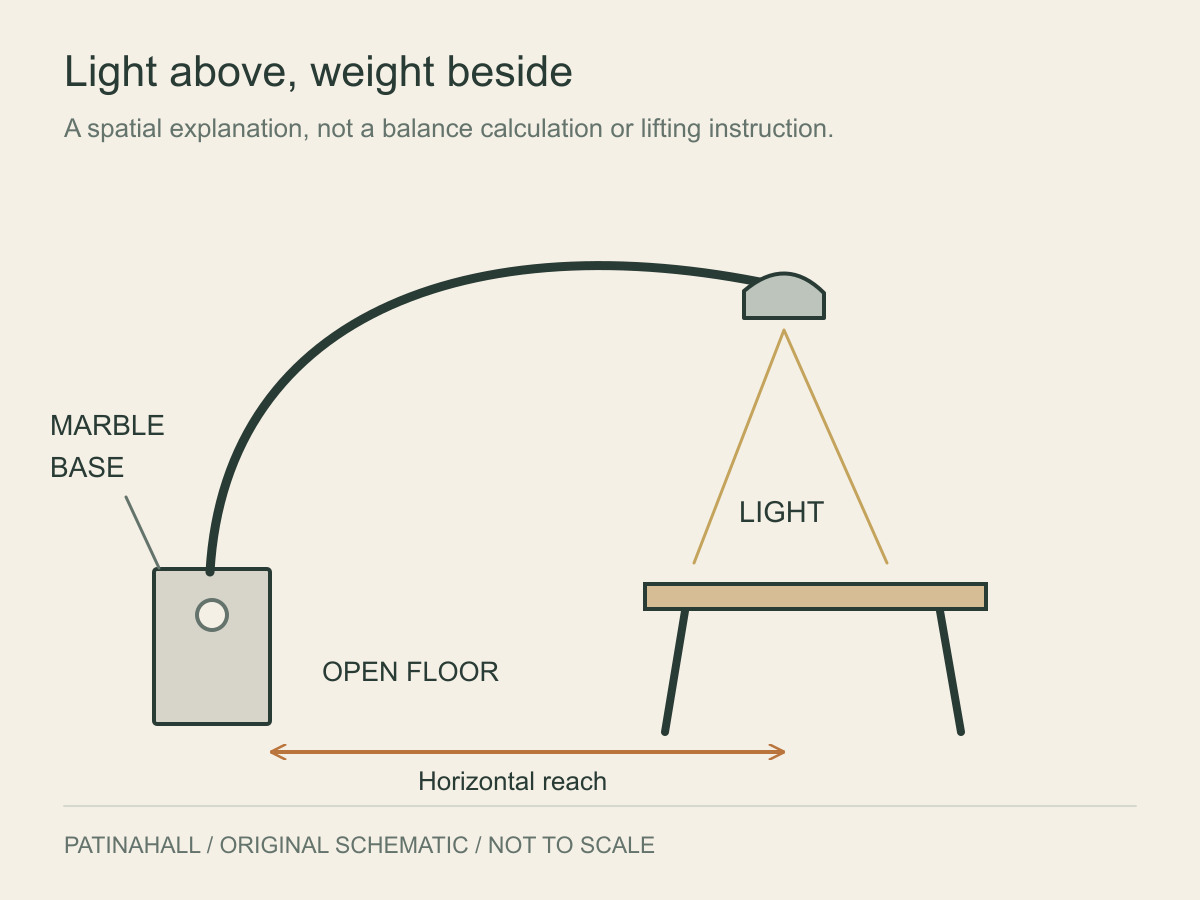
Arco combines a floor support with an overhead position. The arch reaches across the gap, allowing the base to stand apart from the table. The curve becomes a way of organising the room, rather than a flourish added to an otherwise complete lamp.
The marble has a job
The long reach creates a structural demand. Weight carried away from a base tends to tip the assembly. Arco answers with a substantial block of marble, turning mass into a visible part of the design.
Marble can signal luxury, but here it also solves a practical problem. The base is compact in plan relative to its weight. Its blunt, stable-looking body gives the eye a point from which to follow the slender metal structure upwards and outwards.
The hole through the block belongs to the same logic. In the historical account, a rod such as a broom handle could pass through it to assist lifting. The Quirinale’s description also records Castiglioni’s explanation that the softened edges and hole had practical purposes.2
The detail is memorable because it admits a consequence. A heavy counterweight helps the lamp stand; it also makes the lamp awkward to move. The object carries an answer to both requirements.
Two brothers, one continuous line
The design dates to 1962 and is jointly credited to Achille and Pier Giacomo Castiglioni. Pier Giacomo’s archive makes that shared authorship explicit. Reducing the credit to the more familiar brother loses part of the design’s history.3
Its line is exceptionally easy to remember: block, rising curve, shade. Yet those three parts do different work. The block supplies stability, the stem spans the distance and the shade places the light where it is wanted. Their clarity is why the silhouette can explain so much before a reader knows its name.
The space below the stem is part of that silhouette too. The arc can leave a passage between the support and the lit area. It is worth looking at the empty floor in a room photograph, not only the shining metal above it.
The room is part of the lamp
Arco occupies more than the rectangle of marble touching the floor. Its working territory extends towards a table and into the air above the people around it.
That is what makes the design interesting beyond its familiar outline. It asks a room to accept one concentrated weight in exchange for a light somewhere else. Follow the arc back from the shade, and the whole arrangement becomes clear.