Bringing the serving table to the chair
A fixed side table determines where a cup can be put down. A trolley lets the serving surface arrive beside the person who needs it. Aalto gave that everyday movement a conspicuous form: large disc wheels beneath a curving birch frame.
Artek connects the tea trolley to British tea culture and to Japanese woodwork and architecture admired by Aino and Alvar Aalto. Those influences meet in a domestic object organised around carrying and serving, rather than a ceremonial piece of furniture.1
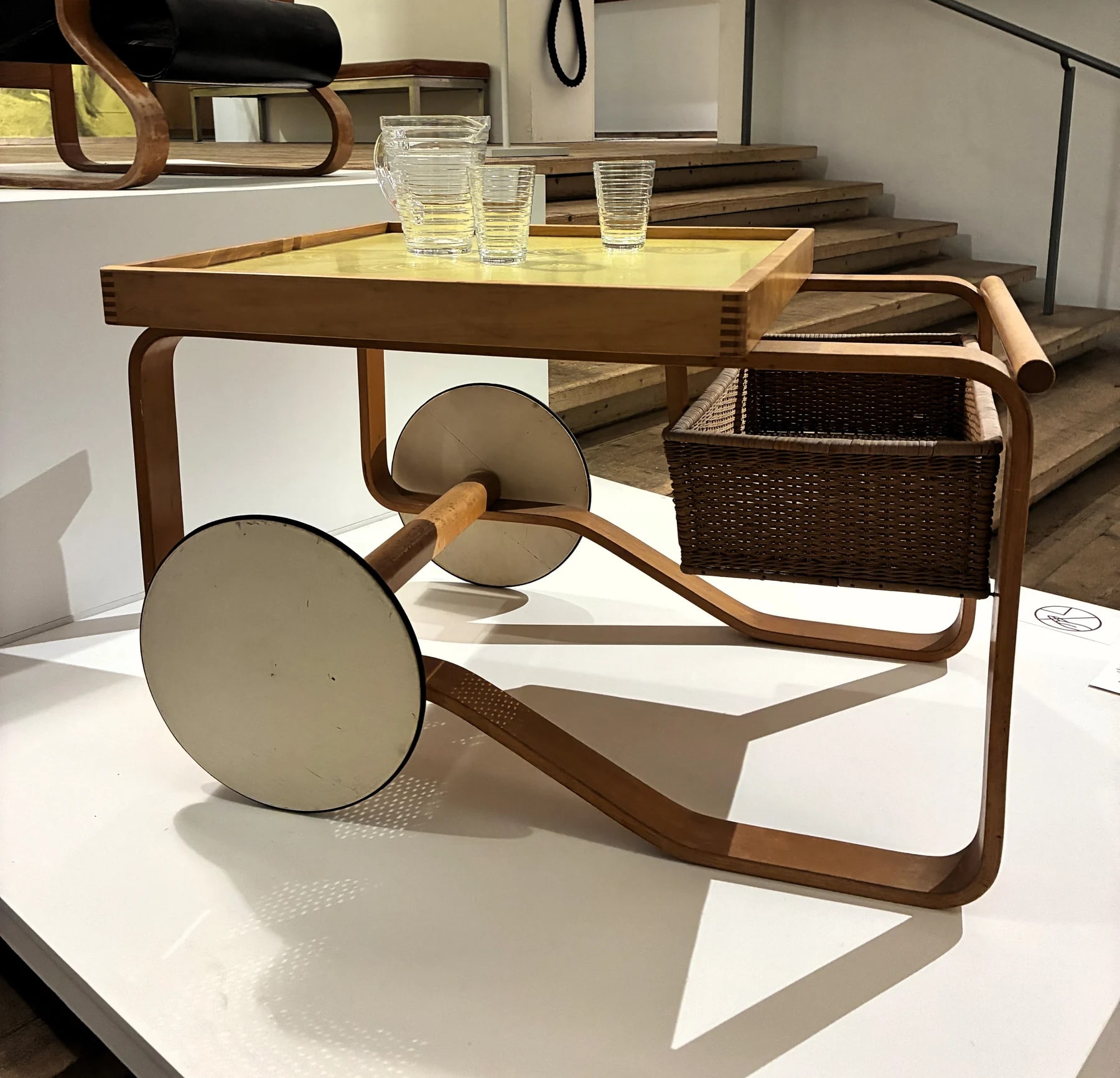
The wheels matter to the composition as well as to movement. Their circles occupy much of the side view, while the curved frame carries the eye upwards towards the serving space. The trolley announces how it travels before anyone takes hold of it.
A tray and basket offer different spaces
In Gotogo’s photograph at Millesgården, a shallow tray sits beside a deeper woven basket. One surface keeps its contents in view; the other creates an enclosure. The trolley therefore offers two kinds of carrying space within the same narrow footprint.3
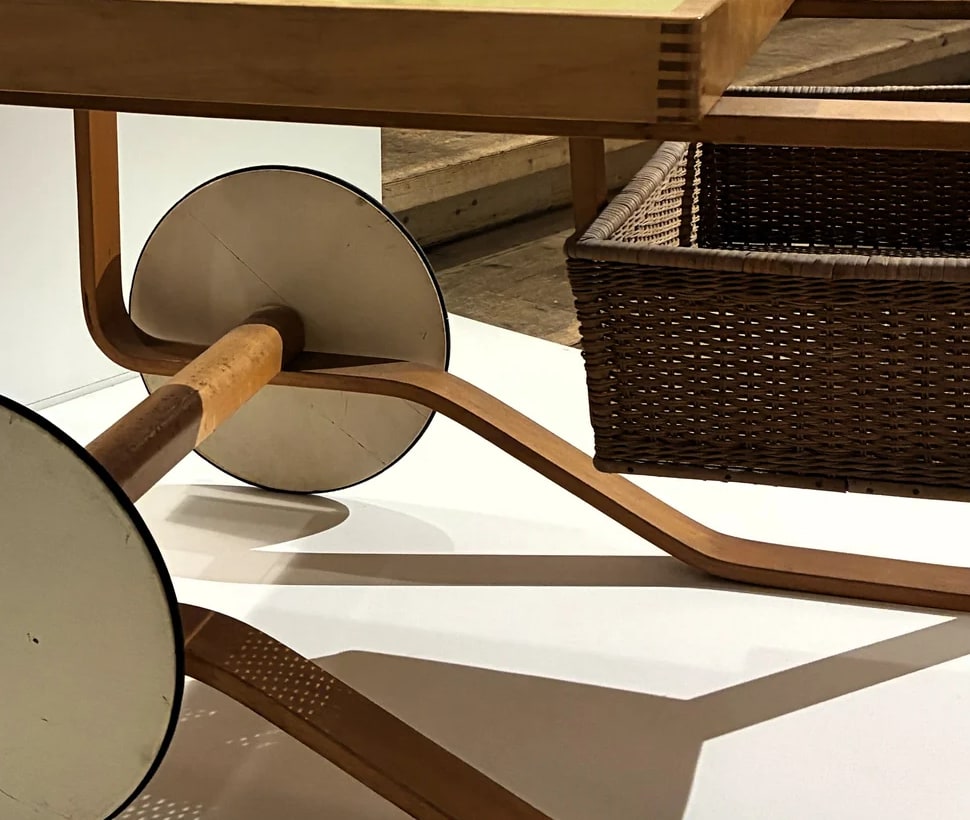
The closer view brings the basket, frame and wheel together. It is a crop of the same photograph, letting the reader follow the change from woven surface to bent wooden edge without losing the relationship to the whole object.
This is the useful distinction to notice when looking at the family: the frame carries the contents, but the arrangement of trays, shelves and containers determines how those contents are held.
Two documented arrangements
MoMA records model 98, dated 1936–37, in laminated birch, linoleum and rubber. Artek’s model 900 dates to 1937 and combines a birch structure with ceramic tiles and a rattan basket; the maker places its international launch at that year’s Paris World Exhibition.21
These are distinct ways of furnishing a mobile serving piece. A broad surface and a basket do different jobs from a pair of shelves, even when the curved wood and disc wheels make their relationship obvious.
The result is a small change to the room’s routine. Tea does not have to remain beside one fixed table: the cups and serving things can move together. Aalto made that modest freedom the most visible part of the object.
